
A Real Life White Whale that Destroyed Over 20 Whaling Ships and Survived Encounters with Another 80
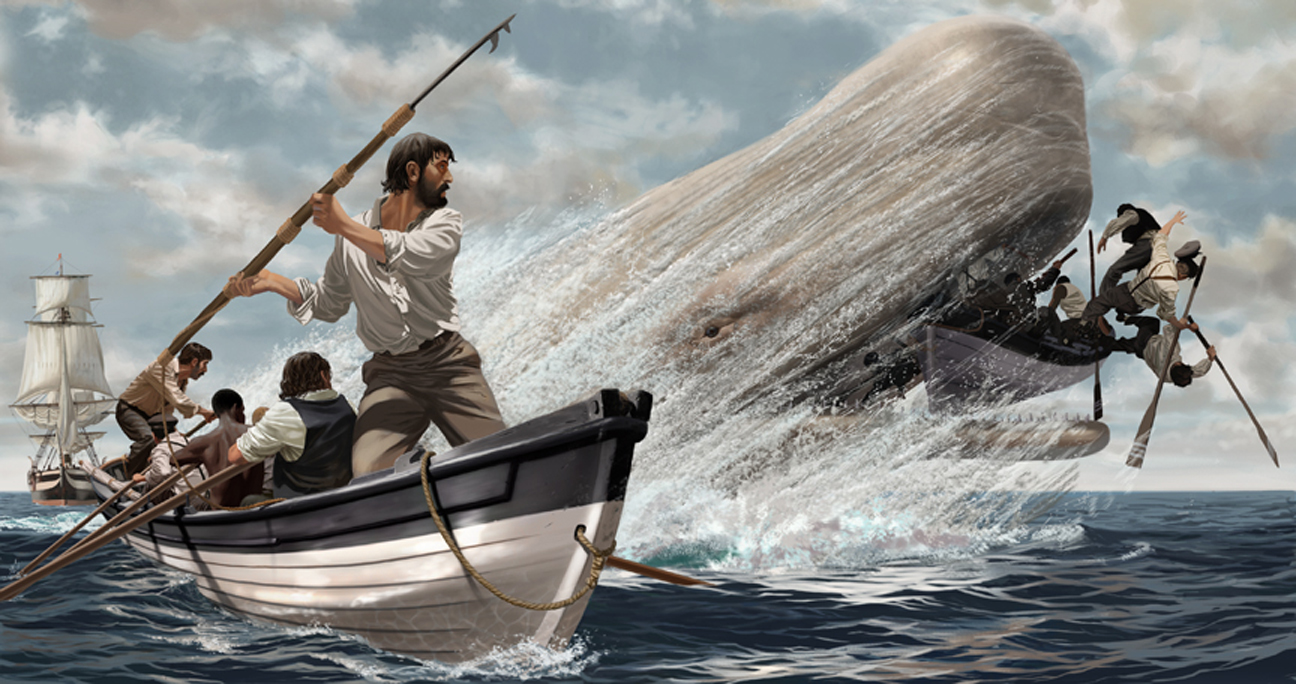 Today I found out about a real life white whale that destroyed over 20 whaling ships and reportedly survived encounters with another 80 or so.
The massive 70 foot long albino sperm whale was named Mocha Dick and was one of the two whales that inspired the novel Moby Dick. Mocha Dick was given his name as he was first sighted off the coast of Chile near Mocha Island; the latter “Dick” part of the name is thought to have simply been after the practice of naming certain deadly whales common names like “Dick” or “Tom”. The whalers that first spotted him attempted to kill him, but he survived the encounter.
Over the course of the next 28 years Mocha Dick earned a reputation as one of the most cunning and feared whales in the ocean. During that span, he was spotted and attacked by at least 100 whaling ships. He successfully destroyed around 20 of those ships that attacked him and escaping all but the last.
According to famed explorer and writer Jeremiah N. Reynolds, Mocha Dick finally met his downfall after observing a mother whale whose calf had just been killed by whalers. The mother whale first attempted to herd her calf away from the whalers after it had been harpooned, but soon the calf went belly up. When the whale realized her calf was dead, she turned on the whalers and attempted, unsuccessfully, to destroy their ship. Instead, she herself was harpooned and mortally wounded before she was able to strike the ship.
Upon observing all this, Mocha Dick decided to get in on the fray and also attacked the whaling ship directly after the missed hit by the mother. Mocha Dick successfully destroyed one of the smaller whaling boats, but was injured in the process by a harpoon. Here is the account of what happened after, according to Reynolds who collected the story from the first mate of the whaling ship that finally took down Mocha Dick:
The other whale that helped inspire Moby Dick was a huge sperm whale that destroyed the Essex in 1820 around 2,000 miles west of South America. Herman Melville learned of the story of the Essex when the whaling ship he was on, only 100 miles from where the Essex was destroyed, encountered another whaling ship, which had the son of the Essex’s first mate, Owen Chase, aboard.
After the Essex was destroyed, the 21 man crew took refuge on three small whaling boats that had almost no supplies to sustain them. Their choice at this point was to head for known habitable islands that they feared were inhabited with cannibals, 1,200 miles away, or head for South America 2,000 miles away, but about 4,000 miles by the quickest sailing route due to the winds that time of year. Despite this distance, they chose South America. Ironically, as you’ll read shortly, their choice of not choosing the much shorter route for fear of cannibals, resulted in some of them resorting to cannibalism.
During their journey, they did at one point encounter an island that they more or less stripped of its resources to help sustain themselves. They also left three men behind there, at the time thinking likely to their doom, to help conserve supplies and increase the chances the others would make it back.
What followed was an incredibly gruesome tail. As they traveled, they steadily lost crew due to lack of nourishment. At a certain point, they were forced to give up burying their men at sea and, instead, began eating them and drinking their blood. They eventually even had to resort to not waiting for someone to die, but, rather, drew lots for who was to die and nourish the others with their body.
In the end, 95 days after their ship was destroyed, they were rescued with only five left alive aboard the two remaining small ships (one was lost along the way with the crew never heard from again). Miraculously, the three left on the depleted island, though near death when eventually found, survived the event.
If you liked this article, you might also enjoy our new popular podcast, The BrainFood Show (iTunes, Spotify, Google Play Music, Feed), as well as:
- The Novel That Contains Over Fifty Thousand Words, None of which Include the Letter “E”
- The Origin of the Loch Ness Monster
- Where the Expression “I For One Welcome Our New X Overlords” Came From
- The Origin of the Big Foot Legend
Bonus Facts:
- While Moby Dick today is considered a great work of literature, in its day, it wasn’t very successful and only earned Melville $556.37 and less than 3000 copies were sold over the next 40 years or so before Melville died.
- A common whaling nickname in the early 19th century for whales that spout blood after being harpooned (meaning they were likely soon to die) was “Dennis”.
- Mocha Dick’s body yielded around 100 barrels of oil. Over 20 harpoons were found embedded in his body after he was killed.
- Jeremiah N. Reynolds not only helped inspire Moby Dick through one of his narratives, but also helped inspire Edgar Allan Poe’s The Narrative of Arthur Gordon Pym of Nantucket. This was through Reynolds’ lectures on his notion that the Earth was hollow.
- While Mocha Dick was fearsome with whaling ships, he left all other ships alone, due to the fact that he rarely attacked unless he was first attacked. He even was known to swim docilely around and along side ships at times. As soon as the ship would try to harpoon him though, he would attack.
- Mocha Island is a small island (about 19 square miles) off the coast of Chile, which was famously used by such people as Vice Admiral Sir Francis Drake and Olivier van Noort as supply bases. Pirates also once frequently used the island as a base. Among other things, Drake was famous for being the second person to captain a ship all the way around the world. Olivier van Noort also accomplished this feat, becoming the first Dutchman to sail all the way around the globe.
- Mocha Dick
- The Wreck of the Whale Ship Essex
- Mocha Dick, or the White Whale of the Pacific, by Jeremiah Reynolds
- Moby Dick
- Mocha Island
- Mocha Dick, the White Whale of the Pacific
- Sperm Whale
- Moby Dick
- Captain Ahab Revenged
- Essex
- Jeremiah N. Reynolds
- 7 Famous Albino Animals
- Tristin Lowe: Mocha Dick Sculpture
- Origin of the Name “Moby Dick”
- Image Source



| Share the Knowledge! |
          |
 |
Humans are savages
I agree. Animals should inherit the earth. When we get the flu we raise our body temperature to kill the virus. Looks like the Earth is doing the same. I’d happily step aside and let the animals have the place!
You are happy to kill yourself?
There exists an excellent account of the Essex tale, called “In the Heart of the Sea”. I highly recommend it.
I find it hard not to root for the whale.
No creature on Earth can match the senseless violence of man, nor revel in their savagery with nearly so much pride.
I also find it hard not to root for the whale.
Whaling was then and still is a horrific gruesome killing of the oceans most magnificent mammal. Mankind is a brutal savage killer and it is clear by his actions – an invasive species that does not belong on Earth. Any GOD that would create so many wonderful and intelligent creatures to live on a rare water world pearl in the cosmos and then put Human Beings on it to kill everything he can – then God must be messed up !
Genesis 1:26
Then God said, “Let Us make man in Our image, according to Our likeness; let them have dominion over the fish of the sea, over the birds of the air, and over the cattle, over all the earth and over every creeping thing that creeps on the earth.”
Genesis 2:15
The Lord God took the man and put him in the Garden of Eden to work it and take care of it.
We have power over all animals and everything on earth it is up to us to keep earth flourishing, which we have, especially whales in North America.
Oh yeah, that seems to be working really well.
I just saw the Ron Howard movie, “In the Heart of the Sea”, which told this story. I thought it was a decent movie, but not great. I felt bad for the whales, knowing what we do about them now. Currently Japan, Norway and Iceland are the only countries who are still whaling.
Lucky that petroleum was uncovered as a replacement for whale oil.
Mocha Dick did not destroy 20 whaling Ships, he destroyed 20 whaling Boats. The picture with the article shows you the difference, if you are a landlubber 🙂 The Boat is what is getting chomped, the Ship is the one with square sails in the background.
Harpooned sperm whales often turned on the whaleboats, damaging or sinking them. Many sperm whales carried harpoons in their bodies, stuck there when the whale line, connecting boat and harpoon, parted, or was cut to keep the whaleboat from being dragged down underwater.
Mocha Dick was probably famous partly because he was easily identified as an individual, unlike the rest of the sperm whales, with their normal black-brown coloration.
Good facts! Sadly I can’t use your facts; I can only use the facts in the article because my teacher won’t let me take a source from another person that comments. 🙁
Whaling SHIPS known to be sunk by whales are the Essex (1820), the Ann Alexander (1851) and the Bark Kathleen (1901). What Mocha Dick destroyed are whaling BOATS, thirty-foot-long rising boats attached to a “whaler” and used in hunting whales. Numerous paintings and engravings from the 19thC show whaling boats being smashed by whales.
As a distant relation to George Pollard, Jr (Captain of the Essex) and Owen Coffin (a sailor on the Essex, and Pollard’s cousin), I had a peculiar sense of pride when I first read In the Heart of the Sea and when I stumbled upon this article.