
Why Mint Tastes Cold
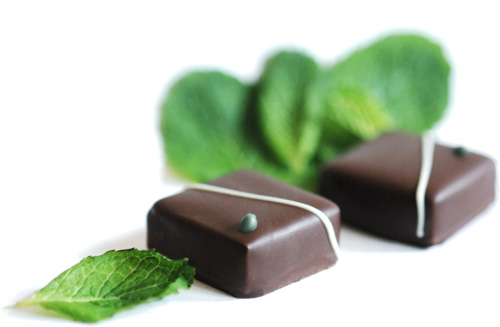 Today I found out why mint tastes cold.
Similar to why peppers taste hot, what’s going on here is there is a chemical in mint, menthol, which is tricking the brain into thinking that the area the menthol is applied to is cold; even though in fact, it’s the same as it was before. More specifically, menthol binds with cold-sensitive receptors in your skin; these receptors contain things called “ion channels”, in this case TRPM8. The menthol makes these much more sensitive than normal, so they trigger and you feel a cold sensation, even though everything is more or less the same temperature as before.
This extra sensitivity is why when you eat peppermint, which has a relatively high level of menthol, and then you breathe in deeply through your mouth, your mouth feels extra cold. Your cold receptors are reacting much more strongly than they normally would to the air which is cooler than the inside of your mouth.
Menthol is a compound classically obtained from various mint plants, though now is often synthetically produced due to the extreme high demand for menthol in a variety of products. Menthol is a waxy, crystalline substance that is somewhat clear or white. Interestingly, it is actually solid at room temperature and melts just a few degrees above room temperature.
Now for an experiment: Take a Jalapeno pepper and an Altoids Peppermint and eat them at the same time. What happens? … Seriously, someone want to try this and report back? Given that the capsaicin in peppers and the menthol in mint are both effectively fooling the brain into perceiving hot and cold using similar ion channels, despite no actual change in physical temperature, it would seem like that the two may well cancel one another out in the brain (how can one feel hot and cold coming from more or less the same receptors?); or at the least, one would think it would produce a very unique sensation. So do they cancel each other out or does one win-out over the other?
If you liked this article, you might also enjoy our new popular podcast, The BrainFood Show (iTunes, Spotify, Google Play Music, Feed), as well as:
- Why Garlic Makes Your Breath Smell Bad
- Why Mentos and Diet Coke React
- All Lifesavers Spark When Chewed, Not Just Wintergreen
- Why Asparagus Makes Your Pee Smell
Bonus Menthol Facts:
- Menthol can be used in solid form as “mineral ice”, as a substitute for real ice, if none is around. As far as your brain is concerned, the drink you drink with the menthol is cold, even though it might actually be warm. Makes for handy “icing” of your drinks on camping trips.
- Mint leaves or mint oil containing high levels of menthol will also help repel mosquitoes and can even do more than just repel them; it has been shown that mint oil can actually kill the mosquitoes.
- Menthol is very effective for providing short term relief for sore throats and other minor mouth and throat irritations.
- Menthol is also effective at reducing muscle aches and pains, which is why it’s used in products like “IcyHot”.
- Menthol was successfully isolated from mint by the Japanese over 2000 years ago, but has only been isolated in the western world since the 1770s.
- Menthol is also used to treat sunburns, as it provides a cooling sensation (often used in conjunction with aloe).
- Menthol is added to some cigarettes to reduce the throat and sinus irritation caused by smoking so that you can ignore even more warning signs from your body that you should really stop smoking.
- Menthol works as a low level pesticide.



| Share the Knowledge! |
          |
 |
Menthol Cigs taste colder as well…thanks for the info
VERY interesting about the mint! And you have me wanting to try the mint/pepper combo. I’ll let you know if I do.
I tried the Jalapeno + Altoids thing in a middle school science class. It tasted awful, but felt really strange. I’d recommend it if you figure out how to avoid actually tasting it.
I really want mint chocolate now….dammit.
I now know why mint tastes cold!
I wouldn’t be trying to use menthol crystals as icecubes, it would probably kill you.
The msds for pure menthol shows
“Toxic. Estimated fatal dose, average human, is 2 g. General gastrointestinal upset can occur with pain, vomiting, vertigo, drowsiness and coma. Death from respiratory failure can result in cases of severe poisoning. ”
see,
http://www.jtbaker.com/msds/englishhtml/m1131.htm
or the wikka page at http://en.wikipedia.org/wiki/Menthol
fro more information.
So I’d stick to regular mints and such.
cool…..good to know!!!
Then I wonder why chocolate tastes warm J/K !!
In case anyone’s still reading, I should share the story of a museum exhibit I heard about, where you could grab a pipe which had both hot and cold water flowing through it (the two streams were mixed about an inch above, and hadn’t fully reached equilibrium). It produces an extremely uncomfortable burning sensation, because the only time the heat and cold sensory neurons are both activated naturally is when the heat or cold is so intense that the signal “overflows”. You have to exert a lot of will just to keep your hand on the pipe.
If anyone still wants to do the experiment I’d be interested to know how it goes.
If I were to guess, the “uncomfortable” sensation is because your brain is confused, similar to a common cause of motion sickness. Some people can ride on any rollercoaster, but get carsick if they try reading in a car. It’s because the book moves with them, and they eyes are telling the brain, “we are not moving” but your inner ear feels the moving sensations and says “yes we are.” Result? Your brain pitches a fit and you feel sick. Wonder if it’s a similar thing going on if your brain hears “It’s hot!” “No, it’s cold!” from parts of the body is very close proxmity to each other (the ion channels).
I thought the capsaicin in peppers burned because of the acidic content, not because it was fooling the heat receptors in your tongue. There’s a difference between an acid burning you, which can actually increase the temperature in your mouth, and your heat receptors being fooled. If I’m right then a jalapeño+altoids shouldn’t be anything but a cooling sensation that leaves you burning in pain, it shouldn’t confuse your brain too much.
“The burning and painful sensations associated with capsaicin result from its chemical interaction with sensory neurons. Capsaicin, as a member of the vanilloid family, binds to a receptor called the vanilloid receptor subtype 1 (TRPV1).[40] First cloned in 1997, TRPV1 is an ion channel-type receptor.[41] TRPV1, which can also be stimulated with heat, protons and physical abrasion, permits cations to pass through the cell membrane when activated. The resulting depolarization of the neuron stimulates it to signal the brain. By binding to the TRPV1 receptor, the capsaicin molecule produces similar sensations to those of excessive heat or abrasive damage, explaining why the spiciness of capsaicin is described as a burning sensation.” -wikipedia
so, the burning sensation is NOT caused by acidic content.
I just conducted an experiment with what I had on hand: Girl Scout thin mints cookies and Tabasco sauce. It yielded a rather odd result. First I ate a couple thin mints making sure I got plenty of cool “mintyness” in my mouth. Then I took a big daub of Tabasco and rubbed it directly on my tongue. Surprisingly this didn’t taste horrible as I had suspected it would (I guess Tabasco really does work with everything). The sensation was something like “burning cold”. The temperature “feel” was of cold due to the mint, but there was the definite burning sensation of the capsaicin from the Tabasco.
After a few minutes, a more “heat” feel took over on my tongue, with the throat still feeling “cold”. So in conclusion, menthol and capsaicin do not cancel each other out, but cause both expected sensations if in an odd way. I also think the burning sensation from the capsaicin felt more potent than it normally does when I eat Tabasco (and I use it a lot).
If anyone wants to try this, I suggest a similar method instead of eating jalapenos and altoids which sounds thoroughly disgusting.
What does’ very unique’ mean? correctly used from Latin ‘unus’ means ‘ one.’
Interesting article. I’m intrigued now, by the idea of combining heat and mint!
I stopped smoking years ago after decades of puffing on menthols. To stop the cravings and give my lungs the feeling of inhaling smoke, I used Altoids. Breathing in with one in your mouth simulates filling your lungs with smoke perfectly. As the cravings go away you then stop using the candy. Friends of mine have tried my method with regular cigs as well and they say Altoids or cinnamon imperials do the job. I am still smoke free after 20+ years, thank God.
I had students do the mint experiment in test tubes and record the results. Mint dropped the temperature 2-5 degrees Fahrenheit. Se something in there is really working, not just stimulating your taste buds.