
There Was Once a Woman Who Had Immortal Cells
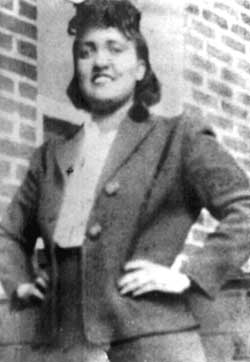 Today I found out there was once a woman who had immortal cells. These immortal cells have multiplied to the point that if you were to weigh all of them that live today, they’d weigh about 50 million metric tons, which is about as much as 100 Empire State Buildings.
So who was this woman and why are scientists keeping about 50 million metric tons of her cells supplied with fresh nutrients so they can live on? The woman was Henrietta Lacks and her immortal cells have been essential in curing polio; gene mapping; learning how cells work; developing drugs to treat cancer, herpes, leukemia, influenza, hemophilia, Parkinson’s disease, AIDS… The list goes on and on and on. If it deals with the human body and has been studied by scientists, odds are, they needed and used Henrietta’s immortal cells somewhere along the way. Her cells were even sent up to space on an unmanned satellite to determine whether or not human tissue could survive in zero gravity.
Go to just about any cell culture lab in the world and you’ll find billions of Henrietta’s cells stored there. What’s unique about her cells is that, not only do they never die, in contrast to normal human cells which will die after a few replications, but her cells can also live and replicate just fine outside of the human body, which is also unique among humans. Give her cells the nutrients they need to survive and they will live and replicate along forever, apparently (almost 60 years and counting since the first culture was taken). They can even be frozen for literally decades and later thawed and they will go right on replicating.
Before her cells were discovered and widely cultured, it was nearly impossible for scientists to reliably experiment on cells and get meaningful results. Cell cultures that scientists would try to study would weaken and die very quickly outside the human body. Her cells gave scientists, for the first time, a “standard” that they could use to test things on. Even better, her cells can survive being shipped in the mail just fine, so scientists across the globe can all use the same standard from which to test against.
Henrietta Lacks herself was an impoverished black woman who died on October 4, 1951 of cervical cancer at the age of just 31 years old. It was during getting her cancer treated that a doctor at Johns Hopkins took a sample of her tumor without her knowledge or consent and sent it over to a colleague of his, Dr. George Gey; Dr. Gey had been trying for 20 years, unsuccessfully, to grow human tissues from cultures. A lab assistant there, Mary Kubicek, discovered that Henrietta’s cells, unlike normal human cells, could live and replicate outside the body.
Henrietta died of uremic poisoning, in the segregated hospital ward for blacks, about eight months after being diagnosed with cervical cancer; never knowing that her cells would become one of the most vital tools in modern medicine and would spawn a multi-billion dollar industry where her replicated cells would be bought and sold by the billions.
She was survived by her husband and five children, the surviving members of which still to this day live in poverty (one who is homeless on the streets of Baltimore) and were long ignorant of the importance of Henrietta’s cells to modern medicine.
If you liked this article, you might also enjoy our new popular podcast, The BrainFood Show (iTunes, Spotify, Google Play Music, Feed), as well as:
- The Species of Jellyfish that can Age Backwards
- Why Do People Seem to Get More Colds During the Winter?
- Why Some People are Right Handed and Some People Left Handed
- What Causes Dandruff
- What the Numbers in a Blood Pressure Test Mean and What They Tell the Doctor
Bonus Facts:
- A few days after the “March for the Cure” for polio, Henrietta Lacks visited John Hopkins after developing a painful knot in her cervix. Little did she or anyone else know, just a few short years later, subsequent events as a result of her visit, would help provide the cure for polio the nation so desperately needed.
- On the day of Henrietta’s death, Dr. George Gey, the head of Hopkins tissue-culture research lab, holding up a vial of Henrietta’s cells to TV cameras, announced to the world a new age of medical research had begun; one that would allow scientists to come up with cures for things like cancer. It was a very short while later that Dr. Jonas Salk was able to cure polio with the help of her cells, which had recently been put into mass production.
- When Henrietta’s cells were originally taken, they were given the code name “HeLa”, the first two letters in Henrietta and Lacks. When members of the press got close to finding the source of the cells and came close to finding Henrietta’s family, the researcher who grew the cells made up a pseudonym, Helen Lane, to try to keep the source of the cells anonymous. Because of this, her real name wasn’t publicly known until the 1970s.
- Henrietta’s immortal cells weren’t just important in aiding in finding cures for diseases and the like, they also ended up indirectly causing major reform in how scientists worked with cell cultures, in terms of making sure that samples weren’t contaminated. While studying some breast cancer and prostate cells, one scientist discovered what he was actually looking at were Henrietta’s cells. What had happened was that Henrietta’s cells floated on dust particles in the air, and managed to survive doing so, and contaminated all the cultures in the area. This created a big problem as it turned out this wasn’t an isolated incident and scientists had been unknowingly working with many samples contaminated with Henrietta’s cells.
- When Henrietta’s husband first learned about his wife’s cells, he misinterpreted what the doctor was telling him on the phone due to the fact that he only had a 3rd grade education; he thought the doctor was telling him that his wife was still alive and scientists had been keeping her in a laboratory for the last 25 years and using her to experiment on.
- Henrietta’s cells were the first human biological materials ever bought and sold. This literally launched a multi-billion dollar industry. Henrietta’s family and descendants almost all live in poverty, including one of her sons that is homeless in Baltimore. The family has not been able to hire a lawyer to try to get what they feel is their cut out of each sale of their mother’s cultured cells.
- The Lacks family lived in Lackstown, which is land located in Clover Virginia. The land was given to the black Lacks family by the white Lacks family, who had owned, as slaves, the ancestors of the black Lackses. Quite a few of the black Lacks’ were also descendants of the white Lacks’.
- Henrietta Lacks’ body lies in an unmarked plot on the family burial ground next to her now abandoned and falling down childhood house. Nobody knows which grave plot is hers.



| Share the Knowledge! |
          |
 |
The Wikipedia article mentions 20 tons of cells, rather than uh, 50 million…?
Regardless, this is really amazing. It’s rather horrible that her family still lives in poverty to this day though.
The book that was written on this woman, which of course I’d take as a bit more credible than Wikipedia, says 50 million. But as you said, that figure and the rest of it is amazing either way, whether the book was correct or Wikipedia.
Why for any reason would a book have more intrinsic credibility than a peer reviewed online encyclopedia which lists its sources? I really feel like the article fails to capture the fact that non-cancerous cells from Henrietta Lacks would not be immortal, and additionally; any cancer cells taken from any human have the potential to be immortal. Henrietta Lacks may be important in that she was first, but I’m afraid her biology is not nearly as unique as you are asserting.
Because (I read the book) the woman who wrote the book did a lot of in-person research, interviewed the family, went to Johns Hopkins, you know. Actually did her research. Wikipedia articles have some sketch and/or outdated research sometimes.
@Nick: Yes, it’s especially horrible that her family should still be living in poverty and/or homeless, given the billions of dollars drug companies have made from her cells. How I wish some law could force these greedy capitalist mongrel dogs to do right by her family and compensate them.
How could such a thing be in all fairness the Lacks family. Deserve a huge amount of whatever has been made. At least to live comfortably for every generation. For them to still live in poverty is ludicrous and homeless unthinkable. Her cells have found cures and treatments. God knows what secrets of longivity for even normal cells they may hold. Many. Have searched for the fountain of youth. Well then this may well be the entrance to it. As technology develops new frontiers may be probed and entered. Both Black and White and any and all offspring. Of this woman should have their fair share of the wealth accumulated. It would be a crime if they didn’t
Wikipedia is not accurate period.
Actually, wikipedia is very accurate.
http://www.livescience.com/32950-how-accurate-is-wikipedia.html
Period.
No…its not
Maybe it used to be accurate. But something changed with it several years ago – disproportionate amounts of power were given to moderators who lack objectivity on various subjects. They were given the power to accept or deny modifications. And now we also have zealots who watch articles and revert any changes from their opinions. I thought it could be saved for a while, but… I think it’s a lost cause now. Wikipedia is no longer reliably accurate in general, and likely never will be again.
I don’t feel like reading into this any further. But according to your article the doc took cells from her cervix. She had cervical cancer. Those cells are cancer cells – and cancer cells are by definition “cancer cells” if they lack cell cycle regulation and apoptosis mechanisms.
Bottom line – those “human cells” are not human cells.
If they’re not human, then what are they?
……….cancer cells
They are still genetically human cells. They have the genes that make said cells stop replicating at a certain point turned off. Every single cell in your body has the same DNA, but what makes a skin cell different from a liver cell is what genes are turned on or off, that is, which genes are being expressed. Something happens to cells that become cancerous which turns off the gene that tells the cell that it has replicated so many times and now it’s done.
Hay. Nice article. This page has been linked from reddit. There are currently 80 comments there.
http://www.reddit.com/r/reddit.com/comments/ckxnw/there_once_was_a_woman_who_had_immortal_cells_and/
Papers from the source available?
Interesting article. Well written, but in the second bullet point, you mean “holding up a VIAL of Henrietta’s cells” not “vile”
@Nathan: Good catch. Dang typos 🙂
It’s tonne not ton.
Get the Lacks a Lawyer.
Kareem brings up a good- and accurate- point, though apparently you didn’t feel the need to respond to it. Cancer cells are immortal, which is what makes them cancerous. They lack the crucial checkpoints necessary to regulate cell growth, ergo they can continue to replicate for as long as they are nourished. Your article is, therefore, extremely misleading, and you as an author seem to be misinformed. Yes, Henrietta Lacks had immortal cells, but that is because they were cancer cells; her “immortal” cells are no different than the cells of any other human being that has developed cancer. Had you done more research, I’m sure you would have known that.
@AJT: That isn’t biologically correct. Cancer cells will die out quite quickly once the host is dead, even if you continue to nourish them in a lab environment. They also don’t make perfect copies of themselves for all time, like her cells do and which is essential when using them for scientific experiments like they are. This is why her cells are such a medical miracle, even to this day.
Tissue was taken from me in 1986,and it became the MCF10 cell line. This is a NORMAL cell line that like HeLa is IMMORTAL. Both our cell lines are used extensively in research. Many of our experiences were the same, along with John Moore. My cells are now being sold for $429 (research)to $6000 (commercial). You are correct, a individual has no rights to their tissue or blood after it leaves their body.
My cells although immortal remain NORMAL, thats what makes them a medical miracle. I am very pleased people are aware of the “ethics” of this segment of research.
I think there was an episode of Law and Order SVU about this family….
@ Kareem: RTFA
@ some douche: tonne = metric ton. RTFA. The term was used properly.
I would like to point out that the author of this article did cite his source somewhat, stating that he took his info from a book written about the woman and the research. As for saying that cancer cells aren’t human cells…that is ignorant! Just because you took a couple bio classes in college that doesn’t make you either a Doctor or and Oncologist (obviously since your information is completely erroneous). Cancer cells are simply cells that do not replicate properly and are therefore non-functional or function improperly. Cancer spreads when a cancerous cell breaks off from the mass and travels through the blood stream or tussues to another area in the body and begins to make more (incorrect) copies of itself. IT IS STILL HUMAN DNA OF THAT INDIVIDUAL.
jlynnsmiley: The primary point is that cancer cells are malformed DNA. Lack’s cells were not malformed DNA. Both are immortal, but the quality of the DNA replication process is the primary difference between the two and the primary reason her cells were so unique.
I have no clue if cancer cells can be nourished and cultivated outside of a human body or not. If yes, then the above still stands. If no, then the fact that they can be cultivated outside of the human body is another one to toss on the pile supporting Lacks’ cells as revolutionary and unique.
@susan cutting. MCF-10 is NOT genetically normal, nor a medical miracle. Mammalian cell lines will die unless they are “immortalized”, or mutated, to interrupt normal cell regulation. MCF-10 spontaneously mutated in the lab (which is normal, don’t be alarmed… but wouldn’t someone with their own cell line have actually read it’s primary research article?)
Source: http://www.ncbi.nlm.nih.gov/pubmed/1975513
This is not only ignorant it’s immoral. This nation owes that family a lot and should not have to be taken to court to do the right thing. They have already admitted to stealing the cells.
Surely there is a lawyer out there who will do something about this. There is obviously a great deal of money in this for all.
John’s Hopkins doctor steals cells from a dying woman, lets her die of uremic poisoning, cashes in on the science. And somehow the family is ‘long ignorant of the important of Henrietta’s cells to modern medicine?’
More like the doctor was ignorant of ethics during a racist, anti-communist era in the country.
This is actually more sad then good. The fact that family is still living in bad conditions is exactly whats wrong with our country. How many peoples lives have been saved then via research of her existence? Yet they get nothing in return…The fact they were illegally obtained and she died from incompetence is even worse.
IF you sign some kind of contract then I understand you have no right to bicker about no profit. But if you didn’t thats BS and criminal. The story alone is incriminating…
I wish it had been mentioned in this article that these cells were only “immortal” because of the chemicals doctors experimentally and without her knowledge pumped her with. As a woman of color living in the 50s she was given the kind of treatment one would expect. She was not being treated for her cancer, she was being experimented upon.
@Phoebe: References?
I have just read this and am appalled that the family of Henrietta has not gained whatsoever from this major breakthrough in science and medicine.Surely their must be somebody or some good samaritan out their to let them know of their rights . this has to be regarded in the context > MANS INHUMANITY TO MAN < .
Why should they benefit? They had a relative die from cancer and medical professionals, researchers and scientists made discoveries and innovations with the matter of a tumor, they did nothing. Henrietta herself did nothing, I’m pretty sure given the choice between survival or having the tumor she would have chosen survival.
There is actually a foundation in her name http://henriettalacksfoundation.org/ and an article telling about efforts to help her family. http://www.nytimes.com/2011/02/05/books/05lacks.html?_r=0
She looks like the face on the Shroud of Turin, only smiling, to me.
i am just wondering is her cells in of themselves were immortal, why did she die?
and how does one biopsy a tumour, and that biopsy of the tumour (which are abnormal cells) become an immortal line?
@kb: Her tumor cells are (apparently) immortal given the proper nutrients they need. The rest of her cells were not. Even if they were, however, they can’t live without proper nutrients and the like, meaning the rest of her body needs to be able to function properly to provide that. Cancer has a way of disrupting all of that.
This article should have emphasized the fact that these cells are only immortal because they are kept nourished. “Give her cells the nutrients they need to survive and they will live and replicate along forever…” Thats a serious case of misleading the readers. How is it immortal, if it is reliant on an external source for its survival?
No other cells was not able to replicate like hers period. They cells are not able to live even with the proper things. So just be thankful that this black woman is a blessing from God.
Somehow the Democrats will blame Trump or her family not getting any money from her cells.
Actually, Harry Truman was president at the time – so all this happened under the watch of a Democrat.
Seriously though, an entire industry has arisen to buy and sell part of a person’s body. This isn’t just stealing a kidney, this is almost a form of slavery. The family should be able to control, or at least benefit from the sale of Henrietta Lacks’ remains.
Another classic story of racism…I think they murdered her because she was just another black person, then ‘dissociated’ the benefits (as usual) and made billions of dollars ‘securing jobs’ for ‘certain people’. God have mercy on us. I find it interesting, though, that scientists have been looking for immortal cells, then all of a sudden a black person shows up.
Hi everyone, I’m 39 years old male and I contacted the virus in 2004.
I did get bad outbreaks for a while, and used to take valtrax. I hated
that medicine, so i stopped it however was having outbreaks several
times a year. VERY PAINFUL. A year ago I decided to seach for the herpes
cure, bc I too believe there is one somewhere in this world. I came
across zeolite (which i tried but did not cure me) and the H2O2 protocol
(ingesting 35% food grade hydrogen peroxide for 30 days, per the books
written by people claiming their tests came back negative). I could
only do 13 days of that because the taste of the h2o2 was making me
sick. So needless to say, that did not help either. As of the past 6
months,until i saw a post in a
health forum about a herbal doctor from Africa who prepares herbal cure
to cure all kind of diseases and virus including ALS, MND,HIV,Epilepsy, Leukemia,
Asthma, Cancer, Gonorrhea etc, at first i doubted if it was real but
decided to give it a try, when i contact this herbal doctor via his
email, he prepared an herpes herbal portion and sent it to me via courier
service, when i received this herbal portion, he gave me step by step
instructions on how to apply it, when i applied it as instructed, i was
cured of this deadly disease within 7 days, I could not walk or talk
understandably before but after i took the herbal cure as he instructed i
regained strength in my bones and i could talk properly unlike before, I
am now free from the deadly virus, all thanks to Dr. Contact this
great herbal doctor via his email [email protected]
Herpes isn’t deadly, scammer.