
The Sun is White Not Yellow
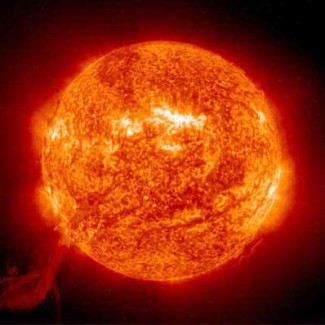 Today I found out the Sun is white, not yellow.
For you graphics people or web developers out there, the exact color of the sun is #fff5f2. The reason the Sun looks yellow to us on Earth is that our atmosphere scatters light from the Sun; so the apparent color of the sun changes. This same scattering effect is why the sky looks blue in the day time instead of black, like at night.
Specifically, what is going on here is the Earth’s atmosphere scatters light in the blue and violet wavelength range, so the remaining wavelengths of light appear yellow. This same effect is why the sky will also often appear yellow when the Sun is disappearing over the horizon, as well as why the sky/Sun can appear more red at times during this phase of the day.
As the sun is setting, more of the shorter wavelength blue is being scattered because of the decreased angle of the sun relative to you; thus the light has to pass through more atmosphere to get to you. This increased diffusion results in less of the blue wavelength being visible to you and thus what remains appears yellow. Similarly, if it is dusty or there are a lot of other larger particles in the air, this will filter out larger wavelengths, resulting in a red sky and red sun.
If you liked this article and the Bonus Facts below, you might also enjoy:
- An Asteroid Field Would Actually Be Quite Safe to Fly Through
- The Earth is Hottest When It is Furthest from the Sun, Not Closest
- The Difference Between an Asteroid and a Comet
- Why the Hottest Part of the Summer is Called “The Dog Days”
- Why We Have a Seven Day Week and the Origin of the Names of the Days of the Week
Bonus Facts:
- Light travels from the Sun to the Earth in about 8 minutes and 19 seconds.
- While it only takes 8 minutes and 19 seconds for the light from the surface of the sun to reach us, it actually takes about 10,000-170,000 years for a photon to travel from the core of the sun to the surface.
- Once regarded by astronomers as a small and relatively insignificant star, the Sun is now known to be brighter than about 85% of the stars in the Milky Way.
- The Sun has an effective surface temperature of 5780 K, which is equivalent to just under 10,000 F and 5500 C.
- The core of the Sun has a density almost 150 times the density of water on Earth. The temperature at the core is close to 14 million Kelvins and Celsius degrees, or 25 million degrees F.
- About 3/4 of the Sun’s mass consists of hydrogen, with most of the rest being helium (23.8%) and about 2% remaining consisting of other elements such as iron, oxygen, carbon, neon, and a variety of others.
- The Sun generates its energy from nuclear fusion at its core fusing the hydrogen nuclei into helium. The nuclear fusion is self regulating; if the Sun’s diameter gets smaller while maintaining the same mass, the pressure at the core increases creating more nuclear fusion which in turn causes it to expand. If it expands maintaining the same mass, the pressure lessens in the core causing less nuclear fusion. So a natural equilibrium has resulted in this process with our Sun, though there are stars that can be observed going through this process of massive expansion and contraction at very steady rates.
- At the core of the Sun, nuclear fusion power produced is estimated at about 276.5 watts/m^3. Interestingly this power production is more equivalent to a reptile’s metabolic energy production than what we would think like a nuclear bomb.
- This is in contrast to the amount of energy per (W/m^2) deposited on the surface of the Earth from the Sun, which is about 1368 W/m^2.
- Each second more than four million tons of matter are converted to energy within the Suns core. At this rate, the Sun has so far converted 100 Earth masses of matter into energy. This will give the sun an effective lifetime as a main sequence star of about 10 billion years with about 5 billion years to go.
- The Sun does not have enough mass to go supernova and explode. However, in about 5 billion years it will enter a red giant phase steadily expanding until it consumes the Earth. But fear not, the Earth will already be dead in about 1 billion years due to the fact that the sun becomes about 10% brighter every billion years; so in 1 billion years the Earth’s surface temperature will be such that no liquid water will be able to exist unprotected on the surface of the Earth.
- The Sun orbits the center of the Milky Way at a distance of approximately 24,000-26,000 light years.
- The Sun completes a clockwise orbit of the Milky Way center in about 225-250 million years.
- The Sun is about 150 million km or about 93 million miles from the Earth; this is by definition one astronomical unit (1 AU).
- The Sun is almost a perfect sphere; its diameter at its poles differs from the diameter at its equator by only 10 km or 6 miles.
- The area of the sun we call the “surface” is really just the outermost layer that radiates a significant amount of light. There is actually quite a bit of the Sun above that layer.
- The Sun’s magnetic field is less than half of what it was just 22 years ago. This has shrunken the Sun’s heliosphere which helps protect the earth from cosmic radiation. Because of this, the Earth is now being struck with significantly more cosmic radiation than just a couple decades ago.
For you graphics and web developers out there, here are some more stars and their associated hex colors:

- Science Made Simple
- What Colour is the Sun?
- Sun
- Star Color (image source)



| Share the Knowledge! |
          |
 |
“the exact color of the sun is #fff5f2” that’s quite a generous way of using the term “exact”. I sincerely doubt the exact color of the sun is limited by a 32-bit color representation :/
The color of the Sun is yellow as expected by it’s spectral class of G2. The Earth’s atmosphere does not hide it’s true color but presents it’s true color.Go to Australia andthe check out the pale yellow color of alpha Centauri as a G2 class just like the Sun! tthe Sun’s disk’s might look white when staring at it because of it’s proximity. But that would be the case with any star if it were close enough.
That’s an irritatingly common misconception, one that is certainly not helped by either the standard naming scheme that assigns color to a star, nor by the fact that basically every “image” of the sun anyone has ever seen is one that has been colored either by it having been taken from within the atmosphere OR by it being colored purposefully afterward.
To be clear; if the sun were truly yellow then it’s light output would be similarly tinted, meaning that A- a rainbow would not be the right color, B- the moon at night would be decidedly less gray looking, and C- there really wouldn’t be much in the way of WHITE anything because it would all look yellow.
Shut up, nerd.
LOL NICE ONE
Here’s another fact:
Sun worship can be found in thousands of corporate logos, products, pop culture references, TV shows, songs, pro wrestling, Family Guy, websites, video games, bowling alleys, shopping malls, fast food restaurants.
It’s everywhere. Why? What kind of mad cult is this?
Well, as this article says, the sun will devour the Earth with heat in about 1 billion years. So, sun worship is subliminal, subconscious death worship, just like the skull and bones logos that are so fashionable. It’s a way of making people feel weak and dependent, and not know why. It keeps you in line, to the same effect as the pyramid logo found everywhere, including the dollar bill.
We are living in infinity, and certain people (cough Bush, cough Kerry, cough Skull & Bones secret society) want to control you from cradle to grave. Even if you’re smart on this, look at the general public. They are drunk with hubris, with no ability to even think of the powers that fight for control of their minds.
Actually, the sun exhibits a phenomenon known as black-body radiation. Yes it shines the entire spectrum, however due in part to its temperature, that radiation is most highly concentrated in the YELLOW portion of the wavelength spectrum. It also shines wavelengths all the way from radio to gamma waves.
Depends on what you mean by “highly concentrated”. The sun’s peak radiation is actually more of a green (which also happens to be the peak sensitivity of our eyes, for good reason). See http://www.soultek.com/blog/uploaded_images/solar_spectrum_captured_by_new_solar_technology-735670.jpg
But color is really just a subjective experience created by our brain. The exact spectrum doesn’t really matter, just what our brain perceives. White paper appears white when lit by the midday sun, and that’s really all that matters.
Well, it might be limited by a 32-bit representation, but #fff5f2 is not even a single bit as precise as that…
ff-ff-ff, or 255-255-255 : 24-bits… That’s way less precise!
Vincent
Not to mention, every single artist in the world is also ON the world, subject to the atmosphere. Useless information is informative but useless! What artist would want to represent the sun in a way that they’ve never seen, and their audience will never understand?
Daniel, while I agree with you, count your bits – there are only 24 there.
No, the sun’s light is white, but the sun is yellow.
“it actually takes about 10,000-170,000 years for a photon to travel from the core of the sun to the surface.” — Our sun’s radius is not 10000-17000 light years… Other things are probably invalid too.
@qwerty: What you are failing to consider is that the process of a photon making it’s way through the extremely dense plasma in the sun, particularly near the core where most all the energy is created, doesn’t happen at light speed. In fact, it happens pretty slowly. For more information on this process, check out the sources or just grab a cosmology book (where I first learned about this back in college).
I’m curious to know exactly why the sun appears white now – I know it is in reality white – does this mean that our atmosphere – density has reduced drastically ?
I’ve been asking that same question for years now with no answer found. You’d think that our once yellow looking sun having now changed to white would be a huge deal especially with all the climate change talk but no it’s never talked about which is very strange.
hey Daniel, STFU fag. k thx
I think sun is basically white.. I think
I beg to differ. If you have ever taken an astronomy/astrophysics course you will see that many stars in our visible ranges can only be picked up by a few pixels on a ccd telescope. The color that you get is usually the highest “density” of a particular light frequency. In that case, the color of the star looks uniform because our sample is so small. So from afar, without a telescope, I’d say it would be safe to say that the exact color of a star can be represented by 32 bits for the sake of a game.
“This is in contrast to the amount of energy per (W/m^2) deposited on the surface of the Earth from the Sun, which is about 1368 W/m^2.”
What is the lumenous efficacy(lumens/watts) of this measurement? so basically I want to know how many lumens hit a cubic meter.
Just as important, the name of The Sun is Sol.
qwerty, you are using the speed of light in a vacuum, but the centre of the sun is not a vacuum. Think of it as an extraordinarily high refractive index.
The sun looks white, not yellow anyways, you’re insane
A contradiction of observation Ethan!
Do you know why we arbitrarily divide the continuous spectrum of the Sun’s light into only three colors, red, green, and blue? Because that’s how our eyes work.
Do you know what color the Sun is? It’s white. Know why? Because we’re the descendants of life that has evolved on this planet for 3.8 billion years. We see the Sun as being white because, not so coincidentally, the exact spectrum it’s putting out is what our entire visual system has spent millions of years optimizing for.
If we ran into aliens who live around a two Solar mass star, they’d see their own star as white, even though it would look decidedly blueish to us. If they looked at Sol, they would say it was red (or whatever their equivalent word for “longer than the median visible wavelength” is).
So Weys, if “we” see the Sun as white and it’s white in space, then it sounds to me that someone has turned off the Raleigh Effect!
I’m 64 years old and I remember when I was little the sun looked more yellow to me. Now it looks whiter and brighter. Is this a result of ozone depletion or something else to do with the Earth or is it a process of ageing? Anybody have an idea?
Isn’t a FACTOID something false that is presented as a fact?
I’m glad you asked. That is a common misconception. See here: http://www.todayifoundout.com/index.php/2010/02/the-difference-between-a-fact-and-a-factoid/
This is useful for space games, art, or anything that would have one’s perspective outside the Earth’s atmosphere. If one were on a different planet, the color perceived would of course change based on the planet’s atmosphere or even if you were somehow inside a nebula or anything that affects light. The light could even appeared warped due to gravitational lensing depending on the viewer’s relative location in space. There are all sorts of things one can quibble over, although, I personally say, let the artists have liberty to make things visually look “good”–accuracy isn’t always important for all applications. Still, some interesting info regardless. It all reminds me of how small we are in the universe as we know it and it makes me want to watch some Carl Sagan Cosmos videos on Netflix 😉
Is not most art based on perception not necessarily reality? If the sun appears yellow from my vantage point the within the confines of my mind the sun is indeed yellow. If you fly me out to space then I guess that perception would change.
Vincent, the last 8 bits are for alpha. 8 bits of each color and then 8 bits of transparency.
Mr Dylan says that the sun isn’t yellow, it’s chicken.
So if you are in space is the sun white?
How can the sun orbit the milky way in a particular direction? It would depend on which side you are observing it from.
Space is so interesting. It’s amazing to think there are 100 million stars in our galaxy and 100 billion different galaxies out there.
Dear Davon
A mistake I often see in printed media is the incorrect use of the word factoid. A factoid is a false or incorrect statement. According to Wicapedia a factoid is defined as ” a questionable or spurious—unverified, incorrect, or fabricated—statement formed and asserted as a fact, but with no veracity.” Language is always changing and evolving maybe some day it will refer to a little known fact but for now it still is defined as stated above.
Thanks
Thanks for the feedback. However, the definition has already more or less changed or rather been modified thanks to certain news agencies out there. Wikipedia is behind the times there; check Websters for a more up to date definition or just read my post here on the subject
Misleading- there are already stars classified as white, and our sun is certainly not in that category.
I thought that agreed number of stars in the Milky Way was around 400 billion.
Given this is a general estimate im sure (and not an actual set number), and given the estimate of galaxies in the known universe (google’d at 170 billion), the number of stars in existence is mind boggling. (simple math, 400,000,000,000 * 170,000,000,000 = 68,000,000,000,000,000,000,000. Whats the name for that place? 68 sextillion stars?)
This article is not entirely correct. All stars are mostly white. But they do have color, whether viewed from Earth or from space.
The reason it is considered a yellow star is because yellow is it’s most predominant non-white color index (which is due to it’s temperature). It can only be viewed as yellow when put through a heavy non-polarized filter to block out the majority of the light. If you look directly at it, it will appear completely white because it will oversaturate the cones in your eyes.
A correct statement would be that the Sun is mostly white with a tinge of yellow. Also, the Earths atmosphere does affect the Sun’s apparent color, but that’s not to say that it doesn’t still have a predominant yellow color when viewed from space.
The sun is technically centered in the green portion of the spectrum, aka we live under a green star. You will never see this, even without the atmospheric effects. The eye is not equipped to deal with this much light, or this portion of the spectrum.
http://blogs.discovermagazine.com/badastronomy/2008/07/29/why-are-there-no-green-stars/
Great blog topic!!!
Daniel: I agree, any computer model spitting out a color code will be limited for many reasons. I think it is only fitting that the “pinkish peach” result is what they found. Is the Sun a girl star? I think not! Lol
physics: The sun is close to a blackbody radiator, but not quite. There are a number of peak energy wavelengths and temperatures that can be discussed and are used by solar physicists:
1) Planck (blackbody) temperature. If you superimpose a ~ 5850K blackbody spectrum over the Sun, it will be a reasonably close match, especially in the red end of the spectrum. The peak wavelength at this temperature is 495.4 nm (4954 Angrstroms). This is more of cyan color (greenish blue), though the color will likely vary for different observers.
2) Effective temperature. At ~ 5777K, an object will radiate the same amount of net energy per unit area as the Sun. The peak wavelength for this temp. is 501.6 nm (5016 Angstroms). This is a green color for most people, I think.
3) Spectral Irradiance peak. Sp. irr. data from space observatories demonstrate peaks that vary from 450.5 nm (near violet) as found in the Wehrli ’85 data set to about 495 nm (near green). These peaks, however, are all very close to the same energy level, so they are more like pimples than peaks. 🙂
4) Spectral Photon flux. It is likely best to convert the spectral energy distribution into a photon flux distribution because it is a better way to model the responsiveness of our eyes. This produces an almost flat distribution across the visible spectrum. Ironically, there is a tiny peak (pimple) in the narrow yellow band, but no one peak makes a continent, and no one wavelength determines a net color observed. A flat photon flux distribution produces a white result.
Gonzobot, I see no reason to always represent the Sun in a color it is not. Further, most of the time the Sun appears as white or yellowish white since its time along the horizon is so short. I hope artists take their liberties and license and keep giving us their colorful versions, but occasionally it would be nice to see a few present it accurately, especially if it is a depiction of the Sun as seen from space.
James, the Sun Ain’t Yeller: Here is a fun and lengthy explanation:
http://www.scientificblogging.com/solar_fun_of_the_heliochromologist/the_color_of_the_sun_revelation
I suspect we are victims of using the yellow crayon in coloring the Sun, which may have left an indelible impression upon us from our youth. There are a number of ideas on this.
Daven and qwerty. The time it take an initial photon to make its way to the surface (photosphere), known as the random walk, seems to be much closer to the 170,000 years. The 10,000 year figure seems to be the time based on a more isotropic model where the Sun’s density was held constant. I vaguely recall a result of 18,000 years for the one paper I saw. I’m no expert, but I suspect I’m right on this.
Skd, the 1368 W/m^2 (The Solar Constant) is the energy per unit area that exists at one A.U., which is the Earth’s orbital radius. The net energy that reaches the surface is about 1000 watts/m^2 for direct sunlight at one atmosphere (AM1, directly overhead).
Cyde Weys. I suspect your evolutionary model is essentially correct, but there is wiggle room in this view, too. Evolution applies to all species and there is an enormous range in vision among species. White tail deer only have two color cones with one the seems to allow them some visibility in the UV range, possible best for avoiding early morning predators and maybe deer hunters climbing into blinds that the hunters think deer can not see their activity. Many birds have 4 color cones. I’d love to see what they see!
Justin & Dan. You raise a good point. For me, the “true color of the Sun” needs some definition to it. I take it to be the color observed if one were to see it from space and at a level that is comfortable for the eye, perhaps around 10 candela/m^2 or so. Astronauts have reported the Sun to appear as a very bright white star, but one all our color cones are maxed-out, then white is the result, regardless if it would look red or blue at a normal intensity level. [I see mac has addressed the oversaturation issue of our color cones.]
Solecize. Ah, you’ve been reading textbooks. That’s a problem. The Sun is classified as a dwarf star (G2V). Often it is stated to be a yellow dwarf star and most of the H-R diagrams will show it as a yellow star, though there is some that have changed this to a white color. The vast majority of textbooks and magazines will show the sun as other than white, even if the textbook tells you that the Sun is a white star, which it is.
Now that we know it is white, think about the problem this presents if we use white as the adjective for the official dwarf star classificiation. Yikes!!! The fun continues…
mac, I doubt that if you were to go in space and look at the Sun that you would see any hint of yellow even on the Solar limb. Solar projections through unfiltered telescopes do not show yellowish coloring on the disk. Since our atmosphere removes predominantly, though only partially, the colors at the blue end of the spectrum, adding these colors back into the white Solar projected disk will not cause a yellowish appearance. But would it give it a hint of blue in the hotter central region. Perhaps it will, but I wouldn’t bet much on it.
Shwan Garbett. Surprisingly, I got interested in this topic years ago when I read an east-coast astronomers very nice magazine 2 or 3 page article explaining why the Sun is a green star. This surprised me greatly and when even the Bad Astronomer (Phil Plait) was unclear on a definitive answer, I knew it might be fun to do my amateur research into this field of study, which is now known as heliochromology – the study of the color of the Sun. [Though it is a tongue-n-cheek term, it is still scientific. It’s fun in the Sun!]
Here, again, is a better story on the Sun’s color…
http://www.scientificblogging.com/solar_fun_of_the_heliochromologist/the_color_of_the_sun_revelation
George, your friendy neighborhood heliochromologist
George,a lot of pseudo-scientific fairy dust that can impress the naive but not me.
J.Robert Oppenheimer knew a little bit about stars did he not?
Well he wrote a famous paper on stellar theory that I saw on Google just yesterday where he opens the paper with the line “The Sun is a yellow star.”
You can find it without much effort.
Now II know that you are a famous heliochromologist , and as such Oppenheimer’s research can’t compare to yours..But you might want to consider his statement abut the Sun’s color anyway!
The rest of us already knew this.
😉
qwerty,
Nice catch on the “10,000-170,000 years for a photon to travel from the core of the sun to the surface” point. Lots of interesting comments in this one.
Regarding the sun’s magnetic field decreasing, 22 years is the normal cycle period. 22 years of decreasing magnetic field followed by 22 years of steady increasing magnetic field. This is perfectly normal and has been going on for thousands of years, tracable in historic weather accounts.
i never read all the comments so spare me if im repeating
If the sun’s rays a white and when they enter our atmosphere they appear yellow. \then whats changing the suns ray from white to yellow may not be our atmosphere but something along its way. The suns ray as many probraly know take 8 minutes to reach our plant and enter the atmosphere as well as the suns ray in our atmospher is not actully yellow but looks yellow as all the rays of the sun like inferred, UV, the blue rays(cant remember name) aswell as the other colours; green, purple etc. mix together causing what to us appears as a yellow ray of light. this is why we can get cancer from the sun because many rays a deadly to us humans.
The photon takes 10k – 170k years to come out of boundary of the Sun because the photons keep bouncing off each other within the Sun after their creation.
Good article.
The sun IS white. The whitest thing in the world or rather out of the world. But it’s always shown in “dramatic” colors, even when shot from space. It can’t be photographed, it seems, from space without filters, in its true colors, i.e., no colors, because it would look like a big messy blur. Or so I’m told. I would like to see a picture of it absolutely white and round and SOLitary. Now that would be truly dramatic.
Where did you come up with the idea that the Sun has a “true color”? Did some scientific organization decide this? You are basically saying that the color of the stars is an objective property of the cosmos, like gravity, at least that what your use of “true color” suggests to me!
I can’t prove this but i’ll bet the farm that Betelgeuse seen from a distance (in space) such that its disk were the same size as the Sun’s would look blazing white, not pale rose as seen from 450 lyrs!
You can see this for yourself on any clear night where Betelgeuse is visible as a white dot surrounded by a rosy aura. I predict that that rosy aura would not be visible if Betelgeuse were close enough that its disk were discernible!
But again, i’m guessing here. I just think that the aura would be overwhelmed by the disks white glare!
Okay first of all, for stars that far from Earth, there are two important factors that will affect the colour you see. The one is caused by the doppler shift and secondly where it is in it’s lifecycle. If it is moving away, the frequencies as observed on Earth are lower, it is known as a redshift, so we see the reddish colour. Also, Betelguese is a red supergiant, it is much further along in its lifecycle than the sun, which is still in the main sequence (HR Diagram). Betelguese is not as hot as the sun.
So yes, Betelguese would look a lot different if it was close enough. But there is a difference between the two stars’ temperature, so there should be an observable difference in colour.
your comments are non sequitur. Star color is a matter of perception and we perceive that color based on where we live. As far as I know we live on Earth, not in space! So the Sun is yellow because that is the way it looks!
There they go again. White people making up stuff because they’re to racist.
The pyramids were built by white people? LOL
The Egyptian kings were white. LOL
Now the Sun is white. lmao
Man, white people need to get over it. You’re not really white. More of a “peachy” color.
“we waz kangs”
Whites built civilization, and every other great thing on this Earth.
Meanwhile, africans and other races are still building mud huts.
Shame on you! If you had been born in Africa with limited money and education , you would be living in a mud but too!
so… the sun is actually Green. not yellow, or white, but green. if you do even a tiny amount of research you can find this info.
We can’t see it as green because our eyes are seeing all the color spectrum output by the sun at once, and then blends them together. So we would typically see the sun as white in space, or yellow or red through our atmosphere. But major the spectrum output of our sun is between the blue and green ranges, putting it right in the green spectrum.
The fault lies in our eyes, we see all the spectrum output at once and our eyes blend them together. this tends to result in the sun looking yellow.
But the suns highest color spectrum output is green.
The Sun’s peak output may be in the green band, but it doesn’t output more blue light than yellow light. The Sun outputs a LOT of yellow light! That’s why it looks pale yellow , even at “high noon”. (telescopic projection please!)
The issue of what color the astronauts/cosmonauts see of the Sun in space has nothing to do with the Sun’s “true color”, whatever that is suppose to mean!
Is this why they classify the Sun as a ‘Yellow Dwarf’? They must have got it wrong.
Now, what colour is it to someone who is colour-blind?
Sure you can assign a hex color to the sun. With the exception of #000000 – pitch black – hex colors are limited to the spectrum of visible light. Even though the sun produces plenty of UV, infrared and gamma rays, none of those are visible to the naked eye. If you wanted to dig deeper, you could do fun things like spectrographic analysis or point a radio telescope at the sun. But those fun things are pretty useless to a graphic designer.
The sun use to be very very yellow, not white at any time of day. If you’re old enough then you know this to be true. The moon shows brighter at night as well. Something has changed and it’s not being talked about, even though it’s a change that couldn’t get any more blatantly obvious.
Is it really correct to say a photon spend 10ky-170ky to exit the sun? Aren’t the photons we see really created in the photosphere, a product of the 5800K there, rather than 14MK in the kernel? I suppose a blackbody radiating at 14MK would have a spectrum far into x-ray or something?
the sun is more like a albino pole yellow or a super pale yellow
The sun at noon day in the 1970’s was very yellow and you could observe it briefly without harm. In recent years the sun at noon day is now a blinding ultra white. Something has changed be it in the sun, our atmosphere or magnetic field. This change is very obvious but there has been no press on the subject. This fact is key to many things going on such as the controversial global warming. What is disturbing though is that barely anyone has noticed this blatant change in the suns appearance even though it’s right in your face everyday. Do people not think anymore, it should shake you up if you didn’t notice this change. You should be asking yourself what’s wrong with me and then reevaluate the world around you. Come on people wake up and get a clue.
Thank you! I am not the only one. in 1983, I was 6 years old and I clearly remembering coloring a yellow sun with yellow crayons, because that is what I saw. This changed started in 2004, and every year it gets whiter and brighter and hotter.
Well Russ, it is not your imagination. The sun’s color and intensity has drastically changed over the last 10 years. The last time I actually remember the sun being yellow was in 2006-2007. The shift occurred sometime in 2009, gradually picking up steam each successive year until reaching where we are today. The lies about the solar cycle peak began in earnest in 2012/13 when the sun reached it;s last cycle peak. From there on, NASA via the news kept kicking the cycle peak further each year, making the peak 2013, 2014, and 2015. Finally in a moment of truth they admitted the sun seemed to be stuck at solar maximum…BUT they quickly added it was at a 400 year cycle low overall. Meaning it’s output had dropped, and a global mini ice age was very possible. Anyone into the scientific method could easily observe this was nonsense…and was just an attempt to cover up the impact of their admission. The sun is NOT acting right, nor is the Earth. There seems to be some evidence that even the whole solar system is having issues as well. The effect observed so far with the sun has been seen mostly in the weather patterns, and in the plant life. Depending on the species, this whiter sun is wrecking havoc on their ability to make chlorophyll, inducing massive deformation due to over stimulation of growth, and weaker than normal flowering and the resulting anemic fruit production. Just this year I observed effects extending to animal life as well. Birds which normally go into wintering mode in September are still in mating mode here in Maryland in October. The third week of October. I’ve seen English Sparrow male doing a mating dance in front of a female, two Crows chasing off a Hawk (Exhibiting anti predatory territorial defensive behaviors) and two male Mockingbirds engaged in territorial fighting. The Coral is said to be dying, first because of our sunscreen poisoning the oceans, but then it is slipped out that UV radiation is the culprit. Then comes a shower of “Greenhouse Gases” are responsible with Global Warming. To me it is obvious. The SUN is not in it’s proper spectrum or power output for it’s former classification as a Yellow Dwarf Main Sequence star. It was classified as a G2 main sequence star by NASA for all of our lives. Based off of studying the stellar classification charts that NASA has, and observing the effects of the sun’s increasing brightness and moving up the color temperature chart in appearance, the sun probably as become at least a G1 if not a G0 star. The next class of stars after G0 are the F-class. These stars star off as being more white (F10) and progress towards being white-bluish as they move up the chart. These stars give off much more UV radiation than G type, and it only grows more so the further you go into the F category. We are experiencing the transformation of our sun into another type of star. Where does this lead us. and what does it mean? As a Christian who loves true science, I have some ideas based off of what I’ve observed thus far. I hope to do a movie series that will bring these ideas out, and let everyone judge for themselves. Just know this…. the government, like with the economy, cannot be trusted to tell you the truth. The longer you remain ignorant, the more control they have. We are NOT rushing to colonize Mars just because of a renewed love of space travel. Think about it.
Jon,if the Sun were changing spectral class so fast as to be discernible within to course of a human lifetime, I think NASA would know about it and hence the rest of the world would know about it too.I mean I don’t see the possibility of a world wide conspiracy among space agencies to keep such a thing a secret!
Secondly, your statement that the F-class stars “start off as being white(F10) and progress towards being Blue white as they move up the chart” is incorrect both theoretically and observationally. The lowest ranking F-class are actually white with a slight yellow cast.(Canopus) while none of the highest ranking are blue-white,at least as far as I can tell from observation and table study.
The economy only has enough money in it for a one off payment of £10k/$13k each. That’s why they’re constantly lying about it and treating us as if we’re stupid.
When it comes to the sun and some other changes on the internet in particular, there is some kind of blind spot going on that’s stopping people knowing about it. Whether it’s afterlife intervention in life or a fundamental failure in nature or because this world and its people are being enslaved, who can say? I’ve noticed some things myself and had some strange things happen in my life. I’ve noticed the sun is now white not yellow, I noticed a gap in my life as though I went away somewhere else then came back to my memories and life (this was 1st October 2017, followed by some strange events in my life almost like a TV show), I’ve also noticed the sun being in the wrong positions during the day this summer, where it was at a 2pm position at 4pm, then moved to the 4pm position in the sky within 10 minutes when I looked away. I also noticed that from day to day at the same times of the day the amount of shade in my garden under a particular tree was a different amount due to the height of the sun in the sky being different.
When did they start calling stars ‘red dwarfs’? Since when did Muhammad found Islam in the 7th century? Since when did yeast and bacterial cells have cell walls and how could they be functional? All is not as it seems here and the intervention and coverup is ongoing.
Religion and its techniques are so similar to society as a whole here, it has commandeered science and this world through the economy which is God and capitalism which is the new religion.
Very good point,I would like to know the reason also?
Shouldn’t that chart technically say Sol and not Sun?
you have it more than backwards bonehead! we see the color of the stars based on physiology,not on atmospheric effects! That is what star color is dummy! T hat chart of hex colors means nothing because that is not the way stars look us!
In the 1960’s I used to look at the sun regularly. It was very yellow then. Not as yellow as a canary but still very yellow. You could never think that it might be yellow or maybe “I see some yellow,” because it was clearly and uncompromisingly yellow. In the 1980’s I navigated a boat on the Pacific using stars. The sun is a star and it is used regularly and I would look at it regularly and it was yellow. I used to look at it and wonder why the world in front of me didn’t look yellow because of the yellow light in which it was bathed.
Then in about 2003, when I chanced to look, the sun was now white. An incredible change. Not white with maybe a little yellow but white, pure white.
That probably means it is hotter since a white star is hotter than a yellow one.
Yes the sun extremely white now, also the moon used to be much dimmer and had a silver-like color or yellow cast t it. Now the moon is so bright white it’s hard to look at, seriously look at the moon now and try to see it’s features like you used to be able too, all the features now are washed out with the intense brightness. Isn’t it strange that these changes in the sun and moon are not spoken of by the media. Silence is all you hear when this should be the biggest story ever, it effects everyone but almost no one notices, very very strange
Light from the moon and stars passes through the same atmosphere. Why do they appear white instead of yellow?