
Alcohol Doesn’t Really “Cook Out” of Food in Most Cases
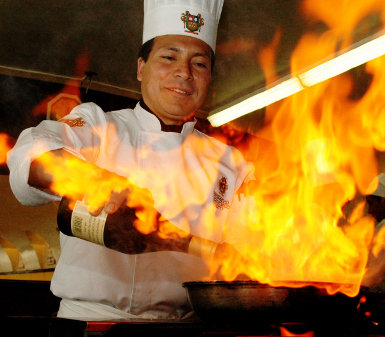 Today I found out alcohol does not “cook out” of food in most cases. The myth that alcohol does all cook out stems from the fact that alcohol has a much lower boiling point temperature (173° F / 78.5° C) than water (212° F / 100° C). Thus, if the temperature is above 78.5° C, then the alcohol should boil off, right?
A group of researchers in 1992 at the U.S. Department of Agriculture, the University of Idaho, and Washington State University decided to find out. In the end, what they discovered was that the “alcohol cooks out” assumption didn’t turn out to be correct for the vast majority of ways most people prepare food with alcohol. In their study, they used a variety of recipes with various sources of alcohol and a variety of preparation types, including simmering, baking, flaming, refrigerating over night, etc. What they found was that the amount of alcohol remaining after cooking was in the range of 4%-85%. The variations weren’t just dependant on how long you kept the temperature above alcohol’s boiling point either. They also found that the other ingredients made a difference in the alcohol retention rate. The size of the cooking vessel also greatly affected the alcohol retention rates. The smaller the vessel, the more alcohol will be retained given some set cooking time, due to the smaller surface area for evaporation.
In terms of preparation methods and times, their results were as follows (all of these assume the temperature is above 173° F, which is the boiling point of alcohol; also, the size of dish and contents of the food mixture affect the results, so this is just a general guideline):
- The highest rates of retention were with alcohol added to boiling liquid and then shortly after removed from heat. In this case, the alcohol retention rate was around 85%.
- The second highest alcohol retention rate came when using the flaming method of cooking, which resulted in around a 75% retention level.
- When using no heat and storing overnight, about 70% of the alcohol was retained.
- When baked for 25 minutes with the mixture not being stirred, the retention rate was 45%.
- When baked/simmered where the mixture is stirred, produced the following results:
- 15 minutes 40%
- 30 minutes 35%
- 1 hour 25%
- 1.5 hours 20%
- 2 hours 10%
- 2.5 hours 5%
Now, you might think from this that if you cooked the thing long enough, eventually the alcohol will all get cooked out. From a practical standpoint, this is more or less true. But if you are ever cooking for or are a recovering alcoholic, you’ll want to know, it’s not really true. There will always be some alcohol remaining as long as there is still any kind of moisture in whatever you are cooking. The reason behind this is that the alcohol binds with water and forms an azeotrope (mixture of two or more compounds where the ratio cannot be changed by simple distillation). So as you boil the azeotrope, the ratio of alcohol in the compound stays the same throughout the boiling process. So you will always retain some alcohol, unless you boil off all the liquid.
Bonus Fact:
- Besides for flavor, alcohol is added to fondue because it lowers the boiling point of the cheese and, thus, helps to prevent curdling.



| Share the Knowledge! |
          |
 |
While this may all be true, you also have to do some maths — for example, a dish that calls for two tablespoons of cooking wine and makes four servings ends up with the equivalent of one sip per person, spread through the entire serving; it’s even less if the wine’s in, say, a marinade which is largely discarded. Even for alcohol-sensitive, recovering alcoholic, or underage diners that’s not going to be a meaningful concentration even if not an ounce cooks off.
As someone who does not want to drink ANY alcohol, I find even a “sip” as unacceptable. ty
@foxxtrot You do realize that ethanol occurs naturally in fruits and vegetables? There’s even an ISO standard to determine the ethanol content in a standardized manner (ISO 2448). So are you going to give up all plant matter in your diet due to some bizarre moral disdain for “ANY alcohol”?
@Jonathan DeBusk Thank you for showing common sense, unlike foxxtrot. I couldn’t have said it better myself.
Firstly, I don’t understand why you say “Some bizarre moral disdain for “ANY alcohol”?” as if you are the judge of what someone chooses to ingest.
Secondly, some people have to abstain from even tiny amounts of alcohol. For people with chronic pancreatitis or certain forms of diabetes, even a sip of of a 13% ABV red wine can be fatal.
Lastly, the amount of ethanol in fresh fruits and vegetables (when I say “fresh” I mean not rotting) is significantly smaller than “the equivalent of a sip of wine”. Not everyone reading this page is you.
Yeah, he didn’t say his objection was “moral.” There are numerous practical reasons a person may totally abstain from alcohol: pregnancy, health issues, prior alcoholism, etc. There are also so many religious groups who choose to abstain from alcohol that it’s not in any way “bizarre.”
As for HunterJE’s “maths,” I think it would be quite obvious that the less wine you use in a recipe the less alcohol you’ll end up with.
Theb don’t risk it by making or rating food cooked with alcohal. Simple as that.
Wow. Great argument. We humans sure can get into defending minutiae passionately. Add just a little liquor and the fur flies! Ok, attack me. Both sides.
I’ve been using antibuse for 7+ years. my wife considers wine to be a condiment. I have had no reactions.
That is true – fermented foods contain some alcohol in it; pickles and Kambucha and Kimchi, green tea and green coffee extra as well. So it almost impossible to avoid alcohol, not even a drop if you do eat these things.
Actually this person is about 90% wrong…i have been apart of 2 experiments dealing with this…and in most pf the tests the alcohol burned out …and the alcohol thats was left i. Some foods was very very little…
@patrick: which experiments? Please cite the papers showing the results. Also, to make a more compelling argument, you should probably explain why the U.S. Department of Agriculture, the University of Idaho, and Washington State University’s study’s results were wrong on this.
Of course, you are asking the commenter to provide more info on the experiments he was involved in than the author of this article provided.
The notion that 35% of the alcohol would remain after 30 minutes of baking is hard to believe. While it may be true in cases of baking something which is full of water, it would not be the same in a cake, where there is less water to retain the alcohol.
According to the article, after 2 hours, there would still be 10% of the alcohol remaining. In the case of Biscotti, which is baked for a total of about 100 minutes, I confidently doubt it would retain 10% of the alcohol.
Contradictary and misleading. How can you say it doesn’t cook out, when clearly it cooks out. You might say it does not completely cook out 100%. But it is cooking out.
Did you read the article? It’s not all or nothing. You have to cook something for many hours to get most of it.
this is actually true. As someone with a liver illness, I’ve been directed not to eat food that has been cooked with alcohol as it does not cook out fully. Even a sip could harm me.
So when adding alcohol to food I add it at the last possible moment and then remove it from the heat. ( You cook your way, I’ll cook mine)
Yes of course it is up to you how you cook. The only difference is now you are aware that you (and those dining with you) will be consuming alcohol.
This post definitely led me to do a bunch of digging, since I cook with beer a lot (mostly for braising or in stews). There’s been some more research since the Augustin studies; one study in particular (Mateus et al 2011, in Food Chemistry) found that 70% of alcohol was cooked out of a fish stew (when alcohol was added with cold ingredients and cooked, covered, for 45min) and 95% was cooked out of a beef stew (when added to boiling ingredients and cooked, covered, for 1hr).
Based on the Augustin and Mateus papers, it seems like most of the alcohol does actually cook out of food (in a lot of common preparations), but that it’s also tricky (impossible?) to cook out 100% of the alcohol without REALLY cooking the hell out of it.
What about like using beer as a marinade, lets say soaking a steak for an 1 hr period, take the meat out and grill it. Not cooking in beer.
Very minimal unless you inject it. The searing would be hot enough to burn out most of it. You can always switch to O’douls if it worries you.
I’ve done a little checking into this too. and I think the part that’s missing is what constitutes ‘alcohol’. In neither of the studies I’ve looked at (the two mentioned above), has the proof of the alcohol being used been clarified.
I find it hard to believe that if I cooked a stew in scotch for 3 hours that the amount of alcohol remaining would be the same as if I’d cooked it in beer or cider.
If I’m right, then it makes all of this less than useful and jut conjecture, when it comes to cooking.
All the best,
Richard
Richard,
All of these quantities are relative to the original amount of alcohol used, not absolute. They are percentages, so the math still works.
As a recovering alcoholic, I’ve written a similar article citing the statistics from the USDA.
How one cooks for their home or establishment is fine, but if you use alcohol in the prep, please list it.
Even simple places like NOODLES use wine and sherry in their preps. Many can be made with out them.
To those of you who think we are being “Silly” over our concern….. would you tell someone with seafood allergies “there is only a little bit in here, go ahead and eat it” or those with peanut allergies “It was only cooked with a little bit”
A little bit is enough to KILL.
Perhaps the alcoholic content may not be much, but the flavor is there, and that can be enough to trigger. I recall checking a menu in an irish place very carefully, and when my meal came the beef had been brazed in Guiness. It scared the heck out of me.
Thank you.
Vanilla extract contains alcohol. Biscotti often has a little Amaretto in it. By the time Bscotti is fully cooked, there would not be enough alcohol in it to be traceable.
As someone earlier mentioned, even fresh friuts can contain trace amounts of alcohol. Do we stop eating fruits?
I have a friend who won’t eat anything with vanilla extract for that very reason. She’s the one with the violent allergic reaction. I like her enough that I won’t test her on it.
One of my daughter’s college roommates kept testing another one’s peanut allergy. I think after the third epipen the one roommate just moved out.
This is gnerally my rule. I usually don’t have food cooked in alcohol if it can be avoided because the taste triggers me. It actually shocked me because I got into recovery more for drugs and just considered alcohol like I considered meth, something I never used habitually but being clean means not using those substances either. The smell of weed smoke does the same thing where the slightest tinge of that second hand smoke triggers my brain to want to get high.
Look who you are trying to have a conversation with-people who take antibuse for 7 years? LOL…. I have read these studies/etc over the years. The ‘book’ says in whatever form at all. Whether it’s cooked out or not, listed as an ingredient on a menu or not, I do my best ‘for myself’ to make myself clear at a restaurant while ordering (I also work at a restaurant so it helps to know how to convey my wishes), and I also have years of experience talking w/ sponsees. If they feel the need to walk a tight rope, they are in my prayers. Enlightening on a particular subject and forcing someone to see things my way are two very different things. I know that 22 years of sobriety has not been too much of a struggle once I finally understood the principles behind the steps.
Jesus Loves you my friend. Congratulations!
“Temperature is about 75 degrees Celsius, which is hotter than is strictly comfortable, but would still be manageable.” That comes out to 167 degrees Fahrenheit–not “strictly comfortable,” indeed. Alcohol boils at 173.
Moderator: please delete my comment;I posted it on the wrong article. :O
They are just saying temperature was above 173 F. I would assume also the rate of evaporation of alcohol would be temperature dependent. May be kind of a faulty chart without temperature listed.
Alcohol only gives flavor to the food just like marinated floors of sour oranges it is not ment to cook food. With the exception of raw fish whrn you leave raw fish over night so that the acidity of yhe lemon cook it
Im surprised that alcohol left out at room temp, say above 85 or so, still retained 75% ..?
Very interesting and useful comments. So thanks for that. On the other hand, what happens if you just boil wine or spirits or simple whatever? No water. No mixture. Meths evaporates at room temperature. I think it does anyway. Vodka I guess might do the same. So what’s the story WITHOUT water, WITHOUT mixture? Wine ALONE? Spirits ALONE? Anyone know? Or know where to go?
Hi. SO this article was written in 2011. Now it is 2016. Modern day science & Technology has advanced. SO, what do you say is the latest update on this issue? Can someone please provide me with links for further research on this? Thank You.
For those professing to be Christians please consider: 1. Christ spit out even a sip while He was on the cross dieing in our place to save us FROM our sins, and He is to be our example. 2. Overcooking food to boil or bake out ALL alcohol also destroys the nutrients our bodies need, therefore it becomes a matter of not eating healthily but to gratify appetite. I choose to follow my Lord’s example. One thing is certain He said, “And, behold I come quickly, and my reward is with me, to give to every man according as his work shall be.”. Revelation 22:12
My opinion is that He would have spat out ANY liquid refreshment as He wasn’t seeking nor did He wish to accept any comfort or relief. It wasn’t because it was alcohol, it was because it would relieve parched lips and pain and thirst.
I would bet He would have spat out water, camel or goat milk, or any other liquid.
He was simply refusing comfort of any sort.
He is the one who turned water to wine, “The Church” uses wine to symbolize His blood, alcohol in moderation has health benefits, some doctors prescribe it for relief of certain kidney ailments.
I feel sometimes we take things far far too literally – so it HAPPENED TO BE WINE, I believe it was not wine, but liquid refreshment.
Some believe gambling to be a sin- because they “cast lots” over His possessions, so we are to believe that God adds that to the list of sins because of that?
Gambling can be a personal curse, and causes many problems, but if it’s a sin, then all of the people who have participated in fund-raising, raffles, silent auctions and so on for churches and charities have sinned big-time.
I find it difficult to believe a loving God would create humans just to watch them suffer, be sad or lethargic, never dance, never do fun things within moderation. And that is the key to life – all things in moderation. Excesses are the trouble.
There is alcohol in so many things – I guess i’m a really naughty person as I totally enjoy apples, apple juice and many other fruits and natural foods.
Marti: Remember Christ’s first miracle? Turning water into wine at a wedding. He drank wine with His followers many times, including the Last Supper.
Tell me, how is it you decide which parts of the Bible you’re going to follow, and which parts you’re going to ignore?? It looks to me like you’re choosing parts that allow you to preach to others and feel superior.
Shame on you. People like you give the rest of us Christians a bad name.
Here’s a quote for you: “Judge not, lest ye be judged.” Matthew 7:1
FOR…..you apparently have a reading comprehension problem.
And Jesus turned the water into wine, and I did not read a single truth in 99% of the comments.
I call bullshit. I have been cooking for decades. I can attest to the use of many spirits to my dishes and can safely say that ALL alcohol boils or sautes off. Don’t believe me? Brown some chicken and deglaze with brandy. Light a match to it, watch the flames. Let flames die. Try to repeat. No flames. No flames = no alcohol.
No flames = higher water to alcohol ratio than would allow ignition of the remaining alcohol, actually
Take a beer. Light a match to it. No flames = no alcohol.
Except this doesn’t work– once the alcohol concentration falls below a level in ratio to water, it won’t burn anymore, but still some of the alcohol is there. Just like my beer has alcohol in it but doesn’t burn.
Personally, I do not have a problem with cooking with wine or beer or both for that matter. However, I can sympathize (not the correct word, but can’t think of the correct one at this moment (Senior moment)) for those with sensitivities. My wife is beef and beef extract sensitive. We bought and consumed some Vegetarian Vegetable Soup a few years ago > > and she reacted to it. The manufacturer fessed up (via e-mail exchanges) that some of the “spices” are in fact beef extracts. So there ya go; not all is as it seems. Those “spices” are low enough in volume or percent or ???? that they are not required to be listed separately.
I was a bad boy several years ago. The state has only recently finally allowed me to drive a car again, albeit with an alcohol interlock device. So, I have to blow into this thing to start the car, and I was warned that any alcohol would cause the car to not be able to start. I still have a bottle of listerine, but I only use it at night. Thus, this was good knowledge to have. God knows having a Moules Meuniere, or something, then not being able to start the car would suck.
The links in the “References” section above go to a website that is no longer active. Could the Daven Hiskey or anyone else please provide the bibliographic information for a published, peer-reviewed journal article supporting the assertion that the specified percentages of alcohol remain in food after cooking? Alternatively, could someone please list a government (.gov) or academic (.edu) webpage that supports the assertion? Thank you.
“Alcohol Retention in Food Preparation” by Augustin et al. Google that and click on the first link– a PDF on the National Agricultural Laboratory’s (at USDA) site.
All I care when I cook my delicious steak with a good red wine is that it will still taste awesome ! … then i’ll drink the leftover…
Why would anyone but an alcoholic give a rats backside how much alcohol is left in a dish if it tastes good?