
The Difference Between “Faze” and “Phase”
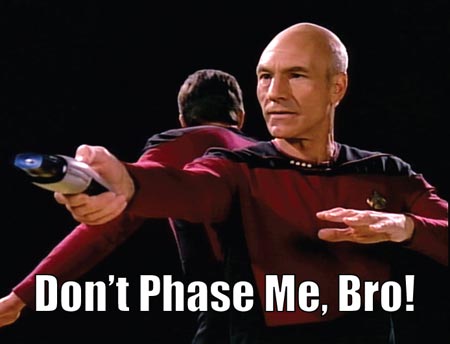 Today I found out the difference between “faze” and “phase”. These two words are often misused, even by professional writers, particularly in regards to the phrase “phased out”, which is more often than not incorrectly written as “fazed out”, due to the two being homophones.
Specifically, “faze” means: “to disturb, disconcert, or daunt; caused to show discomposure”. On the other hand, “phase” refers generally to stages. For instance, the phases of the moon or a phase someone is going through or phases of harmonic motion or the like.
From this, we can see why it should be “phased out” instead of “fazed out”, with “phase” referring to stages and thus “phased out” signally the end of some stage.
So just remember:
- “fazed” more or less = “disturbed”
- “phased” more or less refers to stages.
Bonus Facts:
- The word “phase” comes from “phainein” which means “to show” or “to make appear”.
- “Phase” originally appeared in English around the mid 17th century and was typically used for referring to lunar and other astronomical activities. The first non-astronomical uses of the word appeared in the late 19th century, with those uses typically referring to “difficult periods” in adolescents. “Phase” also got an extended definition around the mid 20th century as referring to synchronizing.
- “Faze” on the other hand comes from a variant of the 15th century Kentish dialect “feeze”, which means “to frighten, alarm, or discomfort”. This “feeze” in turn was from the Old English “fesian” which meant “to drive away”. Interestingly, had the definition of “fesian” carried over to “feeze” and then to “faze”, it wouldn’t actually be wrong to say “fazed out” instead of “phased out”. 🙂
Other Often Misused Homophones:
- Right, Write, Wright, Rite
- Buy, By, Bye
- Cite, Sight, Site
- There, Their, They’re
- To, Too, Two
- Weather, Wether, Whether
- Allowed, Aloud
- Allot, A Lot
- Beat, Beet
- Bridal, Bridle
- Callous, Callus
- Straight, Strait



| Share the Knowledge! |
          |
 |
I thought so. I just wasn’t sure. Glad to hear I’ve been using both phase and faze right! I started to write “none of my pets are phased” and thought it looked wrong. Certain it was wrong, I looked it up and was happy to see I was correct in thinking so. Good article.
Also, just wanted to add that “whether” and “rather” are often confused, too. I confused those two until I was 13 or 14 years old. Took someone correcting me to learn the difference.
I always thought that being in ‘phase’ could also mean being ‘in step’, like a single or 3-phase electrical suppy. If you were ‘phased’, then it meant that you had been knocked ‘out of step’. In other words, that you had been put off your game, or disturbed in some way. Any comments?
Further to my previous comments,the mathematical/electrical meaning of being ‘in phase’ means being ‘in step’. Another word for it is ‘isosynchronous’. It’s like a soldier marching on parade, and being knocked ‘out of step’ in some way. He has therefore been ‘phased’, and has to skip to bring himself back ‘in phase’ with the other marching soldiers. Check out some of the mathematical sites which give their definition on the meaning of the word ‘phase’. If you can understand them, that is!
The word ‘fazed’ is flavour of the month at the moment, and I think is only a phonetic spelling of the other word ‘phased’. Probably created by Americans who tend to spell words phonetically.
“Faze” has been around since the early 1800’s. Hardly a flavor/flavour of the month and certainly not a phonetix spelling of “phase” (Dictionary.com lists the Old English “feeze” as the etymological root of “faze”). As a mathematician I recognize the attraction of using “phase” in place of “faze” but there is a difference between disrupting a pattern and being bothered.
*phonetic (fat finger syndrome)
In “regard to” not “regards to”.
You could write (or say) “as it regards to”, however, you shouldn’t write (or say) “in regards to”
Give your regards to Broadway but give regard to an issue.
People also “often misuse: by, buy, and bye”? Phase/faze I can understand, but “by, buy and bye?” Yeahhhh, no. People are dumber than I thought…
Actually, I don’t think native English speakers are likely to confuse “by”, “buy”, and “bye” – they just misspell one or more of them. In the case of “faze” and “phase”, I think people actually confuse the words, thinking that “phase” might mean “disturb” or “upset” because of connections with the phases of the moon, or with the Star Trek “phaser” weapon. It is sometimes difficult to distinguish errors in word usage from errors in spelling, but I think usage errors are more serious, because they cause the meanings of words to become muddled in the mind of speaker and listener alike.
Easy to spot: use the word like in “i am unfazed” when you say “you was not disturbed”
A sad one that I see way too often online is “past” vs “passed”… I will see people write things like “this passed week”.