
The Dare That Led to the First Hurricane Hunter
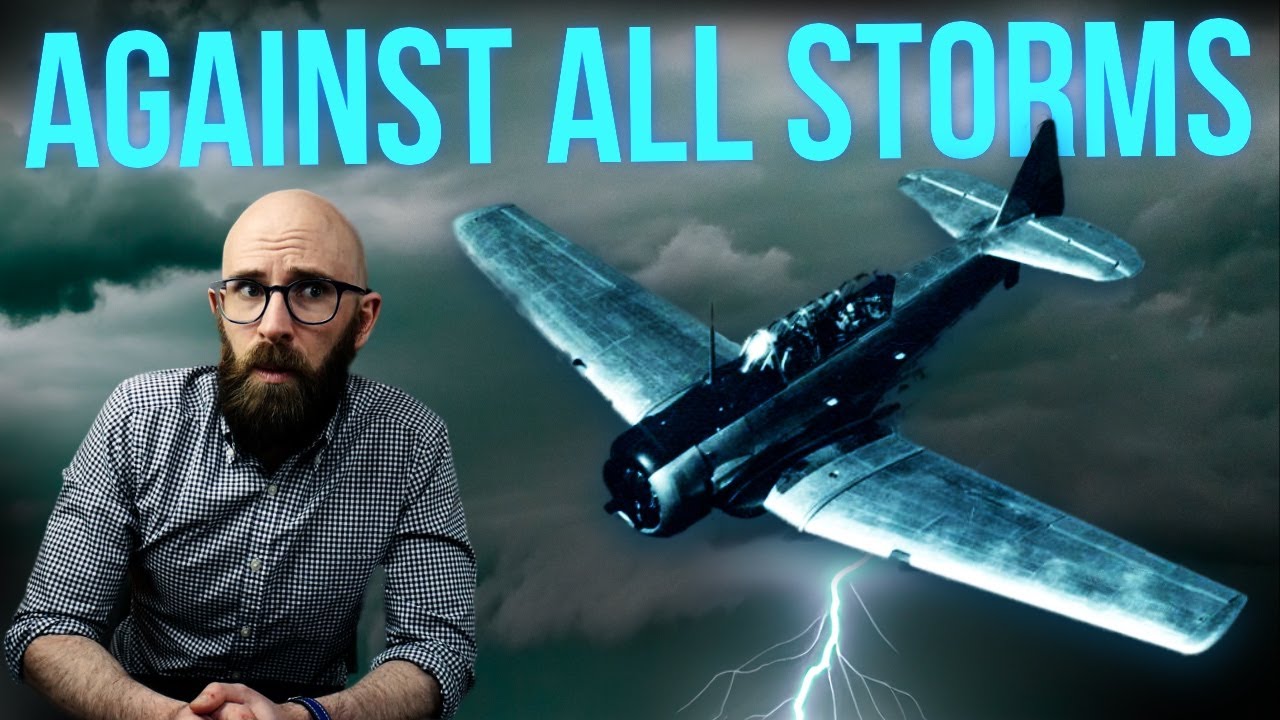 On the morning of July 27, 1943, U.S. Army Air Force Lieutenant Colonel Joseph Duckworth sat down to breakfast at Bryan Field near Galveston, Texas. Outside the wind howled as a category 2 hurricane bore down upon the coast. The storm had come as a complete surprise; as a precaution against U-boat attacks a radio blackout had been ordered for all ships in the Gulf of Mexico, preventing early warnings from reaching the shore. Colonel Duckworth’s breakfast companions were a group of visiting British pilots being trained to fly on instruments, who, upon learning of the approaching hurricane, bet Duckworth that his North American T-6 Texan, the standard American single-engine training aircraft, was too flimsy to fly through the eye of the storm. The wager was laughably small: a single highball cocktail. To their surprise Duckworth accepted, and what happened next would change the history of aviation and meteorology forever.
Born in Savannah, Georgia on September 8, 1902, Joseph B. Duckworth had aviation in his blood. After graduating as a U.S. Army Air Force Cadet in 1928, through the 1930s Duckworth served as an airline pilot for the Ford Motor Company, Curtiss-Wright Flying Service, and Eastern Airlines, accumulating over 12,000 flying hours and becoming intimately familiar with the art and science of instrument flying. Up until the early 1920s, most pilots only flew ‘contact’ – that is, in conditions that allowed them to maintain sight of the ground. But with the introduction of the U.S. Air Mail Service in 1918, the need to maintain delivery schedules spurred the development of Instrument Flight Rules or IFR, used for when pilots fly in zero visibility conditions such as at night or in bad weather.
In 1940, Duckworth was recalled to the Army Air Force as a Major and in 1942 was placed in charge of the instrument flying program at Bryan Field in Texas. What he found there shocked him. While airlines had made massive progress in the science of instrument flying, the Air Force was still languishing in the 1910s. He states,
“The first shock I received was the almost total ignorance of instrument flying throughout the Air Corps. Cadets were being given flight training as if there were no instruments and then directed to fly an aircraft across the Atlantic at night. Losses in combat were less than those sustained from ignorance of instrument flying alone.”
Indeed, while most training aircraft were equipped with the necessary instruments for blind-flying, such as gyrocompasses and artificial horizons, instructors told their pupils that “those were for airline pilots” and bizarrely instructed them to keep them locked to prevent damage to the delicate equipment. Wartime demand for aircrew had also led to training being dangerously truncated from one year in 1940 to six months in 1942, with the number of flying hours required to fly a multi-engined bomber in combat dropping from 1000 to only 3. So disgusted was Duckworth by this state of affairs that he later stated he wanted to:
“…cut [the Cadets’] prized silver wings in half and tell [them] that the other half would be given them if they survived six months.”
Duckworth’s first order of business was to evaluate the instructors, most of whom he found to be grossly under-qualified. He thus established the first Air Force Standardization Board to train and evaluate flight instructors. He also developed a completely new training program and manual to instruct pilots in instrument flying. And it worked: between May and October of 1942 the number of students at Bryan Field nearly doubled, but the accident rate fell by more than half. Thanks to this success, in November, Duckworth’s system was implemented across the entire Southeast Training Command, and his manuals would be used by the Air Force for decades to come. For this reason, Joe Duckworth is widely regarded in the Air Force as the father of instrument flying. Thus, when those British pilots made their bet with him about flying in a hurricane on that July morning in 1943, there were few men more qualified to take them up on it. But why would he want to?
Aerial weather tracking was nothing new in 1943. In August of 1935 a United States Weather Bureau station in Jacksonville, Florida detected a hurricane developing east of the Bahamas, which they determined would make landfall on the north coast of Cuba. But when the storm failed to arrive, on September 2, Captain Leonard K. Povey of the Cuban Army Air Corps took off in his Curtiss Hawk II biplane and soon spotted the hurricane heading north towards the Florida Keys. The Labour Day Hurricane of 1935 proved so destructive that Povey would recommend the establishment of a regular aerial hurricane patrol to avoid future tragedies. But until Duckworth’s flight in 1943, nobody had actually flown into a hurricane.
Knowing that official approval to do so would take hours to obtain – if at all – Duckworth headed straight to the airfield and enlisted the services of the only navigator on duty that morning, Lieutenant Ralph O’Hair. Such was O’Hair’s faith in Duckworth as a pilot that within minutes the pair were off the ground and flying south towards the Gulf of Mexico. As they passed over Galveston, air traffic control asked if they were aware a hurricane was approaching. When Duckworth nonchalantly answered “yes”, the tower simply asked where to send the search party if their aircraft disappeared. Minutes later, Duckworth and O’Hair plunged headlong into the storm.
O’Hair later described the flight as like “Being tossed about like a stick in a dog’s mouth.” But despite the British pilots’ dire predictions, the T-6 made it through in one piece and soon emerged into the calm eye of the hurricane. Duckworth lingered long enough to take some notes on the shape of the eyewall before turning around and plunging back into the howling 130mph winds. When he and O’Hair landed back and Bryan Field, waiting on the tarmac was weather officer Lieutenant William Jones-Burdick, who asked to be flown into the hurricane so he could take some measurements. And so it was that Duckworth took off once again and performed the historic feat a second time in one day.
Duckworth would later downplay the heroism of his accomplishment, explaining that airline pilots at the time regularly flew in high altitude Jet Stream winds of up to 150mph. But he would admit, with typical understatement that surely his British compatriots probably appreciated, that:
“The only embarrassing episode would have been engine failure, which, with the strong ground winds, would probably have prevented a landing, and certainly would have made descent via parachute highly inconvenient.”
While his superiors were alarmed by his unauthorized flight, there is no record of Duckworth being reprimanded for it. Nor is there any record of him receiving his promised cocktail, though his breakfast companions’ next meal undoubtedly contained some variety of crow.
At the end of the war, Joe Duckworth was promoted to Colonel and served as commander of Hickham Field in Hawaii, retiring from the Air Force in 1955. Over the next 9 years he taught physics at Albion College in Michigan, served as head of the Safety Bureau for the Civil Aeronautics Board, and became a consultant for the Aircraft Owners’ and Pilots Association before passing away at Battle Creek Community Hospital on July 26, 1964 – almost 19 years to the day from his historic flight
But the legacy of that flight lives on. The hurricane of July 27, 1943 killed 19 people and caused over $17 million in damage (or about $300 million today), prompting local authorities to abandon radio blackouts and the Air Force to establish the first dedicated aerial weather unit, the 3rd Weather Reconnaissance Squadron or the Hurricane Hunters. Flying B-25 Mitchell medium bombers from Presque Isle, Maine and Gander, Newfoundland, the 3rd WRS was tasked with locating and tracking storms along the entire eastern seaboard, especially around the strategically vital Atlantic shipping lanes. The unit later received more sophisticated RB-29 Superfortress aircraft, with which it achieved the first medium-level penetration of Hurricane Love on October 19, 1947.
Deactivated later that year, the unit was reborn in 1951 as the 53rd Weather Reconnaissance Squadron, which still operates to this day. Based at Keesler Air Force Base in Biloxi, Mississippi, the 53rd operates a flight of 10 WC-130J Super Hercules transports, specially modified with a suite of sophisticated meteorological instruments. While nominally an Air Force Unit, the 53rd ultimately receives its orders from the U.S. Department of Commerce, forming part of a national strategy to minimize loss of life and property due to extreme weather events. As part of the National Hurricane Operations Plan, the 53rd maintains the ability to intercept up to 3 storms per day with a response time of 16 hours, its area of operations stretching from the Mid-Atlantic to the International Date Line in the Pacific. Crews can fly a variety of mission profiles, from simple low-level investigations to locate developing hurricanes to dropping weather buoys ahead of storms to missions where the aircraft remains in the eye of the hurricane for as long as possible, allowing the storm to be tracked with pinpoint accuracy. While satellite imagery has made tracking hurricanes much easier in recent years, certain data like barometric pressure or interior windspeed can only be measured directly using aircraft, meaning that units like the 53rd will continue to play a vital role in the United States’ hurricane management efforts for the foreseeable future.
Similar to, but distinct from the 53rd are the Hurricane Hunters of the National Oceanic and Atmospheric Administration or NOAA based at Lakeland Linder International Airport in Florida. While the 53rd is primarily tasked with tracking and measuring storms as an emergency response, the NOAA Hurricane Hunters primarily conduct long-term scientific research. However, the Air Force maintains the post of Chief, Aerial Reconnaissance Coordination, All Hurricanes, or CARCAH, whose primary job we can only assume is trying to explain that title when not coordinating the activities of the two units in an emergency if required.
In line with its pioneering mission, over the years the 53rd has achieved a number of notable firsts. In 1973, Sergeant Vickiann Esposito, a weather buoy operator, became the first woman in Air Force history to qualify as aircrew, while in 1977 1st Lieutenant Florence Fowler became the first woman to be rated as a navigator.
As for the danger of flying into the world’s most powerful storms, like Colonel Duckworth 80 years before, the men and women of the 53rd see it as just another part of the job. As Majors Kendall Dunn and Tobi Baker explain:
“We fly into weather when all other aircraft have to stay at least 20 miles out to avoid it. Flying into storms, this is our type of combat.”
“This opportunity is unique, because you can say you’re one in 20 in the world that does your job. You get to experience something that mother nature produces, that not many others get to see with their naked eye. There’s nothing like breaking through the eye-wall and have an open sky above you and being encompassed by a bowl of clouds around you that has so much destructive power.”
And to think it all started with a simple wager over breakfast.
Expand for References
Colonel Joseph Duckworth, Morning Star, November 28, 1993, http://www.albionmich.com/history/histor_notebook/931128.shtml
Glines, Carroll, Duckworth’s Legacy, Air Force Magazine, May 1, 1990, https://www.airforcemag.com/article/0590duckworth/
Hard, Rufus, Ask Rufus: The Legacy of Joe Duck, The Dispatch, August 22, 2020, https://www.cdispatch.com/opinions/article.asp?aid=83068
Atkins, Randy, Col. Joe Duckworth Makes History – July 27, 1943, Star Tribune, July 27, 2009, https://www.startribune.com/col-joe-duckworth-makes-history-july-27-1943/51781242/?refresh=true
Gregg, Tim, Rellis Recollections: Bryan Field Officer Flew Into a Tropical Storm on a Bet, The Eagle, April 29, 2018, https://theeagle.com/brazos_life/rellis-recollections-bryan-field-officer-flew-into-a-tropical-storm-on-a-bet/article_5300c471-698f-5df7-866b-71dc4c92ea88.html
75th Anniversary of First Flight into the Eye of a Hurricane, NOAA, July 27, 2018, https://www.weathernationtv.com/news/75th-anniversary-first-flight-eye-hurricane/
Escher, Kat, Why does NOAA Still Send Pilots Into Hurricanes? Smithsonian Magazine, July 27, 2017, https://www.smithsonianmag.com/smart-news/why-does-noaa-still-send-pilots-hurricanes-180964135/?utm_source=facebook.com&utm_medium=socialmedia&fbclid=IwAR3QMoZcnkmj2HRbgPu1H_cFOy-QMPYVfHJaP_e8Bk4RF3TbLfu0vKO3ThY
The Mission of the Hurricane Hunters, Hurricane Hunters Association, https://www.hurricanehunters.com/mission.html
Carranza, Sgt. Christopher, Meet the Air Force Reserve ‘Hurricane Hunters’ Chasing Storms, USO, Aug 26, 2020, https://www.uso.org/stories/2458-meet-the-air-force-reserve-hurricane-hunters-chasing-storms-like-hurricane-dorian
Calitz, Garth, “Hurricane Hunters” The 53rd Weather Reconnaissance Squadron, Flightline Weekly, May 26, 2020, https://www.flightlineweekly.com/post/hurricane-hunters-the-53rd-weather-reconnaissance-squadron


| Share the Knowledge! |
          |
 |