
Who Invented Fast Food Chains?
 Ah, fast-food- greasy cow muscle mush topped with melted coagulated milk, diced bodies of allium cepa, and the blood of tomatoes, all wedged between the ground up yeast enhanced carcases of wheat plantlife and served with a side of the fried corpses of tubers. Or for the king of them all- the delectable breasts of the noble Gallus domesticus, battered and fried with 11 herbs and spices and dipped in your favorite artery clogging congealed liquid. In all, humanity asserting dominance over all life forms on Earth as we convert the relics of their hopes and dreams and evolutionary paths to our feces- because we can.
And there is nothing they can do about it…
But while today when we think of fast-food we tend to think of the likes of McDonald’s, KFC, or whatever the hell the crazy bastards at Taco Bell are coming up with this week- mixing and matching their same set of ingredients in new and exciting ways that make us all just say- shut up and get in my food hole-…. it turns out humans have been creating fast food joints for almost as long as we’ve had food holes.
So who actually invented the Fast Food Restaurant as we know it today, and how did the concept evolve through today from its earliest days when three cavemen Ugh, Rog, and Gary started selling mammoth on a stick at their oxen back establishment, until one day Gary showed Rog’s mate his giant club, after which he ooga’d her booga and the whole venture fell apart, not just putting an end to URG’s, but also setting humanity back at least a thousand years on inventing the greatest thing we’ve ever come up with- KFC…
Fucking Gary man. Ruins everything.
…Well, put on a bib, unbutton your trousers, and let’s dive into the fascinating history of Fast Food restaurants, and the forgotten establishment that helped birth the modern chains we have today.
To begin with, before we embark on our quest to trace the origins of fast food, we need to define exactly what we mean by this term. The simplest definition we can rely upon comes from the Cambridge Academic Content Dictionary: ‘Cheap, often hot food that is prepared and served quickly in a restaurant.’
From this perspective, quick meals served at a restaurant are certainly not a modern phenomenon. Since the dawn of civilization, people have been busy, and/or living in less than ideal accommodation, and generally lacking time. Thus, facilities designed to serve a hot meal quickly have been staples for seemingly as long as humans have been humaning.
One of the very first such establishments – at least the oldest we know of – may have been located in the Mesopotamian settlement of Godin Tepe, currently an archaeological site in the mountains of western Iran. The location was studied throughout the 1960s and 1970s by the team of T. Cuyler Young Jr, from Royal Ontario Museum, Toronto. Among the ruins, the archaeologists were intrigued by a mud-brick structure, dating back to 3200 BC, made of several small buildings surrounding a central courtyard. One of them had two large windows, and inside researchers found bowls, food remains and almost 1,800 clay bullets – used as sling ammunition for hunting or warfare.
Cuyler Young first posited that these large windows acted as a storefront of sorts for an eatery at Godin Tepe. Patrons filing outside the building could grab some quick food to go before getting back to their Mesopotamian business. According to archaeologist Hilary Gopnik, the menu offered by this ancient take out restaurant may have included goat or sheep roast, lentils, beer and wine. While those bowls found inside the building probably stored rations of grain.
But what of those sling bullets? According to researcher Virginia Badler, University of Toronto, their presence suggests that the main patrons of the joint might have been soldiers, patrolling the trade routes in the area.
Of course, it may be that the building with the two windows was not actually a restaurant, but rather the equivalent of an army supply centre. Or something else altogether, as the lack of documental evidence does not allow to formulate a definite verdict.
For something much more definitive, we need not look further than the Roman Empire. Because, of course… it’s always the Romans … Mainly because they were good at writing stuff down and conquering the world so we know a lot about them.
In any event, archaeological evidence at Pompeii, Herculaneum and Ostia has revealed how cities in the Roman Empire were replete with eateries, called popinae, or thermopolia, where ordinary citizens could grab a quick, hot bite on the go, or a cup of mulled wine. These restaurants specialised in simple fare such as sausages, offal, whitebait, pulses, baked cheese, boiled or roast meat, and hot tarts. The specialties were arranged in earthenware jars, themselves embedded into long counters, or bars. These counters were usually street-facing, so that the aroma of freshly cooked food would entice patrons to order their meal.
Some of the more sophisticated venues, such as the thermopolium in the Regio V area of Pompeii, were adorned with colourful frescoes, to further grab the attention of passers-by. Which was essential, considering the amount of competition given that a single, short street in Pompeii could have as many as a dozen popinae.
The Regio V business, owned by one Nicias [Nicky As] was adorned with artwork depicting both ingredients and scenes from mythology. Which may sound like an odd combination … But if you think about it, the marketing material of modern fast food chains also combines food imagery with celebrity endorsements, or tie-ins with popular culture franchises – arguably the mythology of our time!
And just like modern restaurants, Pompeian eateries were not immune from scathing customer reviews: a graffiti scrawled on the Regio V popina accused Nicias of being a ‘Shameless Sh*tter’
Poor old Nicias may have not deserved the insult, considering his frescoed thermopolium looked fancier than the average. Most thermopolia, in fact, had no seating facilities, and most patrons took home their orders. While nowadays a take away dinner may be something of a treat for a lazy night, for most citizens of the Empire it was a necessity. While the wealthy elites dined in their fancy homes, catered by their slaves, your average Caius lived in a cramped tenement apartment, with no facilities to preserve, store, let alone cook enough food for the family!
For this reason, Roman writers associated popinae and thermopolia with the lower levels of society, depicting them as the haunts of the most disreputable sorts.
Those crazy poor people and their desire to eat. Just sickening.
For example, poet Horace, in the first century BC, dismissed them as ‘greasy’ establishments, frequented by shady types who indulged in gambling and drinking, as well as frequenting sex workers, which I think we can all agree should be brought back as a staple of fast-food establishments….
Some decades later, his colleague Juvenal provided a more precise picture of the typical clientele, which consisted of murderers, thieves, executioners, coffin-makers, and fugitive slaves.
If we jump to the other side of the Atlantic, the earliest possible description of fast food on American soil comes from Bernardino de Sahagún. This Spanish missionary and ethnographer moved to Mexico in 1529, and compiled a 12-volume work on the history and civilisation of the Aztecs. Such an extensive account could not leave out a mention of Aztec cuisine, and in particular a vivid description of local culinary stalls and their specialties: tamales and tortillas, cooked at a fast rate and in large quantities, to be consumed on the go.
Some of the tamale variants offered by the Aztec cooks sound truly mouthwatering, as the corn dough packets were filled with turkey, fish, rabbit, eggs, beans, or squash, and then seasoned with a sauce made of tomatoes, chillies and squash seeds.
Other options may appeal only to the most adventurous taste buds, such as the prickly pear, frog, gopher and axolotl tamales.
Sahagún’s account does not mention numbers, but he gives a vivid impression of the incredible quantity of food stalls, of which many were not really up to scratch:
‘The bad food seller [is] he who sells filthy tamales, discoloured tamales–broken, tasteless, quite tasteless, inedible, frightening, deceiving; tamales made of chaff, swollen tamales, spoiled tamales, foul tamales–sticky, gummy; old tamales, cold tamales– dirty and sour, very sour, exceedingly sour, stinking.’
The quality of 16th Century Mesoamerican fast food clearly fluctuated wildly from one stall to the other. Each vendor had their own recipe, their own fillings, and some of them clearly did not know what they were doing. In other words: it lacked standardisation.
Which takes us to a more modern definition of fast food. It is not only about preparing, serving and consuming food quickly. In the words of Professor Angelika Eppe, University of Bielefeld [Bielefeld = Bee Lay Feld], Germany:
‘The term “modern fast food” also promises a potential replication of ingredients, appearance, quantity, consistency, amount and, most importantly, of taste and touch. In this specific sense, “fast food” is synonymous with completely standardised foods and drinks.’
And that’s the key concept: standardisation. A standardisation of the eating experience that can be obtained only by formalising all aspects of food preparation and consumption: from a rigidly controlled supply chain, to cooking methods akin to a factory assembly line. Those formalised practices can then be replicated across a number of premises, featuring the same menus and décors.
The concept of a chain, or franchise, is inextricably linked to the history of American fast food. And an oft’ forgotten landmark date in that history is March 21, 1921: the opening of the first White Castle restaurant. This venue is sometimes referred to as the first fast food restaurant, and White Castle as the first, all-American, fast food chain. However, while White Castle was essential in the evolution of the fast food industry – and we’ll return to it – it was not the OG modern fast food franchise.
That honour belongs to another restaurant, whose origins are 100% European, though it was for a time very popular in the United States: the Automat!
But let’s proceed in order. According to Prof Eppe, in her incredibly succinctly titled paper ‘The “Automat”. A History of Technological Transfer and the Process of Global Standardization in Modern Fast Food around 1900’, the need for fast food emerged in industrialised metropolises worldwide at the end of the 19th Century.
As the urban labour market exploded, a new social group emerged: labourers and clerks who had to endure long commutes, long work hours, and had little time to eat. Combined with industrialization and improvements in supply chains, such as better preservation methods making it easier to pack, ship and store huge quantities of food, the modern fast-food restaurant was an idea whose time had almost come. But this was not enough: innovation behind the scenes had to be met by innovative front-of-house practices …
Since the mid-1840s, technological advancement in the retail sector began to see automatic, coin-operated vending machines emerge. Early models were developed by perfume makers in the US, Britain, and France, with Parisian Philippe Leoni being at the forefront of automated fragrance sales.
In the 1870s, British engineer Parceval Everitt expanded the concept of vending machines to confectionery, and his sweet-supplying contraptions became all the rage! German chocolate maker Ludwig Stollwerck took notice during a business trip to England, and convinced his business partner brothers to invest in vending machines to sell their products. The Stollwercks thus partnered with inventor Max Sielaff [See Laugh] to develop a new range of automated dispensers for their bonbons.
The idea was for the machines to distribute chocolate samples as a marketing stunt. But the German public loved them so much that within a few years most of Stollwerck’s candy was sold through the ‘mute vendors’, as they were known back then.
What does this have to do with fast-food restaurants?
In 1895, Stollwerck and Stielaff founded a new company, devoted exclusively to automated sales of food items. This was the German Automat Company, or DAG. [Deutsche Automaten Gesellschaft]
In the same year, Sielaff had a momentous meeting with Philippe Leoni, the Parisian perfume maker. Following the success of his perfume vending machines, Leoni had diversified his business into beverages, creating the ‘Bar Automatique’, in which patrons could buy soft drinks, milk, even alcohol, from coin-operated tellers. The venue was advertised as such:
‘Visitors enter our Bar just as they would a shopping arcade, but without being observed or approached by anyone.’
In other words, the key selling point of the ‘Automatique’ was that patrons could avoid scrutiny, and, in general, human contact. A notion I think we can all get behind. There are literally people out there when you step out of your door…. Some of them even try to interact with you. Gross.
Inspired by Leoni’s success, Sielaff pitched an idea to the Stollwerck brothers: why limit ourselves to chocolates, or drinks? How about creating an entire array of vending machines, where patrons could get a full, hot meal for a few coins? The business partners agreed, and by 1896 Sielaff was able to present his ‘automatic buffet’ at the Berlin trade exhibition.
It was a huge success, prompting the DAG directors to create a new company, Automat Gmbh, and to set up the first ever entirely automated restaurant: the Automat!
The naming department did not get a bonus for creativity that year, but I guess it did what it said on the tin …
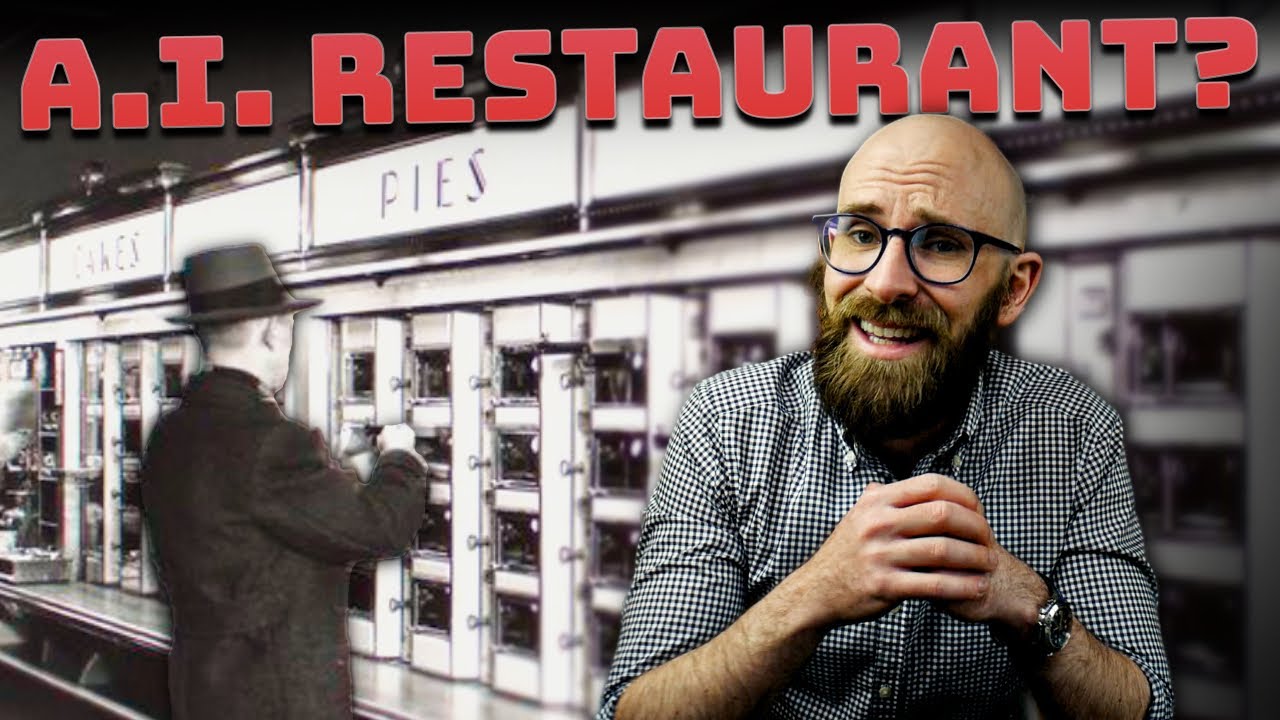
The first Automat opened in Berlin’s Friedrichstrasse [Freed rick strass-ay] and presented itself as a series of vending machines, side by side, fronted by a continuous counter. Initially, machines dispensed only cold sandwiches, but very soon the restaurant started offering hot dishes, too. Each dish was placed behind a window, which would open after inserting a coin.
The interior was rather striking, all marble and mirrors. Not only was this décor rather luxurious, but it was also easy to clean, which appeared to be Sielaff’s main concern. Urban residents at the time were starting to take stock of the health risks associated with poor food preparation, and thus appreciated restaurants which projected an image of cleanliness.
Sielaff and the Stollwercks initially marketed their Automat as the ideal restaurant for single, self-reliant, business-like men, who wanted to grab some decent grub without the torture of interacting with human beings. But Berliners did not appreciate this pitch, and the restaurant took off only when it started targeting tourists and middle class couples on shopping expeditions, still a staple of fast-food customers.
Their ads featured key words such as
‘Up-to-date!’
‘Casual’
‘Quick and good’
And
‘No tipping!’
Which is all strikingly similar to my college girlfriend’s tinder profile description…
In any event, the success was immediate, and the Automat Gmbh team opened several new locations in Berlin.
But their core business model was not to create a restaurant franchise, let alone directly manage their chain. Sielaff and the Super Chocolate Bros were more interested in manufacturing the vending machines, which would then be sold as fully integrated, automated restaurants. Their clients would then install them into their own premises throughout Germany, and use them as they saw fit.
In other words: dozens of restaurants used the Automat Gmbh vending machines, but only a limited number of Berliner venues were operated directly by the company. Therefore, the Automat restaurants were far from being a truly national chain, but it seems that at least the Berliner locations applied a certain degree of standardisation.
At the start of the new century, Automat Gmbh expanded its business by selling automated restaurants to clients in Belgium, Britain, Denmark, France, Sweden, Switzerland and South Africa.
But the region where their vending machines were most badly needed was the American East Coast. Its fast growing cities were home to an ever expanding army of clerks and employees, in need of a quick lunch or snack. This demand was initially met by the mushrooming cafeterias, also known as ‘quick lunch rooms’.
According to food historian Harvey Levenstein, the first such cafeteria was a Swedish-run establishment, set up in Chicago in the 1880s. The owners first positioned their venue as a ‘smorgasbord’, or sandwich buffet, which also served hot coffee. But as they were looking for a fancier sounding name, they combined the Spanish word for coffee, ‘café’, with the suffix ‘-teria’.
Business partners Joseph Horn and John Hardart, of Horn & Hardart Baking Co., operated a successful cafeteria in Philadelphia, but were looking for ways to increase efficiency and meet growing demand. During a business trip to Berlin, Horn was deeply impressed by the Automat, and thus contacted Sielaff and the Stollwercks to order a fully equipped restaurant.
The price tag came at 37,000 marks, which, according to Bundesbank estimates, equate to $309,125 in 2024 money. Unfortunately, the first ever automatic restaurant to sail for the US, was lost in a shipwreck off the Irish coast! Luckily for Horn & Hardart, Sielaff was a true customer service legend: not only he immediately dispatched a second set of vending machines, but he travelled to Philadelphia, to directly oversee their installation free of charge!
The first Automat on US soil thus opened on June 9, 1902, and it was advertised as a
‘New Idea Lunch Room’
The launch campaign claimed that, as a patron
‘You absolutely help yourself, no waiting or delay, you see what you want and get it immediately.’
By the end of 1902, another automatic restaurant had opened in New York. This was not owned by Horn & Hardart, though, but by one August Weil, another client of the Automat company in Germany. Weil’s Automat attracted some good business on Broadway, which may have prompted the two entrepreneurs from ‘Philly’ to expand to the Big Apple.
Very soon, the Horn & Hardart coin-op cafeterias dominated the New York market, especially in Manhattan. While their machines were still provided by the Automat Gmbh, the premises and furnishings took on a distinctive American feel: with their Art Nouveau touches, they were still luxurious compared to modern fast food chains, but were definitely simpler and more practical. The lunch rooms were larger than their German counterparts, and the table layout encouraged strangers to sit together and engage in *dry heaving* casual chit chat.
By 1910, the ‘H&H’ automated eateries were so popular that they were celebrated as an all-American invention, steeped in the country’s tradition of democracy and stealing other nation’s ideas and calling it their own. A Washington Post article from March 29 claimed that
‘The automat was born in New York … It was exported to Germany, and there it has flourished like a green bay tree. It appears that the Germans have an idea that Americans never eat except the food and drink be served by a slot machine … The crowning glory of the quick lunch room as an American institution is its democracy. The Wall Street banker and the Wall Street newsboy regularly eat . . . at the same place. With all its faults, the quick lunch room is an American institution of which we ought not to be ashamed.’
The Automat experience may have broken down class barriers amongst patrons, but according to Prof Epple:
‘This kind of democracy did not include everybody. On the contrary, the economic success of the Automat in New York and Philadelphia relied on the exclusion of black people and immigrants, who could be perfectly “trapped behind the Automat”. It was their miserably paid labour that made food in the Automat so cheap’
Early marketing material and imagery also suggests that Automats were staffed by African American cooks and cleaners, who received low wages and worked long hours.
We can glean some hints of Automat working conditions from a September 15, 1917 article, published by Philadelphia’s Evening Public Ledger:
‘In order to give their men better working conditions, several of the all-night restaurants operated … by the Horn and Hardart Baking Company will be closed during the early hours of the morning. After six months of exhaustive study of working conditions, the officials of the company have decided to put their men on an eight-hour shift instead of the old twelve-hour schedule. No reduction in wages will accompany the shortening of the working day’
Which sounds great: shorter hours, same pay! Although the article specified that the new labour regulations applied to five out of six restaurants in Philadelphia, but there was no mention of the New York venues.
In the Big Apple, Horn and Hardart proved to be far ahead of their time in another department: electric vehicles. An advert published by the New York Edison Company in May 1918 boasts how the restaurateurs had bought nine electric trucks from them! Of course, before Henry Ford ruined everything by making automobiles affordable to the plebians of the world, helping them feel like they deserved nice things in life, electric cars and their wealthy owners were king of the road, as it should be…
OK, but how did a New York Automat work exactly? As a patron, you would walk in, and take a look at the dishes displayed behind the vending machines’ windows. You would then insert the right amount of nickels into a slot and turn a knob to open the window. Food was served hot or cold, on rather refined dishware and crockery. Once you had removed your dish of choice, kitchen workers would replace it with a new serving. Service was thus immediate, and patrons did not have to endure lengthy queues or eye contact with another human.
Behind the scenes, kitchen staff operated by following highly standardised practices. According to author Nicolas Bromell, in his paper The Automat: Preparing the Way for Fast Food, recipes and instructions were rigorously compiled into extremely detailed training manuals:
‘The corporation imposed regulations on how big the square of bacon on top of the beans should be (one-by-one inch), exactly how long to cook it, how much to serve, when to turn over the slice of bacon. Automat manuals told managers not only how to prepare food, but also how to position it on a plate’
Preparations were frequently sampled by ruthless ‘central commissaries’ employed by Horn & Hardart, who had no qualms in harshly suppressing any deviation from corporate dogma. According to one kitchen employee: ‘We sent back 500, a thousand, gallons of soup because an ingredient was missing. Not because it was bad—an ingredient was missing!’
The aim was to reassure loyal customers that all dishes tasted exactly the same, all the time, across the entire restaurant chain.
So, to recap, the Horn & Hardart Automats were a restaurant chain, offering food for fast consumption, prepared according to rigid standards. These elements would make them the first, modern fast food chain in America, but the company would fail to replicate their incredible success beyond the confines of New York. Quoting from Bromell again:
‘The changes Horn & Hardart initiated may have eventually spread nation-wide, but the cafeterias relied on the transportation system and demographics of New York City to keep this new format profitable’
In essence, in order for their business model to work, Horn & Hardart heavily relied on Manhattan’s high density of office buildings and subway stations, which ensured a constant footfall of hungry patrons.
It would take another restaurant chain to solve these problems and truly introduce the world to the idea of a widely geographically spread restaurant with consistent food and service regardless of where you are- see our surprisingly fascinating video- From 0 to 1000 to 0- What Ever Happened to Howard Johnson’s?
But going back to Horn & Hardart, nonetheless, the company enjoyed an enormous volume of revenue and kept growing. By 1952, Horn & Hardart operated 171 restaurants across Philadelphia and New York. Not all of them were Automats, but this figure made them at the time one of the largest restaurant chains in the world.
By the end of the decade, however, the chain was haemorrhaging customers: the culprit was not competitors, but a shift in American lifestyle. Tens of thousands of urban residents started moving to suburbs, and soon also corporate headquarters moved away from Manhattan, the Automats’ chief hunting ground.
In the 1960s, Horn & Hardart tried to differentiate their business by opening traditional suburban restaurants, selling frozen meals, and even marketing their own brand of coffee – which can still be bought today.
The original Automat chain is now largely forgotten, and definitely not immediately associated with the concept of ‘modern fast food chain’. Other names might spring to mind: economic giants such as McDonald’s or Burger King, whose rise to culinary stardom was propelled by a food item as American as the bald eagle: the hamburger.
But neither of those chains can boast the claim of having been the original hamburger staple fast food restaurant.
That honour arguably belongs to White Castle, which can also be credited with introducing many innovations which are now part and parcel with modern fast food restaurants. But before we get to them, it is worth exploring the origins of the ‘king of sandwiches’- the humble hamburger…
We can trace its first steps back to Germany, again, where local cooks had been preparing a tasty, flattened meatball of ground beef since the 17th century, known as frikadelle. German sailors, many of whom travelled out of Hamburg, popularised the frikadelle in the port of New York City sometime in the 19th Century, where it was presumably re-christened as ‘Hamburg steak’.
The first mention of a ‘hamburg steak’, recorded by the Library of Congress’s collection of historic newspapers, comes from an 1872 article in the Evening star. The unnamed journalist sings the praises of Thorpe’s, a restaurant located 14 miles outside of San Francisco:
‘As for the Hamburg steak, that is a long way beyond my powers of description … the memories of its juicy tenderness and delicious flavour will long live to tickle the palate and awaken pleasant associations’
Of note: the author does not bother to describe what a ‘hamburg steak’ is, implying that, as of 1872, the readers were already well acquainted with the dish. Another interesting point: the paper was published in Washington D.C., but it was about a restaurant in California, implying that the hamburger was already an established staple from coast to coast!
The first recorded mention of a ‘Hamburger sandwich’ instead, can be traced back to an 1889 article by the Walla Walla Union, in Washington State. This implies that between 1872 and 1889 an unknown cook, probably the owner of a lunch wagon, market stall, or county fair booth, had the brilliant idea of stuffing two slices of bread with America’s favourite meatball.
This dating lends credence to the claims of two possible contenders to the title of Father of the Hamburger.
The first candidate is Charlie Nagreen, from Seymour, Wisconsin, now home of the Hamburger Hall of Fame. According to locals, the 15-year-old Charlie sold his first hamburger in 1885, whilst manning a Hamburg steak stand at the Outagamie County Fair. He realised attendees had trouble eating the meatballs while walking around the Fair’s exhibits, and thus Charlie had the simple and brilliant idea of smashing the Hamburg steaks between two slices of bread.
But the good people of Akron, Ohio, might beg to disagree. The local Akron Beacon Journal, writing in 1951, attributed the honour of the invention to Frank and Charles Menchen. While at a County Fair in 1885, the two brothers ran out of their lead ingredient, ground sausage, and replaced it with ground beef instead. The new sandwich was an instant hit, and the brothers named it after the town hosting the Fair: Hamburg, New York!
Other origin stories place the laurels of triumph upon the heads of German cook Otto Krause, Danish immigrant Louis Lassen, or Texan Fletcher “Uncle Fletch” Davis. But these stories claim the first ‘burgers were grilled in 1891, 1900 and 1904, respectively.
Whoever truly first invented it, some 30 years after its descent from culinary heavens, the hamburger crossed paths with restaurateur Walter Anderson, of Wichita, Kansas. In early 1916, he perfected a method of preparing tasty hamburgers, by smashing the beef patty with a spatula, seasoning it with shredded onions, and then placing both halves of a bun onto the meat, to pick up its flavour.
On October 16, 1916, Anderson bought a street car, fitted it with a counter and three stools, and started selling his tasty, squared, perfectly grilled hamburgers. They were nicknamed ‘sliders’ and sold at the price of 5 cents, or 80 cents in today’s value. Patrons were encouraged to take home several sliders at the time, with the slogan
‘Buy ‘Em By the Sack!’
Anderson’s business was doing great. By 1920 he was able to open two more stands, and picked up a business partner along the way: Edgar Waldo “Billy” Ingram, a realtor and insurance salesman. Billy chose the name of their new company, a brand which stood for purity and strength: White Castle. And on March 21, 1921, Walter and Billy opened the first fixed White Castle location, in Wichita.
Already from the get-go, Anderson and Ingram devised what would become the next leap forward in the evolutionary development of American fast food. The Horn & Hardart Automats had introduced the concept of standardised menus across a number of similar, immediately recognised locations. Their kitchens, however, still operated according to traditional practices and cooking methods.
It was White Castle which helped pioneer that defining feature of fast food chains: a carefully designed and systematised cooking process, akin to a factory assembly line. This process had obvious benefits: first, it allowed for staff to make the best possible use of every available square inch of space within their cramped kitchen; second, it made it possible for them to quickly cook and serve high volumes of food to meet increasing demand. Third, it helped make it so the cooks didn’t need any real extensive training.
The White Castle founders had another intuition: making their kitchen visible to patrons. You see, in 1906 author Upton Sinclair had published his novel The Jungle, which had exposed the bad practices of the meat packing industry. Since then, the American public had grown suspicious of preparations involving ground meat. But an open kitchen would reassure patrons about the cleanliness of White Castle employees!
This had another unintended consequence: it revealed to the public the highly efficient burger assembly line devised by Anderson and Ingram. And according to journalist Adam Chandler, the patrons loved it!
‘There was a real assembly-line fervor that was raging across America. White Castle adopted this model … [They] had these efficiencies built into it that really spoke to the fascinations of the era.
The success of White Castle was immediate, spawning copycat restaurants as early as 1922, such as Royal Castle in Miami, or White Tower in Milwaukee. Some of these early imitators were successful in their own right, but could not keep up with Anderson’s and Ingram’s fervent creativity and constant introduction of innovative features.
Such as the custom-made buns, baked to White Castle’s specifications, and perfectly tailored to the size and shape of their square hamburger patties. Or the introduction of specially lined cardboard boxes, which kept the sandwiches warm, and prevented them from getting soggy.
Next, in 1931 as the aforementioned Howard Johnson’s was beginning their own insane rise in parallel, again see our video From 0 to 1000 to 0- What Happened to Howard Johnson’s, Anderson and Ingram were also perfecting the efficiency of their supply chain by introducing frozen beef patties. These could be shipped securely by a central supplier to any White Castle location in the US, ensuring consistency of size and taste.
By 1933, Anderson and Ingram directly controlled 125 White Castle restaurants across 16 different cities. At this stage, Walter Anderson developed a strong interest in the growing sector of aviation, and thus decided to sell his share of the company to Ingram for $340,000 – almost $8.3 million in today’s value.
Now the sole helmsman, in 1934 Ingram introduced a concept adopted by later fast food chains: controlling the supply chain by acquiring or straight-out setting up partner companies. In this specific case, Ingram created a new business called Porcelain Steel Buildings Company, dedicated to manufacturing kitchen equipment, front-of-house furnishings, and even portable buildings made with steel and porcelain panels.
In other words: White Castle was in direct control of building their own, well, White Castles!
Incidentally, during WWII, the Porcelain Steel Buildings Company was drafted into the war effort, and contracted by the Department of Defence to build amphibious vehicles for the military.
But in any event, the White Castle chain continued to grow after the war, becoming the first chain to sell one billion burgers by 1961. The company today includes some 345 locations, all based in the US, and all still controlled directly by White Castle, which has remained a family-run business for four generations, with Lisa Ingram being the latest CEO.
While White Castle is generally acknowledged as the first modern fast food chain, this mantle is sometimes attributed to another business, A&W Restaurants. The adventure of A&W started on June 20, 1919, when Roy W. Allen opened his root beer stand in Lodi, California. In 1922, Allen partnered with a former employee called Frank Wright, to open additional vending points.
The two combined their initials, thus coining the brand A&W. In 1923 they opened their first restaurant in Sacramento, California, dishing out frosted mugs of ice cold root beer to wash down sandwiches, peanuts, popcorn and other snacks. Hamburgers were added to the menu at a later stage.
So, just by comparing those dates, it is evident how the White Castle duo, Anderson and Ingram, got to market earlier than Allen and Wright. As early as 1921, White Castle was already a chain, as Anderson and Ingram already managed one restaurant and three stands.
What A&W Restaurants can claim, however, is being the first chain to have become a fast-food franchise, a key ingredient of most modern fast food companies.
In other words, they sold to individuals the authorization to market their branded, easily recognisable and trusted food and drinks.
It was a win-win: as early as 1925, Allen and Wright sold their franchise rights for a sweet upfront fee; franchisees, taking advantage from a growing brand recognition, would easily attract patrons without the hassle of figuring out a winning menu or the right marketing strategy.
To further attract franchisees, A&W promised that they could earn up to a restaurants’ average yearly income in just six months.
In 1927, two of the early franchisees were J. Willard and Alice Marriott, who opened the first A&W in Washington, D.C. After opening two more successful venues, in 1957 Willard and Alice founded what would become their primary business: Marriott Hotels!
Decades later, the A&W chain became notable also for the introduction of what was, on paper, a fantastic idea …
According to the chain’s official website:
‘In the 1980s, then-owner A. Alfred Taubman launched the “Third is the Word” campaign to promote A&W’s new third-pound burgers and compete with another brand’s smaller quarter-pound burger.’
The company aggressively marketed a hamburger weighing one-third of a pound, or 150 grams, for the same price as the competitor’s smaller patty, at a quarter of a pound, or 113 grams. But, as Taubman’s recollected:
‘Despite our best efforts, including first-rate TV and radio promotional spots, they just weren’t selling’
It was a no-brainer: more meat for the same price. But why were they still losing to competitors? After extensive market research, Taubman found the answer:
‘The majority of participants incorrectly believed one-third of a pound was actually smaller than a quarter of a pound’
Thus, the general public’s lack of understanding of fractions tanked the idea. Despite A&W still being a beloved chain to many Americans, it would never achieve the same popularity as their quarter-pounder competitor. Which was, of course, McDonald’s!
An overview of fast food history cannot avoid mentioning the ‘Golden Arches’. But as we already released several videos about the origins and legends of McDonald’s, we will only cover some basics here. If you want much, much more in the hilarity of all of it, see our video: What’s So Special About McDonald’s Fries?
But for a brief outline here, brothers Maurice and Dick McDonald, also known as ‘Mac’ and ‘Dick’ moved from New Hampshire to California in 1928, seeking employment in the booming film industry. After a brief stint at Columbia Movie Studios, the brothers purchased a theatre in Glendale, Los Angeles County.
They got their first taste of the restaurant industry via their dad, who sadly was not named Ronald, but, instead, Patrick. Senior McDonald started a hamburger and hot-dog stand called “The Airdome” in 1937 in Monrovia California and, in so doing, indirectly changed the fast-food world forever. After gaining some experience and money with this, his sons then branched out on their own, making a classic drive-in style barbeque restaurant in San Bernardino that did quite well.
Eventually they got to thinking how they could improve the restaurant, with the pair noting they were particularly inspired by Henry Ford’s assembly line process. Thus, they began brainstorming how to streamline several aspects of their restaurant system to be vastly more efficient in pretty much every possible way a restaurant can be, including creating an assembly line process of food preparation and getting rid of waiters. In all of this, helping to significantly decrease prices and time from order to getting your food, and throwing their own contributions into the birth to the more modern incarnation of the fast-food restaurant experience we all know today. And so it was that after shutting down their restaurant for a few months to re-tool and train their staff in 1948, they launched this version of their establishment and what they called their “Speedee Service System”, with one of their staple products being their salted, phallic shaped potato innards.
While today using french fries as a staple product in a restaurant geared toward serving customers more or less immediately upon order is par for the course, at the time it was not given that french fries are actually a pretty labor and time intensive creation from start to finish- needing at minimum to peel the potatoes, dice them appropriately, rinse off excess starch, then dry them, and then after all that, finally, spend some time frying them up. And heaven forbid they get cold, as cold fries are generally not awesome. Or god help you if you slice and dice them too early, as they also have a tendency to discolor rapidly if you do so. Further, at this point, all of this was more or less done by hand on site. As such, many similar burger places of the era who were trying to focus on speed would go with the French Fries’ rather attractive cousin, the potato chip.
But, as noted, the McDonald’s brothers wanted to go with French Fries instead. So just how did they come up with their iconic fry and who all was involved? Well, go watch our video What’s So Special About McDonald’s Fries after you’re done with this one for more.
But going back to the general tale, during the process of all this, Mac and Dick had also removed all amenities which encouraged patrons to hang around their joint without buying much food, if any: the jukebox, for example, had to go! Next, they scaled down their menu to the items which represented the vast majority of all sales: burgers, coffee, sodas, pie and potato chips. After another round of careful review, the latter two were replaced by milkshakes and the aforementioned french fries respectively.
Another important change was the introduction of the Self-Service System. Previously, patrons could wait in their cars as ‘carhops’ collected their orders and brought them their food. Now, customers had to walk to the counter, collect their burgers and fries in paper wrappers, and take their food home, as the restaurant had very few seats available.
Finally, as noted, the McD brothers took a leaf from the White Castle rulebook and perfected the assembly line in the kitchen. Each member of their 12-person crew had one specialised job, which they had to perform to perfection, in order to achieve the perfect union of quality and quantity: a replicable taste which did not disappoint, produced in huge numbers.
By 1952, the McDonald’s at San Bernardino was already attracting the attention of other entrepreneurs, which would learn from the lessons of Mac and Dick. One of them was Keith Cramer, who later co-founded Insta Burger King in Jacksonville, Florida, in 1953. He would later drop the ‘Insta’, and continue running his chain as ‘Burger King’.
In 1952, the McDonald brothers adopted the franchising practices pioneered by A&W and Howard Johnson’s, with three licensed locations opening by 1953. But the McDonald’s brand really started taking over the nation only when Mac and Dick partnered with milkshake machine salesman Ray Kroc.
On March 2, 1955, Kroc founded McDonald’s Systems, Inc, to sell franchise rights. Or rather, award them, as he had developed a new system: instead of paying an upfront fee, now franchisees were to devolve 0.5% of their gross sales to Mac, Dick, and Kroc.
The trio soon partnered with a new buddy, Harry Sonneborn, who would introduce another innovation to deal with franchises. McDonald’s Systems would invest their funds into buying commercial real estate in promising locations, and then rent the venues to their franchisees.
If the newly opened McDonald’s was profitable, it would attract footfall and in general help drive the economy of the area, thus increasing the value of the real estate. The parent company would then collect rent, in addition to their 0.5%.
If the new franchisees did a poor job, or failed to honour their agreements, the company would evict them, find another tenant, or sell the venue – again, for a profit.
So, whatever the prospects of a newly opened McDonald’s restaurant, the company was bound to make big bucks out of it. And a primary source of revenue was not fast food, but real estate!
Indeed, in modern times, McDonald’s makes about 1/3 of their revenue from their franchises on real estate, all once causing Ray Kroc to quip he wasn’t in the hamburger business, but rather “My business is real estate.”
The success of this system ensured the spectacular growth of McDonald’s – and later of its imitators – throughout the US, and worldwide.
As a consequence, new companies and businesses sprung up, to ensure that growing chains would be supplied with the necessary ingredients, kitchen equipment, packaging, furniture, even toys to accompany their kid-friendly menus, the latter a concept famously pioneered by the aforementioned Howard Johnson’s. Again, see our video: From 0 to 1000 to 0- What Ever Happened to Howard Johnson’s?
To recap, McDonald’s were not the first business to disseminate fast food nation-wide. They did not invent the concept of standardised food across their restaurants, nor the practice of assembly-line cooking, nor the restaurant franchising model. And were actually quite late to the game in quite a lot of these things. But by perfecting innovations already introduced by Horn & Hardart, White Castle, Howard Johnson’s, and A&W, they were able to shape the economy of fast food as we know it today. Though, as illustrated, humans have been taking advantage of fast-food seemingly as long as we have been humaning. But it took modern industrial food production and distribution, and a handful of pioneers to take this all to the next level in the delicious artery clogging establishments we know and love today.
Expand for Referenceshttps://scholarship.claremont.edu/cmc_theses/361/
https://books.google.com/books?hl=en&lr=&id=KDNpAgAAQBAJ&oi=fnd&pg=PA279&dq=fast+food+history&ots=XqseqZvJ8k&sig=SLiKGtmxO5q0BpJCFF_beUMh5vY
https://www.jstor.org/stable/23182270
https://www.brepolsonline.net/doi/abs/10.1484/J.FOOD.1.100652
All about the Burger: A History of America’s Favorite Sandwich, by Sef Gonzalez. https://www.everand.com/book/489770461
http://www.historyoffastfood.com/
https://www.smithsonianmag.com/history/crispy-salty-american-history-fast-food-180972459/
https://www.fastfoodnation.co.uk/development-fast-food.html
https://news.artnet.com/art-world/pompeii-opens-recently-discovered-ancient-fast-food-restaurant-1998265?amp=1
https://www.tastesofhistory.co.uk/post/roman-fast-food
https://www.mentalfloss.com/article/66277/6-examples-early-fast-food-ancient-history
https://www.commonlit.org/en/texts/fast-food-in-ancient-rome#:~:text=A%20thermopolium%20was%20a%20small,a%20stove%20in%20the%20back
https://www.businessinsider.com/fast-food-ancient-rome-history-2018-4
https://www.foodtimeline.org/foodmaya.html
https://penelope.uchicago.edu/encyclopaedia_romana/wine/thermopolium.html
https://oxfordre.com/classics/display/10.1093/acrefore/9780199381135.001.0001/acrefore-9780199381135-e-8072?source=post_page—————————
https://www.iris.unina.it/handle/11588/762911
https://www.livescience.com/16773-ancient-takeout-window-godin-tepe.html
https://chroniclingamerica.loc.gov/lccn/sn83030431/1918-05-08/ed-1/seq-4/
https://chroniclingamerica.loc.gov/lccn/sn83045462/1872-07-22/ed-1/seq-1/
https://www.bakerhistoryblog.com/post/walter-anderson-the-founder-of-white-castle
https://eu.dispatch.com/story/news/2013/09/08/did-you-know-porcelain-palaces/24157298007/
https://www.whitecastle.com/about-us/our-history
https://web.archive.org/web/20190531190300/https://www.sfchronicle.com/travel/article/Float-On-100-Years-of-A-W-in-California-13910259.php
https://awrestaurants.com/blog/aw-third-pound-burger-fractions



| Share the Knowledge! |
          |
 |