
The Difference Between Jelly and Jam
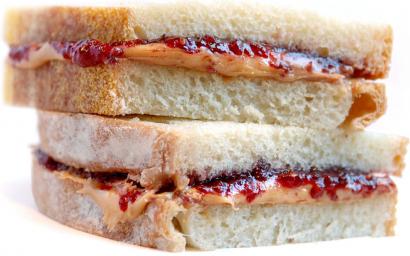 Today I found out the difference between jelly and jam.
The difference between jelly and jam is that jelly is made strictly from the juice of fruit while jam is made from crushed fruit. Specifically, jelly is made by crushing fruit, then straining out everything but the juice. The juice is then boiled, typically with sugar and pectin added, the latter of which reacts with the sugar and heat to give the jelly a thicker consistency for spreading.
The first step in making jam is about the same as jelly, but instead of straining the juice, the crushed fruit is left in, often with the seeds, if they are relatively small, such as with certain berries. Unlike most all jellies, jam may not contain pectin, as the mashed fruit will often give it sufficiently good consistency for spreading.
If you are wondering how to tell the difference between jelly and jam on sight, the jelly will spread pretty evenly, while the jam will tend to be a little lumpy.
Bonus Facts:
- While there is a difference between jelly and jam, according to the U.S. Food and Drug Administration, jam and preserves are to be considered the same thing. However, generally speaking, people call a fruit spread a preserve if the fruit chunks are somewhat large and it is called a jam if the chunks are relatively small and well mashed. Thus, the FDA doesn’t consider the two different as they only differ in the relative amounts the fruit was mashed, which differs somewhat anyways from brand to brand.
- Fruit “butters” are generally just a variety of jelly. All the fruit is strained out to leave the juice. The juice is then heavily enriched with a variety of things, such as pectin, and then can be whipped or cooked down until it becomes extremely thick.
- Yet another name for certain fruit spreads is “conserves”. These are simply jam where several different varieties of fruit are mixed to make the jam. They also will occasionally include nuts mixed in.
- Pectin is an indigestible carbohydrate, and thus is a good source of fiber in your diet. When heated with sugar and water, it thickens into a gel. It is found naturally in the cell walls of most fruits.
- For whatever reason, jelly is significantly more popular with kids than jam and jam is significantly more popular with adults than jelly.
- Around one billion pounds of fruit spreads are produced annually in the United States alone.
- Nine flavors of jams and jellies account for over 80 percent of the total U.S. production, with about thirty additional flavors comprising the remaining 20%. The most popular is grape jelly, followed by strawberry jam.
- Annual retail sales of all fruit spreads comes in around $630 million per year.
- The average American person will eat around 1500 peanut butter and jelly sandwiches by the time they turn 18.
- Jams and jellies have about half the calories of butter or margarine and unlike butter and margarine, contain zero fat.



| Share the Knowledge! |
          |
 |
Jelly/jam terminology differs in the UK.
Yes. What Americans call “jelly” is what British people call jam. What Americans call “Jell-O” is what British people call jelly.
Indeed things are different in britain but the name of something doesn’t change the fact that it’s the same thing..
Did you mean “on site”, or “on sight”?
Indeed. Dang fingers are used to typing “site”. 😉
RIGHT, listen u twats, EXPORT grape jelly to Europe, it will sell
all my kingdom for a decent PB&J sandwich
The “Factoid” section rocks! As much as the post! 😀
“If you are wondering how to tell the difference between jelly and jam on sight, the jelly will spread pretty evenly, while the jam will tend to be a little lumpy.”
I kinda disagree: grape jam for instance will spread smoothly and opaquely, while grape jelly has lumps of translucent gel-blobs which must be spread down to an acceptable smoothness with the knife. Jam is more like… cranberry sauce? While jelly is more like jello.
Lolol this made me laugh to think THIS is what we talk about as adults. I thought the same thing though.
I agree and was going to say the same thing. Jam also can be easily scooped out with a butter knife but jelly always break away into pieces that you have to spread out more. Plus if your bread isnt fresh jelly is harder to spread but jam got you covered.
I agree with Jack! In fact, I was going to say the same thing after confirming no one else did, and Jack did. I buy Grape Jam for my PB&J sandwiches because Jelly is like having crunchy peanut butter and tries to tear the bread as it’s being spread. Jam goes on much easier and spreads fine where Jelly is horrible to get even across the bread.
This is however the second place I’ve checked that implies jelly spreads easier than jam, so what gives with that.an The first I assumed was a typing error where the fingers did not match the brain, but to see that twice on the same subject from two separate locations… Na, something is wrong here, so what gives. Why say jelly spreads easier than jam when that is not the case???
Sorry, I know this is old, but while making my PB&J I always wonder, but previously failed to look it up when done. This time I looked it up while eating them and they are good… 🙂
Rob
My guess is that they both sourced the same mistaken notion that jelly was more spreadable than jam. Either that or one made the mistake 1st, and the 2nd one used the first as it’s source.
Either way, I agree: When making a pb&j sandwich, jam is always preferable to jelly. Jelly will kill the bread, while the jam spreads very easily
The real difference is you can’t jelly your dick down a girl’s throat.
man that joke had me laughing very clever and i’m also happy i know the difference between the two
Are you serious? Jam spreads evenly, while Jelly is spread lumpy. Very lumpy yuck!
I’m so glad that my daughter had the privilege of reading your disgusting comments while doing her research paper. I was monitoring her so I was able to shield her eyes before she could read too much because I make sure I am always next to her while she is on the internet just in case there is a situation like this. Thank you so much for imparting on us your ignorance and vulgarity. The mother-daughter moment we were able to share while I explained your lewd comments to my eight-year-old was priceless.
You go mom. I agree was very vulgar and am dissapointed that you felt the need to put such language on a site that many younger minds may go to
Yes, how dare the internet contain indecent material…!
in the jam preparation use whole parts of pulp but in jelly preparation use juice of the fruit.
Today you should find out that there’s no such word as “anyways.” The word is “anyway.”
Probably best to hold off on life’s mysteries until you master grammar.
@Bob: “There is no such word as ‘anyways’…” “Anyways” has been around since around the 13th century (and if you whip out your trusty Webster’s dictionary, you’ll find “anyways” there). Regardless, there is such a word because I typed it and not a single person was confused about what I was saying. The sequence of letters then successfully conveyed an idea universally understood by those who are literate. So even had it not previously been a word, it would successfully now have become so, with an understandable definition and all. Now, coming up with a word out of thin air would have meant it wasn’t in the dictionary, but the dictionary is always behind the times on the current state of total words in a language. If a new word and definition paring become popular enough, then it will, of course, appear in the dictionary and Grammar Nazis the world over must pick new words to lament about. In this case, you will find “anyways” in the dictionary already.
.
To be clear, I do very much appreciate when people take the time to point out potential grammar mistakes I have made, especially when done politely, though you didn’t bother with that, adding your “Probably best to hold off on life’s mysteries until you master grammar.”
.
I’m not in any way immune to typos and for the most part I like to get rid of them in my writing when pointed out, particularly when they introduce ambiguity. Sometimes I even learn something I didn’t already know, grammatically speaking, though with years of doing this and thousands of articles read by millions of people, that ship has mostly sailed. More often than not, particularly when getting away from some of my early articles which are frequently typo riddled, it is more often a case of a conflict of my grammatical philosophy vs. the rigidly taught principles in educational institutions the world over.
.
To me, language is all about conveying ideas and thoughts, preferably in a clear manner. Getting back to the topic at hand, is writing “anyway” instead of “anyways” any more clear? (Not to mention things like “afterwards”, “sometimes”, “always”, “downstairs”, etc.) Is there any confusion at all introduced by adding an “s” to adverbs? In a similar vein, if I were to say “laters” instead of “later” or “backwards” instead of “backward” or any number of similar modifications, does this disrupt comprehension in any way? Certainly sometimes it can introduced awkward sounding words doing this, but once one is used to reading such an “awkward” modification, it tends to cease to be awkward unless it’s completely outlandish.
.
So if clarity is not sacrificed, I see no reason that some arbitrary rule like “adverbs cannot have plural form” should be rigidly adhered to. One similar such rule that makes no sense is the now antiquated “you can’t split infinitives” rule. In fact, to wildly split infinitives is completely possible. The reasoning behind this rule is simply that you can’t split infinitives in Latin. Hence, even though it was completely possible in English, and sometimes even makes ideas clearer to do so, it was for a long time considered poor grammar as Latin was considered the language of academics and if you can’t do something in Latin, you shouldn’t do it in English. Thankfully, few today consider this “split infinitive” rule valid.
.
In this case, “anyways” is a word and clearly understood, even if many a grammarian would prefer “anyway” be used. But in extreme cases, often entire words must be made up to convey an appropriate idea, which is how language grows and evolves. (On this site, I myself have so far invented 3 words, which despite tens of thousands of views on those specific posts that contain the words, not 1 person has seemed to notice. Why? Because it’s clear what I meant by them given the context so it gave no one pause- these were cases where I simply couldn’t find a word that meant what I was trying to say, so I made one up that was perfectly clear in the context.)
.
Sticking to overly rigid rules in writing is a great hindrance much of the time, with little benefit. Certainly there are settings where it’s appropriate to do so, such as in a resume or the like. But in this particular setting (my website), it isn’t necessary. The point here is to be clear. If I achieve that- I don’t care whether I have run on sentences- odd grammatical manifestations- lack of correct punctuation- random use of dashes where a comma or semi-colon would have been more appropriate- or anything of the sort. 😉
.
You might be interested in this, which says it in a significantly more eloquent way than I ever could.
@Davin Hiskey (interesting name), interesting article, I’ve always been curious.
.
I also enjoyed you sticking it to the grammar nazi. Thanks for the entertainment.
.
(will these show up as separate paragraphs? How do you do that?)
Nazi. You keep using that word. I do not think it means what you think it means. 😉
I think you imagine yourself in overly grand terms. Misspelling and inattention to grammar are hallmarks of laziness and call into question the rigor applied to researching the underlying facts you present. There is meaning in language, and to claim that you’re too creative to bother with that meaning is a cop-out. The item mentioned is not an obscure rule misunderstood by the majority of native English speakers. Its a simple matter of spelling. You vacillate between defending your mistake as a typo, a legitimate use because “it’s in the dictionary,” and a noble expression of defiance against the boring old squares who still value the language as a common framework for communication that is enabled by (perish the thought) rules.
I must assume that your error was not a typo because it is doubtful that anyone would engage in such a lengthy defense of what is by definition a mistake. The only logical assumption is that you meant to use the term and now feel that you must provide justification. The claim that a word is “in the dictionary, so it must be correct” is a tired and inaccurate argument. The dictionary documents words that are used widely enough to attract the dictionary writers’ attention. It does not aspire to provide formal guidance on grammar or diction. Similarly, history books will often document slavery and human sacrifice that occurred in the past. Just as there are rules governing language, there are rules prohibiting those odious practices. Using your logic one might claim that like grammar and spelling, those rules are arbitrary and stifling and that we should be free to implement any of the practices documented in the text.
You may notice that the dictionary flags some words, including your ‘anyways,’ as colloquialisms. In case you’re wondering, Webster’s definition of colloquialisms calls them “unacceptably informal.”
Of course people can suffer through the careless screeds posted all across the internet and in many cases glean the meaning from them. We can also decipher foreign phrases translated by machine into English but very frequently the translation is not exact and much of the nuance is lost to this imprecision. You assume that “everyone knows” what you mean in spite of your inattention to spelling and grammar, but like the Telephone Game, you really have no basis to estimate to what degree your meaning is diluted or misunderstood.
Spelling and grammar are neither arbitrary nor fixed permanently. Communication is improved and enriched by the specificity, nuance, and depth that accurate spelling and proper grammar provide. Grammatical errors and misspelled words muddle meaning and inhibit clear communication. Language evolves, but claiming that your error is correct does not make it so.
Well I learned one thing from your screed, which I admit I had to look up, I didn’t know one with a blazing inferiority complex was driven to spend so much time in a thesaurus. Good grief!
@ Bob (The Grammer Snob)
OH MY GAWD!!! You are absolutely correct. When I go back and reread this article and replace “anyways” with “anyway”, it changes the WHOLE meaning of the article!!!
He’s writing a fun trivia article, he’s not writing a Engrish text book or inturnashunle treaties…OH!!! and also, he’s human…humans tend to make mistakes.
Are you a person who only hangs out with highfalutin English Profs with their noses in the air that live their whole life Studying the english language just to make sure they never make grammatical errors because they know they will be berated by the grammar nazis, just as they would do to anyone around them…you know, the morons that have alienated all of the normal people so they can only be around snobs/nazis like themselves. If so, WTF are you doing slumming at “Today I Found Out”
Get over yourself!!!
(how many grammatical errors/spelling mistakes I made were intenshunle and how many are just because I can’t pass a Engrish class to save my life…so I will never have a HS Diploma or any other degree that requires me to pass an English class?)
You were rude, Bob, that was the problem. The author of the article schooled you in front of everyone, and now you know that next time you should save the snark for real-life conversation. It doesn’t translate well over the internet.
“Its a simple matter of spelling.” – Bob
It sure is. “Its”? Really? If you’re going to go on a ridiculous rant about spelling and grammar, you better make sure not to confuse “its” and “it’s.” Glass houses…
In case you’re wondering, Webster’s definition of colloquialisms calls them “unacceptably informal”.
Webster’s is a dictionary from the early nineteenth century, the name of which no longer carries any prestige as a genericised trademark. Your point?
Why does EVERYTHING on the internet have to devolve into flame wars? It was simple question of jam vs. jelly, and now its a doctoral thesis on English grammar, interspersed with dick jokes….in the immortal words of Mark Mothersbaugh, “WE ARE DEVO!”
@Jimbo
LOL at “We are DEVO”. Well said.
….also, if these comments are moderated, how did those crude, vulgar, highly inappropriate “jokes” appear here in the first place?
In Britain, “jelly” usually refers to that wobbly gelatin dessert Americans call “jello”, but also in Britain (less commonly) it can refer to a smooth, clear, set, sweet jam-like stuff bought in small jars. E.g. crab apple jelly or cranberry jelly. These are different to apple sauce/cranberry sauce because jelly has no bits of fruit. Strawberry preserve is basically the same as strawberry jam but double the price because it sounds posher.
The author of this site should be free to speak however he sees fit on HIS site. If he chooses to pursue a top career in writing, then he will hopefully sail a new ship to further educate himself in language. Speaking of language, Angry Mom, teaching your daughter to properly site her sources will be a useful tool as she grows older. Don’t use sites that lack editors and proper grammar for research papers. Had you been looking for a credible site, you wouldn’t run into such vulgar jokes or ridiculous arguments over grammar. Have a great day everyone!
You should learn the difference between the words site and cite before criticizing someone else about their writing skills. Your second use of the word site is not only wrong but, given the nature of your comment, highly ironic.
Thanks for this article. I’d always understood that Americans called jam jelly. Yet looking in cookbooks from the 19th century… American cook books, I noticed there were recipes for ‘jelly’ and ‘jame’. I’m thinking… erm, isn’t jelly jam and jam jelly? Thanks for clearing that up for me. As for… “anyways” I didn’t even notice haha. One thing I like about these articles is that reading them is like listening to someone tell me things. I think it’s a complete myth that someone’s spelling and grammar is an indicator of their general intelligence and/or knowledge of a certain subject. I do my best to spell correctly, but in the heat of discussing some subject on which I’m passionate… and I like to think knowledgeable, there are some words I can’t spell to save my life. Equivalent, illegitimate are two examples. I neither know nor care whether I got them right this time haha.
Agreed. I think the authors of this site are more concerned with making the content apealing than avoiding grammatical errors, which is okay. Made for some funny comment threads though.
So what then is marmalade?