
WTF is Up with Walking Like an Egyptian?
 “All the old paintings on the tombs
They do the sand dance, don’t you know?
If they walk too quick (oh way oh)
They’re falling down like a domino
Slide your feet up the street, bend your back
Shift your arm then you pull it back
Life is hard you know (oh way oh)
So strike a pose on a Cadillac”
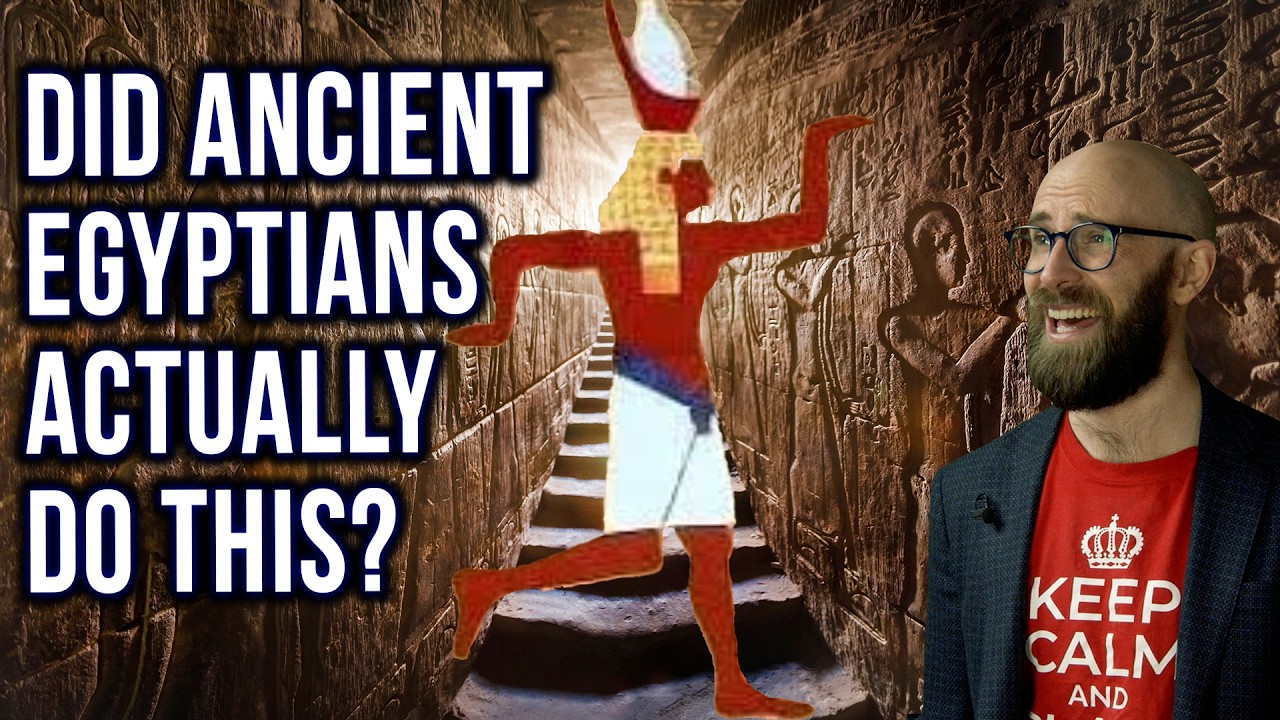
These quirky lines are, of course, from the hit 1986 song “Walk Like an Egyptian” by American pop-rock band The Bangles. But even without these detailed instructions, if someone says “Walk Like an Egyptian”, chances are you know the exact pose they are referring to: torso forward, head sideways, one foot behind the other, arms bent into a Z-shape. Bonus points for shuffling forward while rocking your arms back and forth, accompanied by that stereotypically “Egyptian” melody variously known as “The Arabian Riff” or “Snake Charmer Song”. Over the years, this bizarre pose and gait have become inextricably linked with Ancient Egypt, appearing in countless cartoons, illustrations, films, and other pieces of popular media. But did the Ancient Egyptians actually walk like this – and if so, why? The answer, it may not surprise you to hear, is no, but like all myths and stereotypes this one does contain a small kernel of truth – in this case, the peculiarly stylized manner in which Ancient Egyptians art depicted the human form. So why did they do this?
Nowadays, we are used to art – even highly abstracted art – hewing to a certain kind of realism. We expect objects to look roughly as they would in real life, following the rules of perspective: only certain sides are visible, closer objects are larger than more distant objects, etc. However, this kind of realistic representation is a fairly recent development in art, with the use of a mathematically-accurate perspective dating to the early 15th Century. Prior to this, artists – particularly those creating religious artwork – often had different priorities and followed different artistic rules. For example, size was often used to convey the relative importance of subjects within a work rather than their physical relation to one another. In early Christian depictions of biblical scenes like the Nativity or the Last Supper, for example, the figure of Jesus – both as a baby and an adult – often dwarfs those around him. This convention was also used by the Ancient Egyptians, along with a long list of other, culturally specific rules.
It is important to point out that artists in Ancient Egypt filled a very different role than they do today, producing works not as a means of individual self-expression but for religious or political purposes.
Images painted or carved onto the walls of Ancient Egyptian tombs, temples, and palaces served a wide variety of practical functions, such as glorifying the pharaoh, praising the gods, or guiding the spirit of the deceased to the afterlife. The Egyptians believed that the written word and visual images could perform magic, and that the correct execution of such works was vital to obtaining the desired effect. For example, drawings or sculptures of food left in tombs were supposed to magically become real in order to nourish the deceased in the afterlife. Artisans were thus seen not as creative and expressive individuals, but rather highly-skilled craftsmen or copyists tasked with carrying out the instructions of the creator god Ptah, who had already laid out the conventions of ritual artwork in exacting detail. These conventions included how to write down hieroglyphics, what specific colours to use for certain subjects, and how to represent the human form. Ancient Egyptian artisans prioritized narrative clarity and ideal forms over absolute realism, and thus depicted human figures with their chest facing outward toward the viewer and their head, legs, and arms in profile. The extremities were also depicted identically, with figures having two left or two right hands or feet. While physically awkward, such poses allowed all the most important features of the body to be simultaneously represented in their most immediately recognizable forms- something that would be impossible in a more realistic rendering. Objects in scenes were also not layered atop one another but rather placed beside each other in linear, horizontal fields known as “registers”. Layering and non-horizontal compositions were very rare, and typically only used to convey chaotic scenes like battles. Thus, in their minimalism, formality, and linearity, Egyptian 2-dimensional art has much in common with modern comic strips: both seek to convey a particular scene or narrative as clearly and unambiguously as possible.
3-dimensional Egyptian statuary also followed a strict set of conventions. Male figures were typically depicted in a peculiar rigid striding pose with the head gazing forward, the arms pointing stiffly downward, and the left foot forward. This pose was intended to convey strength, vitality, intelligence, and will, while the left foot was favoured as it lay on the same side of the body as the heart – the seat of the soul and the most important organ in Egyptian mythology. Women, by contrast, were typically depicted with their feet together, conveying their more passive and supportive role in Egyptian society. When sculpted seated or lying down, people are typically either with their hands resting on their legs or with one or both arms crossed over their chests. Pharaohs depicted in this manner typically hold in their hands the shepherd’s crook and the flail, the traditional royal symbols which represent, respectively, the pharaoh’s leadership of his people and the fertility of the land guaranteed by his divine rule. The crossed-arms posture is especially common in funerary art, while mummies were often posed with their arms in this position. This was intended to echo the traditional depiction of Osiris, god of the underworld. Interestingly, this posture may have been inspired by the so-called Lazarus Sign, a common – and totally not creepy at all to witness- phenomenon whereby a brain-dead person will reflexively raise their arms and cross them over their chest.
Despite being subject to a whole canon of rules and conventions, sculptural depictions of Ancient Egyptian people tended to be more realistic than painted ones, with more accurate anatomical details and individually-recognizable features. The reason for this was also religious in nature. The Ancient Egyptians believed that in order to cross over to the afterlife, a person’s “effective spirit” or akh required a vessel to inhabit. Typically this role was filled by the deceased’s body itself, which is why the Ancient Egyptians preserved bodies via the process of mummification. But in case something happened to their body, the deceased were often provided with a realistic-looking statue of themselves which their akh could immediately recognize and inhabit.
But while the conventions of Egyptian artwork remained remarkably unchanged for thousands of years, this doesn’t mean there was no innovation or evolution. One of the greatest periods of artistic innovation took place during the reign of the pharaoh Amenhotep IV, better known as Akhenaten. Breaking radically from tradition, Akhenaten abandoned the old Egyptian pantheon of gods and established a monotheistic religion centred around a sun god known as the Aten. In 1346 B.C.E, he also moved the capital city from Thebes to a site in southern Egypt now known as Tell el-Amarna; hence his reign is typically known as the Amarna Period. Along with the change in religion, artwork during the Amarna Period experienced a dramatic shift in style. The rigid, formalist style of the past gave way to a more organic, naturalistic style, with male figures being given more feminine features such as longer heads and faces; fuller lips; and larger hips, stomachs, and breasts. Arms, legs, feet, and hands were rendered in greater detail, with figures depicted with both right and left hands and feet. The type and composition of images also changed radically. Figures were shown participating in a wider variety of dynamic activities, while the pharaoh and his family were depicted in more naturalistic and intimate domestic scenes rather than rigid power poses. However, despite these innovations, much of the old formalism still remained, with figures still being depicted in the same awkward, chest-forward style as before. And sadly, this flourishing of creativity was not to last. Following his death in 1336 B.C.E, Akhenaten was declared a heretic and the old Egyptian pantheon quickly restored – and with it, the old formal style of ritual art. By the time Akhenaten’s successor, Tutankhamun, took the throne in 1332 B.C.E, nearly all traces of the Amarna style had disappeared.
Yet despite the wide variety of scenes and activities depicted in Ancient Egyptian art – from religious rituals to beer brewing to sports and warfare – one pose is conspicuously absent: the stereotypical, Z-shaped “Egyptian Walk”. So where, then, did this pose come from? Unfortunately, the answer has been lost to history, though as the earliest depictions of this pose or dance come from the early 20th Century, it likely originated during one of the many “Egyptomania” crazes that swept the Western world during this period. Indeed, it is around this time that the familiar “Arabian Riff” or “Snake Charmer Song” that stereotypically accompanies the “Egyptian Walk” first came to prominence, the tune being used to accompany a wildly popular belly dancing act during the 1893 Chicago World’s Columbian Exposition. The tune went on to become a popular hit, being re-published under various titles including “The Streets of Cairo”, “The Hoochie-Coochie Dance,” and “The Southern Part of France.” But the tune did not originate at the fair, having appeared in the “Arabian Song” in French composer Jean-Baptiste Arban’s 1864 Complete Conservatory Method for Trumpet. But just where the tune originated prior to this is also a mystery, with most music historians believing it was adapted from a traditional Algerian melody called Kardoutja. Whatever the case, just like the idea that Vikings wore horned helmets originated with the production designer for one of Wagner’s operas, it is more than likely that the “Egyptian Dance” was the fanciful, orientalist creation of some early 20th Century choreographer.
As for where the Bangles came about their quirky 1986 hit, the story goes that songwriter Liam Sternberg was sailing across the English Channel when the ferry encountered rough water. Struggling to keep their balance, his fellow passengers jerked their arms and legs out in awkward poses that reminded Sternberg of Ancient Egyptian paintings. After scribbling down the words “Walk Like an Egyptian” in his notebook, in 1984 Sternberg composed the rest of the song and recorded a demo with Marti Jones on vocals and percussion performed on kitchen utensils. After being offered to – and rejected by – Toni Basil of “Mickey” fame, the demo caught the attention of producer David Kahne, who convinced the Bangles to record it and include it on their 1986 album Different Light. And the rest, as they say, is history.
Expand for ReferencesHein, Ethan, Where Does the “Egyptian” Melody Originally Come From? The Ethan Hein Blog, November 3, 2011, https://www.ethanhein.com/wp/2011/where-does-the-egyptian-melody-originally-come-from/
Don’t Walk Like an Egyptian, Because They Didn’t Either! A Scholarly Skater, February 6, 2019, https://ascholarlyskater.com/2019/02/06/dont-walk-like-an-egyptian/
Inglis-Arkell, The Lazarus Sign Can Convince You That Brain-Dead People Are Alive, Gizmodo, January 13, 2014, https://gizmodo.com/the-lazarus-sign-can-convince-you-that-brain-dead-peopl-1500081143
Ranieri, Laura, Sideways, Stiff, and Striding: Why Dif the Egyptians Draw That Way? Ancient Egypt Alive, March 25, 2022,
Walk Like an Egyptian, Ancient Art Podcast, September 15, 2007, https://www.ancientartpodcast.org/blog/9/
Amarna Style, Encyclopedia Britannica, https://www.britannica.com/art/Amarna-style
Hansen, Nicole, Comparing Akhenaten’s Amarna Period Art to Traditional Egyptian Art, The Collector, May 5, 2020, https://www.thecollector.com/amarna-egypt-art/
Walk Like an Egyptian, Songfacts, https://www.songfacts.com/facts/bangles/walk-like-an-egyptian
The Story Behind “Walk Like an Egyptian” by the Bangles, 80’s Fashion, May 31, 2022, https://www.80sfashion.org/the-story-behind-walk-like-an-egyptian-by-the-bangles/



| Share the Knowledge! |
          |
 |