
How Did the Crusades Actually Work?
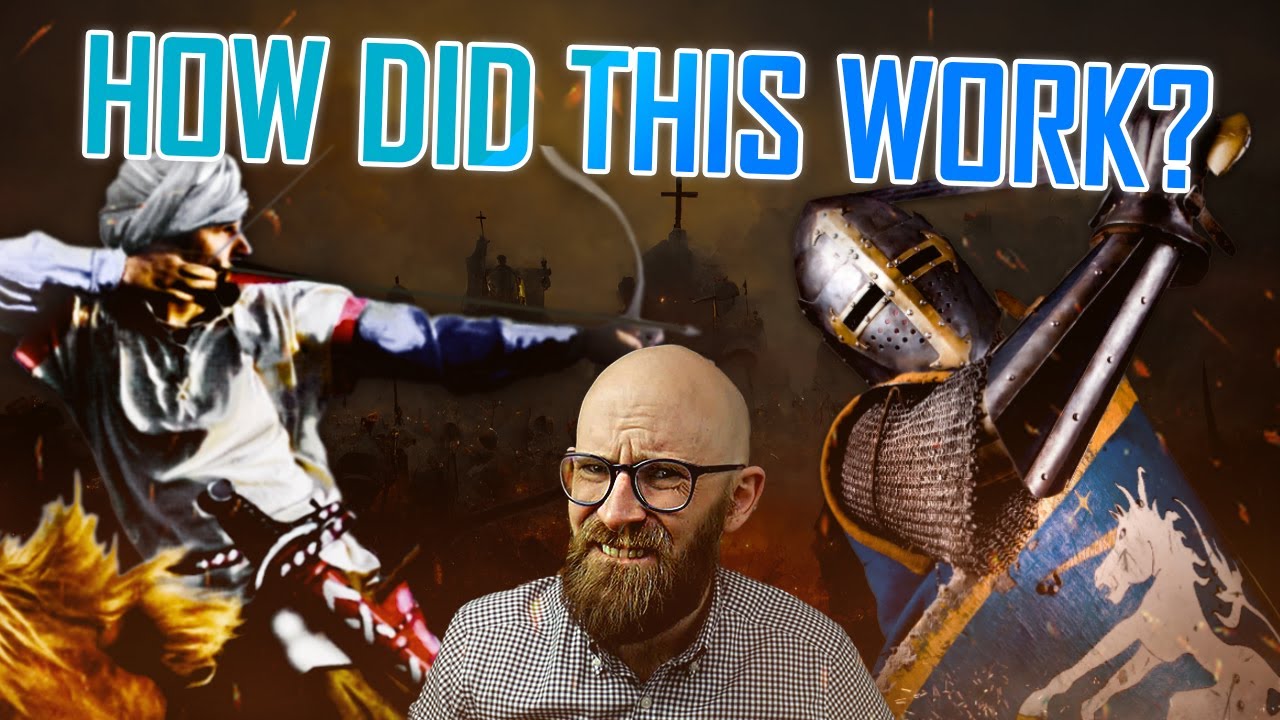 When thinking about the middle ages, chances are that among the many images popping into your mind there stands a noble knight. Now, there are a variety of myths about what it was like to be a knight during medieval times, not just spread by Hollywood, but even by the contemporary legends during medieval times themselves- in both featuring widespread depictions of the chivalric knight rushing to the aid of damsels in distress and generally spending their time being bastions of all that is good and the very definition of “noble”. We’ll get into a lot of these myths throughout this video, but within this mythology we have the white clad Christian knight, his shield or surcoat adorned with a cross. And on the other side an equally imposing Muslim horseman, peppering said knight with dozens of arrows.
But behind the epic facade of titanic clashes in the Holy Land, lurk the mundane realities of Medieval era warfare.
For example: that brave warrior signed by the Cross, was statistically less likely to fall in combat, than to die pants down, squatting behind a bush and emptying his bloody bowels.
But who would have been responsible to feed and water that knight? Who would have paid for his weapons, horses, supplies? Who organised transport for Crusaders troops, and how? Who led them into combat? And going further up the chain: how did Crusades actually start in the first place? In short, how did the crusades actually work from a practical standpoint from start to finish?
If these questions keep you up at night, as they do us, well, you’re in luck. For today we will be diving into all this, as well as a whole lot of knightly myth debunking along the way, including whether any supposedly chivalrous knight in history actually ever rescued a damsel in distress.
So strapon your spaulders and gardbraces, and don your noble helm, and let’s dive into it all, shall we?
First, what even are the Crusades we are talking about exactly? Surprisingly, this is not an easy task to define: historiography can list more than 100 conflicts from the 11th to the 17th Century, which have been described as ‘Crusades’, featuring wildly different characteristics.
To make matters more complicated, the very term ‘Crusade’ was not used until the mid-1500s in the French language, and until the early 1700s in English. Before then, the soldiers participating in these campaigns were referred to as ‘those marked by the cross’. While the campaigns themselves would be referred to as ‘the business of the cross’, or simply as ‘expeditions’ against the infidels, pagan, heretics or whoever was the enemy of the day the leaders wanted to use Jesus against- An individual who explicitly built his entire philosophy around the doctrine “Love your neighbor as yourself” and then went on to give a parable about how your foreign enemy is your neighbor and you should treat them as your most beloved family member…
…
But in any event, for the purposes of our analysis, we will look at those conflicts on which pretty much all historians agree that they were, indeed, Crusades.
These include:
The well-known campaigns conducted by mostly Western European armies from the 11th to the 13th Century against Muslim powers in the Holy Land and the Levant;
The 13th Century expeditions conducted by Christian Kingdoms in northern Iberia against the ‘Taifas’, or Muslim Kingdoms, in the South;
And the longest of them all: the Albigensian Crusade of 1209 to 1229, waged by Northern French barons against the Cathar heresy, prevalent in the Languedoc region, Southern France.
So now- if we look at the features of these conflicts we can extrapolate what made a Crusade a Crusade: a war fought on the initiative of a Christian power, the Roman Catholic Church, or one of their representatives, directed against physical or perceived threats to the Church itself, a Christian state, or Christian pilgrims.
This initiative usually manifested as a call to arms, which might come directly from a Pope, a Monarch, an aristocrat, a bishop, or even a humble preacher. The call to arms expressed a simple concept, such as let us go to the Levant, or Southern Spain, or Southern France, and let us defeat the Muslims, or the heretics.
It may have included a precise military objective, such as:
‘Let’s defeat King Zayyan ibn Mardanish and retake the city of Valencia!’
Or
‘Let’s kick Saladin ibn Ayub out of Jerusalem!’
But it was not uncommon for a call to arms to be at once generic and grandiose in scale. In the case of the Albigensian Crusade, for example, the objective of the Crusaders was to convert or physically eliminate all Cathar heretics in the Languedoc.
The initial appeal to take the cross was followed by the Pope issuing a ‘Papal Bull’, a formal document which provided legit blessing to the expedition to come. With the exception of the First Crusade, all similar campaigns in the period would be sanctioned by these documents.
On the note of the first crusade, knights in Medieval Times were rather well known for their penchant to cause a bit of anarchy wherever they went. In fact, on top of things like recapturing Jerusalem from the Muslims, one of the many goals of the first Crusade, according to history professor Norman Cohn, “was also a matter of giving the largely unemployed and over-aggressive nobility of France something to do, get them out of Europe and stop them devastating the … lands.”
In a nutshell, bored knights with nothing to do when they weren’t training, tended to run amok against their neighboring Christian lands, and the church got tired of it all and how it was devastating their local flocks and stability. And even in the knightly training and practice in the form of things like tournaments, the knights had a tendency to cause a lot of problems.
In this case, the games at these were initially little more than massive melees, including using real, sharpened weapons. Rules were few, with the competitions not that different from actual battles, including capturing other knights and the like. They’d even often group knights by nation, which made the whole thing all the more heated.
That said, the general point, unlike real battle, was not to intentionally kill your opponent, but just knock them off their horse and take them prisoner. Once unhorsed, in the early going, many knights would also hire people whose job it was to rush any knight they had knocked off their horse and beat the crap out of them before taking them prisoner- the point of this being to make it easier to extract the knight’s armor and a bit easier to hang on to while they were in captivity. The knight being stripped of all their valuables and horse would later be offered back to the other side for a price, as well as potentially have their armor and horse offered back, also for a price.
Much like a real battle, any nearby peasants were not necessarily safe during these matches. For example, a given knight might flee from enemy knights and take refuge in a peasant’s home, which was likely then to be ransacked or even burned to the ground to get the knight to come out. Even if they didn’t do this, nearby farm fields were likely to get trampled and crops lost.
As you might imagine, while the knights, particularly the lower ranked and poorer of this class, loved these tournaments for a chance to gain prestige, practice their skills, and the chance to acquire additional wealth via prizes and ransoms and the like, the peasants and the church really weren’t big fans of all the death and destruction that surrounded the tournaments.
Towards the end of calming things down for everyone, including the knights who sometimes died during these mock battles, over the centuries more and more rules were added to the various games, as well as a trend towards blunted weapons. By the late Medieval period, this saw the tournaments start to resemble what is often depicted in film’s like A Knight’s Tale today, albeit with less We Will Rock You.
But the point was, even in their practice the bored knights were causing problems, and getting them out of the country and directing their testosterone against an enemy religion and people apparently seemed like a good idea to the Church in that particular crusade.
But in any event, the first formal Crusade Bull, or ‘Bulla Cruciata’ in Latin, was issued by Pope Eugene III in 1145, on the occasion of the Second Crusade to the Holy Land. This Bull set the template for other similar documents to come, as it included a key ingredient: plenary indulgence, defined by the Catechism of the Catholic Church as a ‘Remission before God of the temporal punishment due to sins whose guilt has already been forgiven’
In other words: a sin may be forgiven by God via the sacrament of confession. But that sin may still carry consequences, sanctions and punishments on Earth. But an act of indulgence can free the sinner from such consequences!
Moreover, the Bull offered a moratorium on interests for debts. And the Church pledged to protect the Crusaders’ family and property, while they were fighting abroad. Finally, those who completed the Crusade, or died fighting, would receive a full absolution for their sins.
In his 1187 Bull, which kickstarted the Third Crusade, Pope Gregory VIII went one step further: now Crusaders would also be granted immunity against legal suits!
Successive Bulls would add further clauses and benefits, in order to drive recruitment. In 1209, Pope Innocent III launched the Crusade against the Albigensians by allowing participants to retain any goods plundered in battle. This appealed particularly to high-ranking knights and barons: from their perspective, the concept of ‘loot’ extended to castles, towns and entire territories!
Innocent was the first to introduce a time clause in a ‘Bulla Cruciata’. Soldiers wearing the Cross now were required to serve only 40 days to gain full indulgence, which was a pretty good deal! So good, in fact, that most foot soldiers and horsemen did just that, returning home when the short terms expired, and creating endless manpower problems to their commanders, not too dissimilar to what almost killed the American Revolution in the early going.
In this one, the traitors to King and country saw their entire army initially built on the back of short term contracts, which, only a few months after the ink was dry on the Declaration of Independence, left George Washington lamenting to his cousin on December 18th, 1776, “I think the game is pretty near up” as most of his army was set to disband all around the same time, and little hope of new recruits given loss after loss and horrible conditions for the soldiers against a vastly superior force, not just in supplies, arms, and numbers, but also because they were British.
But going back to the Crusades, subsequent Bulls could go into very specific detail about who would receive indulgence. For example, in 1237, Gregory IX supported the campaign of James I of Aragon against the Muslim Kingdom of Valencia by granting indulgence to arsonists, to those who had struck the clergy, and to those who conducted trade with ‘the infidels’.
After the call to arms was formalised by the Papal Bull, it was time to spread the message far and wide, a vital part of the recruitment drive. The sales and marketing aspect of the Crusades would normally be handled by travelling preachers, often belonging to the Benedictine and Dominican orders.
The contents of their messages were rather predictable: if you join our fun trip to the Holy Land – or wherever our enemies may be – you shall enjoy a cornucopia of benefits, from indulgence to a plentiful booty! Especially when it came to promoting expeditions to the Levant, preachers added some colour by emphasising the importance and sanctity of the holy places in Jerusalem, especially the Holy Sepulchre. On top of that, they would provide examples of the iniquity, savagery and brutality of the foe of the day, be them the Seljuks and Ayubids in the Levant, the Almohads in Spain, or the Cathars in southern France.
If such incentives to action did not work, preachers would deploy striking imagery. For example, in preparation for the Third Crusade, a popular and effective visual aid was the picture of a Muslim warrior, whose horse was shown urinating on the Holy Sepulchre! Even better, travelling preachers and local clergy could join forces to stage solemn and dramatic processions, accompanied by music and a display of holy relics. A striking spectacle designed to inflame the spirits of common folk and noble knights alike.
The latter category was the natural target audience of Crusade preachers. They were young, brawny, well-armed, professional warriors. They were hungry for action, and had the cash to travel to the theatres of operations. But knights also had responsibilities at home, namely looking after their castle, or lands on behalf of a feudal lord. Therefore, many of them might resist the lure of further adventures far from home! To overcome their resistance, preachers unleashed one of the most powerful motivators in a good salesman’s arsenal: shame.
Especially when ‘advertising’ the first three Crusades to the Levant, travelling friars would disgrace the knighthood class, blaming them for having allowed the holy places to fall into Muslim hands.
If travelling friar preached one knight into participating, they had hit the jackpot. Knights usually moved around and fought with their retinue, which included at least one squire and five to ten men-at-arms or sargeants. Richer noblemen would be able to instantly mobilise tens if not hundreds of footmen and horsemen. But the message of the preachers was extended also to individual fighters, be them mercenaries, members of a local militia, or total ‘noobs’, who had never wielded a spear before. Accounts of the Albigensian Crusade, for example, mention the importance of the latter group, known as ‘poor Crusaders’ or ‘ribauds’.
Even if less well armed, less trained, and less disciplined than the knightly units, these rookie soldiers were highly motivated with all the promises leveled at those who would join and the chance for leveling up their station in life if booty acquired. From a practical standpoint, they were also potentially good fodder to send up to assault the walls of a besieged city.
Now, motivation and morale go a long way, but moving and feeding large masses of bellicose men requires loads of cash!
So, who paid for the Crusades?
This is perhaps the most complex aspect of these conflicts. Knights and aristocrats were expected to fund their own mounts, retinues, supplies and weaponry. But even the upper echelons of feudal society experienced cash-flow problems, and thus had to liquidate their properties, mostly agricultural land. If that was not enough, they would launch the Mediaeval equivalent of funding campaigns, mobilising their relatives into selling family holdings, or collecting cash donations. To facilitate these collections, from the 13th Century onwards, Papal Bulls extended their indulgences and other benefits also to those who only donated money to the Crusades, without actually taking part in the campaigns.
As an alternative, knights and barons could mortgage their properties, with the hope of collecting enough plunder during the Crusade. Or they could enter into complex contracts with religious institutions, such as the case of one Bernard Morel. This knight received a cash advance from a nunnery in Marcigny, Eastern France, and in exchange he allowed the good sisters to collect half the rent paid by farmers on his lands.
On other occasions, knights might offer their services to land-holding monasteries. Often these institutions were embroiled in complex legal actions and territorial disputes against their neighbours. A knight might intervene to settle their disputes and receive a payment from the abbot for their services.
Even so, knights could run out of money halfway through the expedition. Take the example of powerful French knight Jean de Joinville, the seneschal of the county of Champagne, who ran out of funds while in transit to the Holy Land, in 1249. Joinville was stuck in Cyprus, completely penniless, until King Louis IX hired him in his household, and offered him transport to the Levant.
So, that was another source of ‘dough’: the coffers of Monarchs! From the 13th Century onwards, kings and queens took to participating directly in Crusades, thus funding the whole expedition altogether. Otherwise, they might invest large sums into paying stipends to contingents of knights and barons. In exchange, the fighting force would pay them back – with interest – with any loot they might plunder during the war.
But even Royal funding was less reliable than you might expect. First of all, not all Christian kings went on Crusades, as they often had more pressing business to take care at home. And second, they themselves had to rely on taxation provided by their council of barons, before they could even think about waging war! If the aristocracy was not willing to pay more taxes, monarchs could appeal to the Pope, which may allow them the right to impose special tithes on the local clergy, usually limited to one year only.
Speaking of the clergy, it would be natural to assume that the Catholic Church would be the main funders for such expeditions. The institution was notoriously rich, as it collected regular tithes from lay people residing in their dioceses. But this would be the exception, rather than the rule. For example, in 1219 and 1220, Pope Honorius III allowed the Archbishop of Toledo, Rodrigo Jiménez de Rada, to devolve the tithes collected in the areas of Toledo and Segovia into a small Crusade against the ‘Taifa’, or Muslim kingdom, of Valencia, Eastern Spain.
Lastly, expeditions against infidels and heretics could receive healthy injections of cash from the military-religious orders which sprung up in Europe in the early 12th Century, such as the Templars, the Hospitaliers, the Order of Santiago, and that of Calatrava. The Templars in particular had developed a sophisticated banking system: as they escorted pilgrims to the Holy Land, they guarded their valuables for safe-keeping, in exchange for a letter of credit. Once in Jerusalem, the pilgrims could present their letter at the local chapter of the Templars, and redeem their cash. As a consequence, the Templars had access to large quantities of currency, which they would loan out to merchants, aristocrats, even Monarchs for their military enterprises.
Otherwise, they could use their vast wealth to buy entire territories from kings and queens. For example, during the 3rd Crusade, King Richard I ‘The Lionheart’ sold the island of Cyprus to the military order, a sweet real estate deal which allowed him to fund his troops during the campaign!
Once a knight or baron had secured enough funds, he had to sort out the next big issue: transport.
On this note, it was highly unlikely for small groups of fighters to travel on their own. The standard procedure was for feudal lords to organise assembly stations at their castle, or in a cathedral city. Once forces in the same region had amassed at the staging area, the columns of combatants – often followed by suppliers, non-fighting auxiliaries, or even their families – would embark on the long and perilous journey.
During the First and Second Crusades, the overland route was the preferred one. It made for a long, slow and dangerous trip, but at least it was cheaper than travelling by ship! The trend changed after 1147, when German and French crusaders travelling through what is today Turkey suffered heavy losses.
By the end of the century, as funding became more available, preferences shifted towards sea travel. Which was much faster, but carried its fair share of inconveniences, especially cramped spaces, lack of clean water, spoiled food, and infectious diseases.
A common solution to reach the Levant would have been to combine the two methods of land and sea travel. For example, on occasion of the 3rd Crusade, in 1191 Richard I of England, aka ‘The Lionheart’, assembled his troops in France, then marched them to Northern Italy, where he contracted Genoese ships to cover the remaining leg of the journey.
Due to their geographic location and sea-faring skills, Italian cities were the preferred providers of ‘Crusader cruises’. Sometimes negotiations would not go as smoothly as those experienced by the Lionheart, though. On the occasion of the Fourth Crusade, military leaders asked the Venetian Doge to assemble a fleet to transport a force of 4,500 knights with their horses, 9,000 squires and 20,000 foot soldiers. Venice provided the goods, demanding a payment of 85,000 marks in return. But the lack of coordination amongst the Crusader barons led to a mishap of catastrophic proportions, which we’ll explore more in detail later …
This lack of coordination highlights a key aspect of the Crusades: who was actually in charge?
In a ‘standard’ conflict, waged between kingdoms or other territories, this was a no-brainer. The Monarch of said polity would dictate strategy, or delegate military command to a younger or more competent leader.
In the case of the Crusades, Popes may have held spiritual authority, or indicate the broad strategic objectives. But the actual campaigns and operations were conducted by a variety of national, baronial, mercenary and voluntary armies, without a clear chain of command. The First Crusade was particularly chaotic from this point of view, and the lack of clear leadership manifested itself with an overall lack of discipline. Crusading soldiers may have expected indulgence and remission of sins, but wherever they marched they built a solid reputation for binge drinking, pillaging, gambling, casual sex and often not of the willing variety- a staple practice of the so-called chivalrous knight, which is in part why the myth of the chivalrous knight was created in the first place- to try to get them to stop doing things like this. More on this later.
But in any event, from the Third Crusade onwards, Monarchs – if involved – put themselves firmly in command, providing strategic vision and tactical leadership, as well as imposing strong discipline. Henry II of England was the first to impose a code of conduct on his Crusaders in 1188, the ‘Geddington Ordinances’, which imposed heavy punishments against thieving and violent soldiers.
As an alternative to a King, military operations could be directed by a Papal legate, i.e. a direct representative of the Pope’s power. A Legate was a member of the clergy, usually a bishop or abbot, but could be incredibly war-like when the occasion called for it! Otherwise, armies could be led by a council of the most high-ranking barons on site. And these councils might elect or appoint the most experienced general among them, who would take responsibility for overall command.
The Albigensian Crusade, throughout its 20 years of duration, featured all models. At the very beginning, Crusader troops were led by abbot and Papal legate Arnald Amaury.
Amaury was in charge at the first major engagement, the siege of Beziers in July 1209, which ended with a complete massacre. Allegedly, the warrior abbot incited the Crusaders to slaughter all inhabitants of the city. When the knights asked him how they would tell apart the Cathar heretics from the Catholics, according to chronicler Caesarius of Heisterbach, he replied ’Kill them all. The Lord knows who are his own.’
After this unchecked carnage, leadership passed into the hands of a council of noblemen, hailing mainly from northern France. They then appointed Count Simon of Montfort as their General, who did a pretty good job! That is, until his skull was cracked open by a trebuchet projectile in 1219 … then, the French Crown stepped into the fray, with King Philip II Augustus and later King Louis VIII in the lead.
Speaking of all that, let’s take a look at how fighting actually took place. As a general rule, pitched battles were a rare occurrence, taking place when a large contingent, or entire army, managed to intercept an opposing force while on transit.
The common chain of events was for an army to set up camp after a long march. Then, the enemy army would show up, setting up camp at a short distance. One of the two parties might then attempt to provoke the enemy into battle, usually by deploying their troops into formation, in plain view, and/or by harassing the camp with quick cavalry attacks. When a battle did break out, it very rarely consisted of a massive charge from one or both sides. Armies usually resorted to well-tried and tested tactics, in which specialised troops performed the tactics they excelled at.
For example, Muslim armies from Spain to the Levant relied mainly on the use of missile troops and light cavalry. Even better, a combination of the two: mounted archers. Arab, Berber, and Turkic horsemen excelled at a tactic known as ‘feigned retreat’ or ‘tornafuye’.
In which a cavalry squadron pretended to retreat from the enemy. When the latter gave chase, the mounted archers simply turned around and unleashed a shower of arrows. On the other hand, Western European armies – which made up the bulk of Crusading forces – were the masters of heavy cavalry: mounted, armoured knights who charged against the weak points of the enemy formations, causing a rout during which individual soldiers were picked off one by one.
But Crusaders and their enemies actually spent most of their time chasing or evading each other, all the while raiding the countryside to plunder food and other supplies. Both opponents might also resort to burning down farms and crops, as a means to deny access to resources to their foes. From an invading army’s perspective these merry rounds of burning and pillaging had the added objective of crushing the local population’s morale, and to instil a general sense of distrust towards their rulers who were supposed to be protecting them, while also potentially robbing said rulers of vital manpower.
As an example of this sort of thing, we have one 12th century chronicler Orderic Vitalis extolling the virtues of a knight for for once choosing NOT to slaughter a large group of peasants. As outlined in historian Catherine Hanley’s book War and Combat, 1150-1270: “he describes a raiding expedition undertaken by a young knight, during which his men destroy the homes of a group of peasants and kill their livestock. The peasants themselves flee to huddle around a cross; the knight spares their lives, and this charitable deed, according to [Vitalis] deserves to be remembered forever.”
Indeed, so brave; so noble.
In contrast, and seemingly a bit more typical, a 12th century knight and lord, Waleran Count of Mellent, was noted as simply cutting off one of the feet of any peasants he encountered while in his enemies’ lands. The idea presumably being that lord now had just lost a useful worker and had an extra crippled and unhappy individual on his hands to manage, assuming the individual survived the de-feeting encounter with this particular lord.
But in any event, if an entire army was on the move as a compact column, usually it was heading towards a major strategic objective, such as a castle or a fortified city. Once the objective was reached, it was time to enact the staple of Crusading warfare: a siege.
We have an entire hour long video on the subject of the reality of Medieval Sieges you can check out, unimaginatively titled “How Did People in Medieval Times Actually Siege a Castle in Reality?” because we’re just clever like that.
But in brief here, when facing enemy fortifications, Crusader generals had many options at their disposal, each carrying its fair share of pros and cons. The besiegers might try to take the city or castle by storm, for example, by scaling its walls with ladders or mobile towers, or forcing open its gates. This was a sound tactic, although the defenders might not be entirely onboard with being conquered for some reason…, and could pelt the attackers with arrows, javelins, rocks, boiling oil, or even sulphur bombs – a weapon used at least once during the Albigensian Crusade.
On top of that, your own troops liked to not die, so often had many other things higher on their personally daily priority list than rushing pell mell into a massacre like some sort of Orc army thrown against the gates of Minas Tirith. This just wasn’t something often done.
There is a reason the word “siege” literally derives from the Latin for “to sit”.
Alternatively, the besiegers might try to demolish the enemy fortifications by using a variety of artillery pieces, such as mangonels and trebuchets, able to hurl huge stones against walls and towers. The problem with that one was that such war machines were insanely expensive and time consuming to build, few had the expertise to build them, and they were notoriously difficult to transport. Nevertheless, when built, even a single such siege engine could be incredibly effective.
If the objective was a coastal city, besiegers may also have placed their siege engines on ships, so as to bombard their target from the sea, too. The defenders might build counter-artillery of their own, taking shots at the enemy engines, their encampments or troop formations.
On occasion, the besiegers and the besieged might get very creative … in the Autumn of 1229, King James I of Aragon conducted a Crusade against the Almohad King of the Balearic Isles. As he besieged the enemy capital Madina Mayurqa – modern day Las Palmas – he unleashed a barrage from his four siege engines. The Almohad King Abu Yahya sought to protect his city’s walls with a controversial tactic: human shields! In this case, Christian prisoners tied to the ramparts. As a retaliatory move, James intensified the bombardment, but with a different choice of projectile: the heads of Muslim prisoners instead of rocks.
Perhaps less destructive, but way more terrifying!
And from all this if you guessed Medieval knights we have good documentation of in journals and the like commonly exhibited strong signs of PTSD, congratulations, you’re correct.
But going back to the fighting, if trebuchets and mangonels were not able to break through enemy defences, Crusaders could count on the services of sappers and miners, a highly specialised and sought after category of soldiers. Their signature trick was to dig mines and tunnels under a major tower or wall. Then, they would light fires underground, in all severely weakening the foundations and overall structure of the fortification at whatever point they were targeting. Then, it was just a matter of time before the walls came crashing down. It was thanks to his sappers that Richard the Lionheart was able to open large breaches in the walls of Acre, which he conquered on July 12, 1191.
Of course, in reality most of the time given how difficult such fortified positions were to overcome, a successful besieging of any castle almost universally required one thing above all… No, not incredible strategy or better trained soldiers or anything exciting like that. Not even necessarily an army big enough to realistically capture the fortified position. Nope, many, many, many a siege was won without that. You just needed sufficient forces to keep the enemy forces in while you sat there. Yes, in the vast majority of cases, great administration of day to day matters was the path to victory, even with an insufficient force to actually capture the castle by force. Just make sure you have troops and supplies to outlast your enemy until they give up, essentially.
Much, much more on all this and the deep details in Medieval Sieges in our video How Did People in Medieval Times Actually Siege a Castle in Reality?
But going back to the crusades, if a besieging army succeeded in their intent of defeating a walled city or a castle, the inhabitants would typically experience two fates. If the city was taken by storm, it was customary for the winning side to pillage, burn, murder and assault at will. Survivors could be taken prisoner and held for ransom, or sold into slavery. On the other hand, if the inhabitants surrendered to the attackers, they would experience a much more lenient treatment. The local militia or garrison may or may not experience captivity, but the civilian population was usually allowed to exit the city with their possessions or otherwise just keep on keeping on.
The already mentioned siege of Acre is a curious exception: the city authorities negotiated a surrender with the Lionheart, who initially displayed great restraint. But the Crusaders did hold 2,000 prisoners, demanding a ransom from the Lionheart’s great rival, Saladin. When negotiations dragged on and eventually broke down, the Christian English King took Jesus’s words to heart on “love thy neighbor as thyself” and ordered all of this particular neighbor to be massacred.
That said, King Richard had nothing on Shigella- a bacterium responsible for most cases of dysentery. Known back then as bloody flux, this infectious disease caused sufferers to experience violent bouts of bloody diarrhoea, dehydrating them and depleting forces on every side with almost inevitable death once infected. Outbreaks of the flux were facilitated by factors such as malnutrition, lack of clean drinking water, overcrowding, and high temperatures – which were factors all too common during a prolonged, Crusader siege.
Unlike King Richard, however, dysentery was a fiercely democratic disease, as it struck at both rank-and-file soldiers and their aristocratic commanders. Needless to say, we feel sure that Shigella would be Thanos approved.
Louis VIII of France, for example, died of the disease in November 1226, after taking part in the Albigensian Crusade. His son and successor, Louis IX, was equally unlucky, succumbing to ‘General Shigella’ in Tunis on August 25, 1270, during the Eighth Crusade.
Now while you might think a given crusade would have only two outcomes- victory or defeat, there was a third possible outcome that was what happened in reality most of the time- conglomerate copulation.
Or clusterf*ck, as we’d say today.
A victory was usually marked by the occupation of a city or territory. The defeated entity might be annexed by the victor, or it may survive as a client state. Otherwise, the conquerors might found a new kingdom altogether. Sadly, most instances were followed by the expulsion, conversion or massacre of the infidels, heretics or pagans residing in said geographies. It’s what Jesus would have wanted, you see.
For example, the First Crusade concluded with the capture of Jerusalem in 1099, after which several Crusaders barons established four new Christian polities along the Levant coast, from modern-day Turkey to the Sinai peninsula: the County of Edessa, the Principality of Antioch, the County of Tripoli, and the Kingdom of Jerusalem, collectively known as Outremer.
In the case of the Crusades against Muslim states in Spain, the Christian Kingdoms of Castile-León and Aragon might initially impose the payment of a tribute on their defeated enemies, and later annex their territories altogether. Muslim populations would be usually forced to relocate, either to North Africa or another surviving ‘Taifa’ on the Iberian peninsula.
During the long and bloody Albigensian Crusade, sometimes defined as a genocide, those Cathar heretics who had not died in battle had the choice of converting to Catholicism, or die at the stake. Their lands, and those of the Southern French barons who supported them were eventually annexed to the Kingdom of France.
In case of defeat, participating Christian nations would be left licking the usual wounds caused by a lost conflict: coping with massive loss of life, prestige and wealth. Very rarely, however, they had to sacrifice part of their territory. The very nature of most of these conflicts – invasions of far away lands – implied that the triumphant Muslims might not have the intention, nor sufficient power projection, to encroach on the territories of, say, France, England, or the Holy Roman Empire.
The exception were the Christian Kingdoms in the Levant, of course. The Crusades taking place in the second half of the 13th Century failed to relieve the pressure exerted on Outremer, eventually leading to their fall at the hands of the Mamluks.
And now, for one of the most massive FUBARs in Mediaeval history: the Fourth Crusade. As mentioned earlier, the Crusaders had negotiated a deal with the Venetians to be transported via sea to the Levant. But due to poor coordination, only one third of the planned army showed up in Venice, in the summer of 1202.
The fleet assembled by Venice was now both too large, and too expensive for the Crusaders to afford! But the 90-year old blind Doge, Enrico Dandolo, offered another deal: he would give a large discount if the Crusaders helped Venice in conquering the city of Zadar, modern-day Zara, in Croatia. And so it was that the Crusaders ended up laying waste to a Catholic city, to the great displeasure of Pope Innocent III.
But there was more. While intent on destroying Zadar, the Crusaders received another offer, this time from Alexius, Prince of the Byzantine Empire. How about helping him in toppling the reigning Emperor, Alexius III? Once again, the soldiers marked with the cross attacked another Christian city, seizing it in July 1203.
The new Emperor, Alexius IV, proved rather ungrateful, and failed to pay the promised fee. The citizens of Constantinople, hostile to the presence of the Western troops, ended up ousting Alexius in January 1204. With all hopes for their reward now gone, and disgusted at the Byzantine treachery, the combined Crusader and Venetian forces launched an all-out attack against Constantinople, which fell on April 12, 1204. It was payback time, and the invaders pillaged, destroyed and burnt all they could lay their eyes on, subjecting the population to massacres and violations of every imagining.
The past everybody.
This was a devastating blow to the Byzantine Empire, which ended up fractured into four states and greatly impoverished. Constantinople would return into the hands of a Byzantine dynasty in 1261, but the events of 1204 had initiated a long period of decline which would culminate with its fall in 1453.
The decline of the Byzantine Empire greatly favoured the Italian states, and especially the maritime republics such as Genoa and Venice. These mercantile powers had already been enjoying great trade with the Outremer, but as they inherited Constantinople’s sea routes they received a massive boost in revenue.
Other European nations gained tangible advantages from the Crusades. The Spanish kingdoms greatly expanded their territories, leaving to the Muslims only the Taifa of Granada. Which meant that Muslim inhabitants of other Taifas were forced to relocate, and had to begin anew their lives, either in North Africa, or in an increasingly crowded Granada.
The French Crown extended their authority over the region of Languedoc, virtually independent. Of course, this was at the expense of a previously wealthy and culturally rich region, and an estimated one million casualties.
England and the Holy Roman Empire did not gain direct advantages from the expeditions, although the variety of funding streams developed during the period stimulated the banking and credit sectors.
As per the Muslim dynasties and polities in the Middle East, the Crusade game on the long term ended up in their favour. They maintained their hold over the region, which clearly had an immense religious and symbolic value. Moreover, it was an incredibly profitable trade hub along the trade routes linking Europe to Asia. Besides, the decline of Byzantium eventually allowed for the rising Ottomans to expand over Asia Minor, and eventually continental Europe.
But besides the grand political consequences, it is worth considering the impact of the Crusades on those who ‘took the cross’.
Crusading knights and soldiers who made it back alive often found that they would be largely much worse off than when they had left. Physically, they might be debilitated by serious wounds, or the consequences of dysentery and other illnesses. From an economic standpoint, very few fighters returned home with their pockets filled with cash, as loot, if any, was often concentrated in the hands of a few commanders. Moreover, even wealthier knights and barons might have found that their properties had not been protected by the Church, as promised. Neighbouring landowners would frequently attack or plunder their lands while they were away. Or relatives might have been forced to sell property if a harvest had failed, or debts were mounting.
In one such case, a young nobleman who’d joined Richard the Lionheart’s campaign even returned to find his castle burned, his father murdered, and was ultimately exiled into the woods, before forming a band of merry men, successfully, with their help and the help of his moorish friend Azeem, attacking and overthrowing the Sheriff of Nottingham who’d been plotting to take King Richard’s throne while he was away…
That said, regardless of what circumstances such nobles found themselves in upon return, veterans of the Crusades would still enjoy the benefits granted by the Papal Bulls. Most people at the time firmly believed in the importance of remitting sins. And even those who did not believe in an afterlife, could still enjoy immunity from previous lawsuits, and had interest written off from their debts.
Another positive consequence was the great prestige enjoyed by returning Crusaders within their communities, even if their adventure had ended with a defeat. Moreover, their deeds would be celebrated in years and centuries to come, in chronicles, poems, songs, and other media. And after all, isn’t that what we are doing here today? Talking about them close to a thousand years later.
Bonus Fact:
Going back to the idea of the chivalrous knight… Ya… about that. We did a full video on this- Did Any Medieval Knight Ever Actually Rescue a Damsel in Distress?, but in brief, despite the best and extremely lengthy efforts of our quite experienced team researching this to try to find one single definitively known instance of that supposed bastion of chivalry- the medieval knight- rescuing a woman in peril… We couldn’t find a single one, with one possible slightly sideways exception.
In fact, Medieval knights seem to have often not done much of anything about it when even their own sisters, daughters, cousins, or even sometimes wives were kidnapped, in the best case perhaps just negotiating for a return, if anything done. And this is very noteworthy as during Medieval times in the Western world, women of means, whether of the nobility or otherwise in possession of not inconsiderable valuables, were in particular danger from a random guy coming along, kidnapping and forcibly marrying her via simply forcibly consummating the union. Once the mating act complete, presuming she was not otherwise married, she was now his wife and not much anyone could do about it at this point. A great way for a lowly knight to join a much more prominent family.
In one such case, this one giving us some hope of a knight coming to the rescue of the damsel, one Joan Beaumont was kidnapped by 40 men and forced to marry Edward Lancaster with once again the formula being forcible consummation.
In this case, however, Beaumont was already engaged to Charles Nowell who, rather than specifically coming to her rescue sword drawn, instead petitioned parliament, not just to fix the situation with his fiance, but also to fix it for all noble women by passing laws to protect said ladies from being forcibly made to marry in this way.
As to what happened after, the British national archives while detailing the petition itself don’t seem to mention how the case turned out as far as we could find. That said, other records we found seem to indicate Joan married Charles Nowell in 1452, so we’re guessing this one had a happy ending.
This case is noteworthy in our search for a knight rescuing a damsel in distress, however, in that Beaumont’s former husband, Henry Beaumont, was a knight before he died. Further, her son, also Henry Beaumont, also was a knight and he was a joint petitioner with Charles Nowell on the matter. So, while not exactly a knight rushing to rescue a damsel in distress in the way typically depicted in stories, it was a knight helping to write a very sternly worded letter to Parliament to help a damsel, in this case his mother… We’ll leave it to you to decide whether co-petitioning Parliament to have a woman’s forced marriage annulled constitutes a damsel in distress being rescued by a knight.
In the end, it turns out the whole chivalric code was more like loose and varying “guidelines” instituted by the Church to try to reign in the knights going around terrorizing people. As far as actual documented history, rather than the legends and fairy tales, this wasn’t very effective. And even in the mythology of it, we have such references as Andreas Capellanus, who more or less popularized the idea of “courtly love” in the 12th century, noting knights should feel free to do what they wished with any peasant women they encountered, but should act respectfully towards noble women.
All that said, during the late medieval period, these knightly individuals were raised on romanticized stories like that of King Arthur and his knights. So surely some of them tried to mimic certain chivalrous stories of these legendary figures, right? Just one knight is all we need here.
This all culminated in our one hope of actually finding a credible story of a knight rescuing a damsel in distress, swords drawn and ready for a fight- the order Emprise de l’Escu vert à la Dame Blanche, which was established in 1399 by one time marshal of France and governor of Genoa, Sir Jean II Le Maingre.
Why is The Emprise de l’Escu vert à la Dame Blanche special here? This was an order comprising 13 knights dedicated to defending women’s honor and their estates. In short, Le Maingre had become distressed at the many noble women telling him of ways in which they were being ill-used or threatened by those in power and entreating him, as a noble knight, to help them.
Thus, he formed the aforementioned chivalrous order of knights, and then, on April 11, 1399, sent out a letter to be read throughout France of his order’s willingness to drop whatever they were doing at the time and come to the aid of those women in need of it, fighting any oppressors encountered in the process if needs be. Of course, only noble women counted here, and as far as we can tell from Le Maingre’s extensive documented career after, he never once dropped what he was doing to travel around France helping anyone.
As with their leader, we couldn’t find any well documented stories of these knights fulfilling their pledge. But, at the least given this was literally the point of forming this band of knights, and it was formed in response to requests from ladies of privileged petitioning the knights (so we know petitions happened), and they well broadcast their intent to help noble women in distress… I mean, at some point they probably helped at least one woman, right? RIGHT?!?!?!
In the end, if you spend much time reading about the better documented exploits of the medieval knights around this time… Well… let’s just say, it’s probably far more likely that should a verifiable story of a woman and a knight actually come up, that the woman probably needed rescued FROM the knight if anything, especially if the woman was from a family of lesser station than the knight themselves, which was true for most women, or the woman was independently wealthy and unmarried. That woman was likely in the most danger of all from knights.
As 18th and 19th century historian Jean Charles Léonard de Sismondi aptly sums up of the myth of the chivalrous knight, “The more closely we look into history, the more clearly shall we perceive that the system of chivalry is an invention almost entirely poetical… It is always represented as distant from us both in time and place, and whilst the contemporary historians give us a clear, detailed, and complete account of the vices of the court and the great, of the ferocity or corruption of the nobles, and of the servility of the people, we are astonished to find the poets, after a long lapse of time, adorning the very same ages with the most splendid fictions of grace, virtue, and loyalty. The romance writers of the twelfth century placed the age of chivalry in the time of Charlemagne. The period when these writers existed, is the time pointed out by Francis I. At the present day [1810], we imagine we can still see chivalry flourishing in the persons of Du Guesclin and Bayard, under Charles V and Francis I. But when we come to examine either the one period or the other, although we find in each some heroic spirits, we are forced to confess that it is necessary to antedate the age of chivalry, at least three or four centuries before any period of authentic history.”
Expand for ReferencesThe Crusades: A Beginner’s Guide, by Andrew Jotischky
https://www.everand.com/read/433021207/The-Crusades-A-Beginner-s-Guide
God’s Heretics: The Albigensian Crusade, by Aubrey Burl
https://www.everand.com/read/641510040/God-s-Heretics-The-Albigensian-Crusade
The History of the Crusades, by Joseph Francois Michaud
https://www.everand.com/read/385462054/The-History-of-the-Crusades-All-Volumes
Reconquest and Crusade in Medieval Spain by Joseph F. O’Callaghan
https://www.everand.com/read/262336846/Reconquest-and-Crusade-in-Medieval-Spain
Chronica del rey Don Jayme de Aragon
https://www.cervantesvirtual.com/obra-visor/chronica-del-rey-don-jayme-de-aragon-manuscrit–0/html/01e157b4-82b2-11df-acc7-002185ce6064_67.html
Bulla Cruciata
https://cvdvn.net/wp-content/uploads/2018/05/new-catholic-encyclopedia-vol-2.pdf
The term ‘Crusade’
https://www.smithsonianmag.com/history/the-many-myths-of-the-term-crusader-180979107/



| Share the Knowledge! |
          |
 |