
Hitler’s “Ideal Aryans” Who Were Actually Jewish Ad Campaign
 On September 15, 1935, the Reichstag or parliament of the German Third Reich passed the infamous Nuremberg Laws. Comprising the Law for the Protection of German Blood and German Honour and the Reich Citizenship Law, these edicts forbade intermarriage or premarital sex between Aryans and non-Aryans – namely Jews and Roma – categorized people according to ancestry, and denied full citizenship to those who did not meet the proscribed standards for racial purity. As part of this effort to create a unified race-based Volksgemeinschaft or “people’s community,” the Nazi government ran countless propaganda campaigns aimed at illustrating the ideal Aryan citizen. Early that same year, the family magazine Sonne ins Haus or “Sunshine in the Home” held a photo contest to find the “perfect Aryan child.” On January 24, the magazine splashed the winner across its front cover: a beautiful round-cheeked, wide-eyed six-month-old girl. Over the following few years, this photograph was widely circulated around the Reich, appearing in other publications and on postcards. Four years later in late 1939, shortly after Germany’s invasion of Poland, the Sunday edition of the daily newspaper Berliner Tagesblatt ran a photograph of the “ideal German soldier”: a handsome 20-year-old man standing 5’ 11” with sandy blonde hair and piercing blue eyes. This image too was widely reprinted, being used in recruiting posters and other propaganda material. Now at this point you’ve probably guessed where this is going. Little did the Nazi propagandists know, but these two symbols of Aryan racial purity were actually anything but. This is the unlikely story of Hessy Levinsons and Werner Goldberg, Hitler’s Jewish poster children.
Our story begins with Jacob and Pauline Levinsons, a German Ashkenazi Jewish couple from Latvia. Both classically-trained singers, shortly after marrying in 1928 the Levinsons moved to Berlin to advance their careers. Jacob accepted a position singing baritone at a local opera house, adopting the stage name Yasha Lenssen to conceal his Jewish ancestry. Nonetheless, his employers soon found out, and he was promptly fired. Despite rising antisemitism and Adolf Hitler’s rise to power in 1933, the couple remained in Berlin, living in a cramped one-room apartment, and on May 17, 1934 Pauline gave birth to a beautiful baby girl named Hessy. Six months later, as an adult Hessy later recounted:
“My mother took me to a photographer. One of the best in Berlin! And he did — he made a very beautiful picture — which my parents thought was very beautiful.”
Indeed, Jacob and Pauline loved the picture so much that they framed it and displayed it prominently on the family piano. Then, a few days later, something strange happened: the woman who cleaned the Levinsons’s apartment claimed to have seen Hessy’s baby picture on a magazine cover. At first the Levinsons refused to believe her; after all, they argued, many babies look alike. But the cleaning lady was adamant, and soon returned with a copy of Sonne ins Haus – with Hessy’s baby picture plastered across the cover. The Levinsons were shocked – and frightened. Pauline immediately confronted the photographer, Hans Ballin, who, Hessy later recounted:
“…closed the doors, closed the curtains, and took her to a back room.
““What is this?” [My mother asked]. “‘How did this happen?’”
“I will tell you the following,” [the photographer said]. “‘I was asked to submit my 10 best pictures for a beauty contest run by the Nazis. So were 10 other outstanding photographers in Germany. So 10 photographers submitted their 10 best pictures. And I sent in your baby’s picture.’”
“But you knew that this is a Jewish child,” [my mother exclaimed].
“Yes,” [said the photographer]. “I wanted to allow myself the pleasure of this joke. And you see, I was right. Of all the babies, they picked this baby as the perfect Aryan.’”
It was one of the most successful jokes in the history of political protest. Soon Hessy Levinsons’s adorable, secretly Jewish face – personally selected by none other than Propaganda Minister Josef Goebbels – was everywhere, appearing in shop windows, in product advertisements, and on postcards. Hessy’s aunt in Memel, East Prussia – now Klaipeda, Lithuania – even went to buy a card for her first birthday, only to discover her niece’s face all over the store.
“My aunt didn’t say another word, but she bought the postcard which my parents carried with them throughout the years.”
But while the Nazis never discovered that they had been tricked, the ubiquitous photograph put its subject in grave danger. To prevent the government from discovering that their “Aryan” poster child was actually Jewish, the Levinsons kept their daughter hidden away in their apartment:
“I could no longer play in the park. And I couldn’t go to the zoo, my favourite place.”
But despite these measures there were still close calls. On one occasion, a friend of the family was visiting the apartment of a German woman when she noticed Hessy’s photo on the wall. Accidentally, she blurted out “But that is Hessy Levinsons!” The woman reacted angrily to this Jewish name, pulling the picture off the wall before pausing and stating: “Oh, never mind. She is too cute. I’ll hang it back.”
But Berlin was quickly becoming too dangerous for Jewish families like the Levinsons, and in 1936, Jacob – now working for an import-export firm – was arrested by the Gestapo on trumped-up tax charges. Though he was soon released, he and Pauline decided it was no longer safe in Germany and briefly moved the family back to Latvia before resettling in Paris in 1938. During their stay, Hessy developed an ear infection and the family found a Jewish doctor who could make a house call. During the doctor’s visit, Pauline told him the story of Hessy’s baby picture. The doctor informed the Levinsons that more and more French citizens were being influenced by Nazi propaganda, and that publishing the story might be a good way of making the Nazis look foolish. Jacob refused outright, to which the doctor responded: “You know Mr. Levinsons, you have no reason to be fearful. You are not in Germany anymore.” But he was soon to be proven wrong, for two years later the Nazis invaded France. As the Gestapo began rounding up Parisian Jews, the Levinsons fled Nice in the Vichy-administered “Zone Libre” of southern France. There, they struggled to obtain exit visas. While they received a U.S. visa in 1941, they were unable to leave before it expired nor to obtain an extension. Then, in 1942, Jacob managed to obtain Cuban visas by bribing an official at the consulate with a silver cigarette case. He booked train tickets to take the family from Marseille to Lisbon in neutral Portugal, from where they would sail to Havana.
But as the family waited in Marseille, another crisis suddenly appeared. Gerta, a young Jewish nurse the family had hired to care for the children, had been denied a visa and was stuck in Nice. Fearing that Gerta would be rounded up and sent to a concentration camp, Jacob Levinsons left his family in Marseille and travelled to Nice by train. To avoid being searched by the Vichy authorities, he remained in the dining car, ordering food and drinks until he was nearly sick. But it worked: at every checkpoint, the Vichy officers walked straight through the dining car without disturbing the diners. France, everyone…
Once in Nice, Jacob returned to the Cuban consulate and attempted to bribe the same official and obtain another visa for Gerta. But the official refused, explaining that he was already in too much trouble. Jacob stood his ground, vowing to remain in the consulate until he obtained the visa. At the end of the day, the exasperated official threatened to call the police before finally relenting and informing Jacob:
“You know, there is an old law in the books in Cuba that says a man can immigrate with all his possessions, including his slaves. Would you say this woman is your slave?”
Jacob nodded, and the official handed him another visa.
A few weeks later the Levinsons safely reached Cuba. They were among the lucky ones; by the end of the war most of Hessy’s extended family in Latvia had been rounded up and murdered by the Nazis.
The Levisons remained in Cuba until 1949 before relocating once more to New York City. As Hessy later stated:
“My strongest memory from childhood was running away. My father told me once that when there would be a Jewish state there would be no more running away.”
But the Levinsons never moved to the newly-created Israel. Instead, a now teenaged Hessy attended Julia Richman High School and developed a passion for chemistry, earning an undergraduate degree at Barnard College in 1955 and a master’s degree at Columbia University. While at Columbia, she met her future husband, mathematics professor Earl Taft. Meanwhile, Jacob Levinsons returned to Cuba to run a business, which unfortunately failed following the rise of Fidel Castro. But he remained undeterred, declaring to his daughter: “I have survived Hitler; I will survive Castro.”
After marrying in 1959, Hessy and Earl Taft moved to New Jersey, where they taught at Rutgers University. Unfortunately, Hessy was soon forced to quit to raise the couple’s children.
“A research career for women wasn’t compatible with raising kids in those days. It’s amazing how much easier it is now.”
However, she later accepted a position at the Educational Testing Service in Princeton, where she administered Advanced Placement chemistry tests, before moving back to New York in 2000 and joining the faculty of St. John’s University, where she taught chemistry until retiring in 2016. The story of her brief career as a Nazi poster child remained largely unknown until 2014, when she visited the Yad Vashem Holocaust Remembrance Centre in Jerusalem and donated copies of her infamous baby pictures. In interviews she stated:
“I can laugh about it now, but if the Nazis had known who I really was, I wouldn’t be alive…I feel a sense of revenge, good revenge.”
And despite the danger he put her in, when asked what she would say to Hans Ballin, the photographer who took her famous picture, Hessy replied:
“I would tell him, good for you for having the courage.”
The early life of Werner Goldberg, Hitler’s other secretly Jewish poster child, was equally fraught. Born on October 3, 1919 in Königsberg, East Prussia – today Kaliningrad, Russia – Goldberg was initially unaware of his Jewish heritage, he and his brother Martin – born the following year – having been baptized in the Grünewald Lutheran Church. Indeed, his father Albert, a civil servant and combat veteran of the First World War, had left the Jewish community and been baptized as a Lutheran in order to assimilate and marry a Christian. But this conversion failed to protect him from persecution by the Nazis, who viewed Jewishness more as a matter of race than religious practice. Following Hitler’s rise to power, Albert Goldberg was expelled from his position per the 1933 Law for the Restoration of the Professional Civil Service, which forbade Jews from holding public positions.
Two years later, the Nuremberg Laws established a racial hierarchy based on ancestry. Anyone with four German or “Aryan” grandparents was considered Deutschblütiger or “German-blooded” and was granted full citizenship rights. Those who were 1/4 to 1/2 Jewish – that is, having 1-2 Jewish grandparents, were considered Mischling – literally “mixed race” but having the more pejorative meaning of “half-breed” or “Mongrel”. This classification was further divided into two sub-categories: Mischling zweiten Grades or “Mongrel second degree” for those with 1 Jewish grandparent and Mischling ersten Grades or “Mongrel first degree” for those with two. While neither category was considered to fully belong to the Aryan race, both were eligible for full Reich citizenship. Finally, those with 3 or 4 Jewish grandparents were considered Jude or fully Jewish and while considered subjects of the Reich, were denied full rights as citizens. Later amendments to the Nuremberg Laws further clarified the rules regarding Mischlinge. For example, after September 15, a Mischling who actively practiced the Jewish religion or was married to a Jew was considered a full Jew – as were their children. Further, children born to mixed-race marriages officiated after September 17, 1935 were considered fully Jewish, as were mixed-race children born out of wedlock after July 31, 1936.
As a Mischling first degree, young Werner Goldberg was mercilessly bullied as a child, while his maternal uncle joined the Nazi Party and refused to be seen with the rest of the family. In 1935 at the age of 16, Goldberg dropped out of school to work as an apprentice at Schneller und Schmeider, a clothing company with a mixed workforce of Jews, non-Jews, and Mischling. Starting in early 1938, he served a compulsory six-month term with the Reichsarbeitsdienst or Reich Labour Service – an organization formed to provide work for young Germans and indoctrinate them into Nazi ideology – before being drafted into the Army on December 1. Goldberg participated in the Nazi invasion of Poland in September 1939, serving alongside his childhood friend Gerhard Wolf. Wolf later became a high-ranking officer in the SS and may have helped protect Goldberg and his father from state persecution. Shortly after the invasion, the image of the 20-year-old Goldberg – who, despite his Jewish ancestry sported the ideal Aryan features of blond hair and blue eyes – appeared in the newspaper Berliner Tagesblatt with the caption “The Ideal German Soldier.” The photograph was widely reprinted, appearing on recruiting posters and other propaganda material.
Meanwhile, Goldberg’s father Albert was in dire straits. Already in poor health, his ration cards had been cut by the authorities, who were now threatening to deport him east to a forced-labour camp. Outraged that a Great War veteran should be treated in this manner, Werner appealed to his commander, who passed his request up the chain of command. Eventually, Goldberg’s situation came to the attention of General Erich von Brockdorff-Ahlefeldt, commander of the Potsdam garrison, who, after meeting with the young soldier, promoted him and sent him to the proper authorities to “arrange things as they should be for a German soldier.” Thanks to General von Brockdorff-Ahlefeldt’s intervention, Albert Goldberg was spared deportation – at least for the time being.
Unfortunately, unlike in the case of Hessy Levinsons, this time around it did not take the Nazis long to discover their poster child’s Jewish ancestry, and Werner Goldberg’s photograph was quickly pulled from circulation. In June 1940, following the German invasion of France, Werner Goldberg was expelled from the Army under Adolf Hitler’s April 8 decree that all Mischling first degree be discharged from the armed forces – and for more on Hitler’s epically vindictive handling of the French surrender, please check out our previous video Yet Another of Hitler’s Ultimate Dick Moves.
Following his discharge, Goldberg returned to his former workplace, now renamed Feodor Schmeider to eliminate the Jewish surname Schneller. He quickly rose through the ranks of the company, handling uniform supply contracts for the armed forces, and later attended the Reich Committee for Labour Studies or RAFA school, where he was one of only four in a class of 80 students to pass the final examinations. He then served as a RAFA lecturer and even published articles on the textile industry in the trade journal Textilwoche.
But all was not well for the Goldbergs. In December 1942 Albert’s health further deteriorated and he was admitted to Berlin’s Bavaria Hospital. Shortly thereafter, the Gestapo raided the hospital and moved the elder Goldberg to Jewish hospital which had been converted into a transit camp for prisoners bound for the Auschwitz concentration camp in Poland. On Christmas Eve, Werner bravely snuck into the hospital to rescue his father, correctly assuming that the guards would be drunk, absent, or otherwise distracted. But in early 1943 Albert was arrested once again and held at Rosenstraße 2–4, a former Jewish welfare office, along with some 1,800 so-called “privileged Jews” previously exempt from deportation – mainly the Jewish husbands of gentile wives. But while he and the other detainees awaited deportation, one of the most extraordinary events in the history of the Third Reich took place. Hundreds of citizens – including the wives of the imprisoned men and other family members like Werner Goldberg – gathered in front of Rosenstraße 2–4, demanding “Give us our husbands back!” Despite squads of SS soldiers threatening to shoot the protesters on sight, the crowd held their ground, only briefly dispersing during an RAF bombing raid. As one of the protesters, Elsa Holzer, later recalled:
“We expected that our husbands would return home and that they wouldn’t be sent to the camps. We acted from the heart, and look what happened. If you had to calculate whether you would do any good by protesting, you wouldn’t have gone. But we acted from the heart. We wanted to show that we weren’t willing to let them go. What one is capable of doing when there is danger can never be repeated. I’m not a fighter by nature. Only when I have to be. I did what was given me to do. When my husband need my protection, I protected him … And there was always a flood of people there. It wasn’t organized or instigated. Everyone was simply there. Exactly like me. That’s what is so wonderful about it.”
Incredibly – especially in light of how the Nazis usually dealt with dissent – the Rosenstraße protests were successful, and on March 6, 1943, Reich Minister of Propaganda Josef Goebbels, acting as Gauleiter or regional leader of Berlin, ordered the 1,800 men interned at Rosenstraße 2–4 released, writing that:
“I will commission the security police not to continue the Jewish evacuations in a systematic manner during such a critical time [the recent defeat at Stalingrad]. We want to rather spare that for ourselves until after a few weeks; then we can carry it out that much more thoroughly.”
Through a combination of guile, forged documents, and plain good luck, Albert and Werner Goldberg managed to survive the war – the only members of their immediate family to do so. But Werner Goldberg was far from the only German soldier to be caught in the strange, contradictory web of Nazi race politics. Indeed, an estimated 150,000 Mischlinge served in the German armed forces during the Second World War – many with distinction. These included Arno Spitz, a Fallschirmjäger or paratroop officer who was awarded three Iron Crosses for bravery; Luftwaffe General Helmuth Wilberg, Kriegsmarine or Navy Commander Paul Ascher, 1st Staff Officer aboard the battleship Bismarck; and Major Ernst Bloch, an Abwehr or military intelligence operative who in 1939, carried out the daring rescue of Rabbi Menachem Schneerson – AKA the Lubavitcher Rebbe – the leader of the Jewish Chabad-Lubavitch movement (but that is an unlikely story for another video). But perhaps the most high-profile mischling in the German military was Luftwaffe Generalfeldmarschall Erhard Milch, State Secretary of the Reich Ministry of Aviation. Milch’s father Anton was indeed Jewish, though according to Jewish orthodoxy or halakha this would not have made Erhard Jewish as that status is passed down through the maternal line. Nonetheless, Milch’s parentage made him a mischling according to the 1935 Nuremberg Laws, which should have led to his expulsion from the military following Hitler’s April 8, 1940 decree. But as was often the case, the Nazis were more than willing to bend the rules for high-profile figures. In 1935, Reichsmarschall Hermann Göring, head of the Luftwaffe, halted a Gestapo investigation into Milch’s ancestry a Deutschblütigkeitserklärung or German Blood Certificate officially declaring the Field Marshall to be a full-blooded Aryan. The certificate was backed up by an affidavit from Milch’s mother, Clara Vetter, claiming that his true father was not Anton Milch but rather Clara’s uncle, Karl Brauer. This convenient fabrication clearly illustrates how Nazi ideology placed race-mixing above all other social concerns, for it would have meant that Clara Vetter had committed not only adultery but also incest.
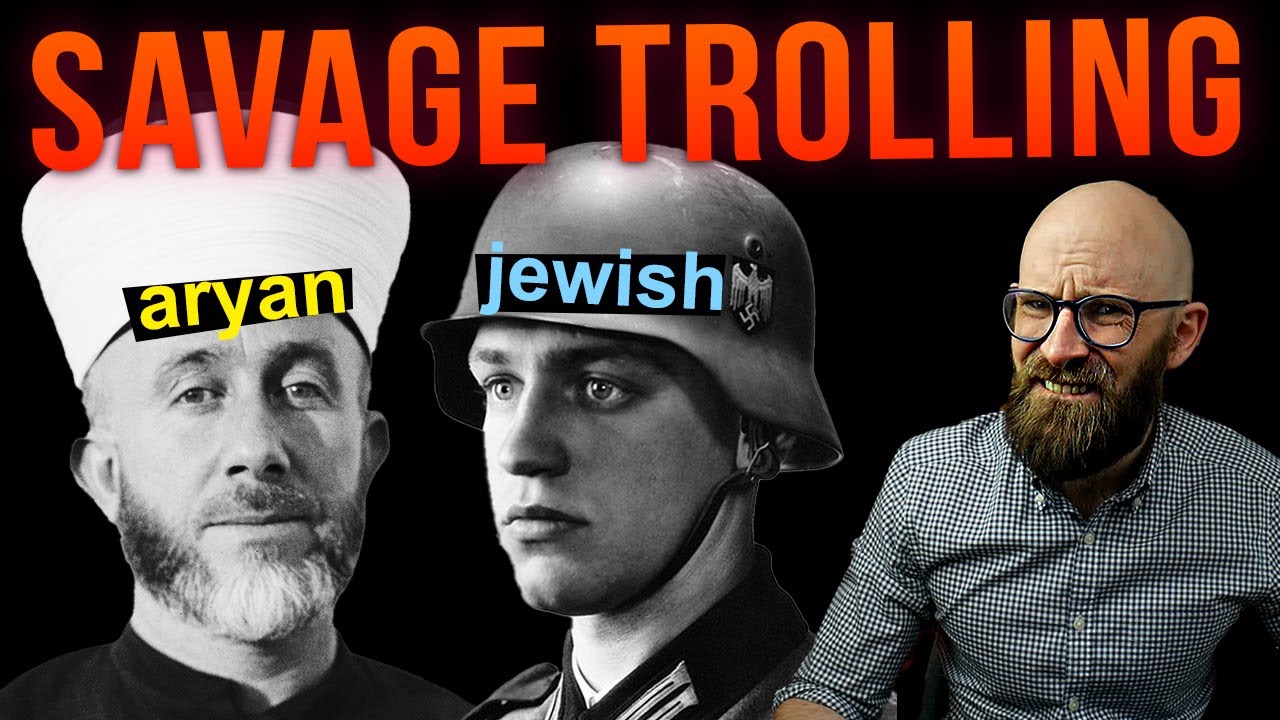
Blood Certificates were handed out to all manner of individuals whenever the authorities found it convenient to circumvent the Nuremberg Laws. For instance, in 1937, Mohammed Amin al-Husseini, the Grand Mufti of Jerusalem and a major leader of the Palestinian nationalist movement, fled Palestine and settled first in Fascist Italy and then Nazi Germany, allying with the Axis Powers in their opposition to British rule in the Middle East and the establishment of a Jewish state. In order to square the ideological circle of an Arab allying with the race-obsessed Third Reich, Adolf Hitler issued al-Husseini with a Blood Certificate, explaining that the Mufti’s blue eyes proved he was descended from European Crusaders. Right…
In other cases, however, the race of fighting men was simply ignored. For instance, in Eastern Europe, the Waffen SS recruited large units of foreign volunteers – including decidedly non-Aryan Cossacks, Turks, and Bosnian Muslims – using them mainly for anti-partisan operations. But not all soldiers were so fortunate, for despite the crumbling strategic situation and severe manpower shortages, near the end of the war Nazi ideology increasingly began to trump military logic, and thousands of mischlinge and other “non-Aryans” were expelled from the German armed forces, with many being declared fully Jewish and deported to labour and death camps. Caught between two worlds, the mischlinge were one of many manifestations of the deep contradictions which lay at the heart of the Nazi state.
After the war, Werner Goldberg entered politics, joining the Christian Democratic Union of Germany and serving from 1959 to 1979 in the Abgeordnetenhaus or state parliament of West Berlin. In the course of his career, he was a strong advocate for German reunification, democracy, and improved Jewish-Christian relations. Prior to his death in Berlin on September 28, 2004, at the age of 84, Goldberg reflected to historian Bryan Mark Rigg on his wartime experiences:
“The Third Reich taught me more than anything, NEVER, EVER, RUN after those who don’t want you. I, and many German Jews and Mischlinge, wanted to stay in Germany and live in this land we had grown to love. It was hard for us to understand that the Deutschland of Hitler had rejected us and did not want us. Most of us did not accept that. Listen to me, in your life, whether it be a girl, a friend, an organization, if they don’t want you, don’t run after them. Find those who accept you for who you are and be with those you like your company. When you ask me, “what is the essence of life or the secret of life?” this is it, my boy.”
Expand for ReferencesMcCoy, Terence, The “Perfect Aryan” Child Used in Nazi Propaganda Was Actually Jewish, The Washington Post, July 7, 2014, https://www.washingtonpost.com/news/morning-mix/wp/2014/07/07/the-perfect-aryan-child-the-nazis-used-in-propaganda-was-actually-jewish/
Lauren K. Wolf, Hessy Taft, Chemical and Engineering News, September 8, 2014, https://cen.acs.org/articles/92/i36/Hessy-Taft.html
Jewish Girl Was “Poster Baby” in Nazi Propaganda, Yad Vashem, July 2, 2014, https://www.yadvashem.org/blog/jewish-girl-was-poster-baby-in-nazi-propaganda.html
Rockaway, Robert, Hitler’s Jewish Baby, Tablet, April 19, 2022, https://www.tabletmag.com/sections/history/articles/hitlers-jewish-baby
Moskowitz, Ira, Caught in the Middle, Part-Jewish Germans Served in Nazi Army, Haaretz, https://web.archive.org/web/20171213040920/https://www.haaretz.com/caught-in-the-middle-part-jewish-germans-served-in-nazi-army-1.185805
Rigg, Bryan, The Sad Story of Werner Goldberg: a “Half-Jew” in Hitler’s Army, LinkedIn, https://www.linkedin.com/pulse/sad-story-werner-goldberg-half-jew-hitlers-army-bryan-mark-rigg
Werner Goldberg, a German who was of half Jewish ancestry, and whose image appeared in the Berliner Tageblatt as “The Ideal German Soldier”, World War II Gravestone, https://ww2gravestone.com/werner-goldberg-german-half-jewish-ancestry-whose-image-appeared-berliner-tageblatt-ideal-german-soldier/



| Share the Knowledge! |
          |
 |