
A Wingtip and a Prayer: The Insane Way British Pilots Defeated Germany’s Secret Weapon
 In the early morning hours of June 13, 1944, the residents of East London were awoken by an unusual sound: a loud, high-pitched chugging like a motorcycle with a broken muffler. Looking up, they saw a small aircraft skimming over the rooftops at tremendous speed, a tongue of flame trailing from its tail. Moments later, the aircraft plunged to the ground in Bethnal Green, and a massive explosion shook the ground. The blast shattered windows, crumbled brick walls, and blew the Great Eastern Railway bridge over Grove road in half. When the smoke and dust settled, 6 people lay dead and 30 severely injured. Over the following days rescue crews combed the rubble for the remains of the crashed aircraft and its crew. They found none, because there were none. London had just come under attack by a new kind of weapon: an unmanned, jet-powered flying bomb. The Germans called it V-1, the British the “buzz bomb” or “doodlebug.” Over the following year, thousands of V-1s would rain down on London and other cities, killing and injuring many thousands in turn, and forcing the British to turn to increasingly desperate measures to stem the tide – including one of the boldest and most badass tactics in the history of aerial warfare. This is the story of how one of Nazi Germany’s most effective “wonder weapons” was finally defeated.
The V-1 was the brainchild of Fritz Gusslau and Robert Lusser, engineers at the Berlin-based Argus Motoren company. During the 1930s, Argus perfected a new type of propulsion system known as the pulse-jet, originally invented by engineer Paul Schmidt. Among the simplest forms of jet propulsion, a pulse-jet consists of a tapered metal tube with spring-loaded shutter valves at one end, a fuel injector, and a spark plug for ignition. When the fuel is injected and ignited, the increase in pressure causes the shutter valves to close, forcing the combustion gases to exit out the rear of the engine. The resulting partial vacuum then causes the shutter valves to open, letting in fresh air which mixes with the fuel and ignites, starting the cycle anew. This cycle, which repeats around 500 times per minute, produces the pulse-jet’s distinctive buzzing or chugging sound. Once the engine is started, the spark plug is no longer needed, as the acoustics of the tube maintain a stable flame front that ignites the fuel-air mixture during every cycle. While loud and inefficient, the pulse-jet had the advantage of being extremely cheap and easy to build – perfect for disposable unmanned aircraft. At first Gusslau and Lusser proposed a remote-controlled target drone for training anti-aircraft gunners, but this eventually changed to an autonomous cruise missile armed with a high-explosive warhead. With its regular manned bomber force severely depleted, the German Luftwaffe was desperate for a new means of attacking the British Isles, and so on June 19, 1942, the flying bomb project was approved. Production of the engine was awarded to Argus, the fuselage to the Fieseler aircraft company, and the guidance system to the Askania company. Though designated in-house as the Fieseler Fi.103, to conceal its true purpose from the Allies the weapon was officially dubbed the Flakzeilgerät-76 or “anti-aircraft aiming device.” Throughout its service it was also known by various codenames such as kirschstein or “cherry pit” and maikäfer or “May bug.” But it was Hans Schwartz Van Berkl, a journalist for the Nazi newspaper Das Reich, who would bestow the missile with its most infamous name: Vergeltungswaffe-1 or “vengeance weapon one”.
The finalized V-1 design measured 7.5 metres long with a wingspan of 5 metres, the fuselage being built out of heavy rolled sheet steel and the detachable wings from plywood. Its Argus 109-014 pulse jet engine, producing 3.5 kilonewtons of thrust, was mounted on top of the fuselage and gave the V-1 a maximum speed of around 400 mph or 640 km/h – faster than most contemporary propeller-driven fighter aircraft. The engine ran off regular 80-octane aviation gasoline fed from a 640 litre tank in the fuselage, which was pressurized using a spherical tank of compressed nitrogen. The aircraft had no ailerons, while the rudder and elevators were operated by pneumatic servos controlled by a simple autopilot. This consisted of two gyroscopes to control pitch and yaw, a magnetic compass to maintain heading, and an atmospheric pressure sensor to maintain altitude. The range of the weapon was controlled by a simple wind vane device in the nose connected to an odometer, which was set just before launch. After a predetermined number of revolutions, the odometer fired a set of explosive bolts that jammed the elevators downward, sending the missile into a crash dive. As you might expect, this system was highly inaccurate, being easily thrown off by winds aloft, but was accurate enough for use against city-sized targets like London. Also of note, the sudden dive also had the unintended effect of making the fuel slosh to the front of the tank, causing the engine to cut out. Citizens of target cities quickly learned to use this sudden cutoff to their advantage, as it meant they had between 5 and 15 seconds to take cover before the missile impacted the ground and detonated its 850-kilogram high-explosive warhead.
Development of the V-1 took place at Peenemunde, the Luftwaffe’s top-secret research centre on the Baltic coast. Here, on Christmas Eve 1942, the first prototype missile was successfully launched from the island of Usedom. The Argus 109 pulse jet did not produce enough thrust for the V-1 to take off under its own power, so the missile had to be launched using a steam-powered catapult similar to that used on modern aircraft carriers. This consisted of a 49-metre long inclined ramp with a slotted tube running along its length, into which a dumbbell-shaped piston was inserted. A small lug protruded from the top of the piston through the slot in the tube, which was connected to the bottom of the missile. The catapult was then connected to a steam generator which reacted concentrated hydrogen peroxide with potassium permanganate to create a hot, high-pressure mixture of steam and oxygen. This propelled the V-1 from zero to 320 km/h in around one second, after which the missile’s own engine took over.
Yet despite this early start, development of the V-1 dragged on for more than a year, with dozens of missiles being test-launched before the design was perfected. Many of these teething problems were due to poor manufacturing quality, a consequence of German industry crumbling under constant Allied bombardment. Full-scale production of the missile did not begin until April 1944, with the first batch of 1,000 being manufactured at the Volkswagen plant in Fallersleben near Hamburg. Meanwhile, a new unit was formed under the command of Luftwaffe Oberst Max Wachtel to launch the missiles. As with the V-1 itself, the unit was officially designated Flakregiment-155 to disguise its true purpose from the Allies. The regiment arrived in the Pas-de-Calais region of France in early June 1944, but did not receive the equipment needed to launch its missiles until the 12th – nearly a week after Allied forces successfully landed in Normandy. This delay was caused not only by material and logistics shortages, but also political infighting over the nature of the V-1 launch sites. Adolf Hitler, obsessed with monumental fortifications, insisted that the missiles be launched from large, heavily fortified concrete emplacements. Many of his generals, however, saw such installations as too vulnerable to Allied air attack, and argued for smaller, mobile launch sites. Luftwaffe Reichsmarschall Herman Göring struck a compromise, ordering 4 fixed and 96 mobile sites.
In the end, the Generals were proven correct, as Allied aerial reconnaissance photographs immediately revealed the existence of the fixed V-1 sites – easily recognizable by their launch ramps and trio of strange, J-shaped buildings. These structures, used to store the missiles prior to launch, resembled skis turned on their side, and so the launch installations became known as “ski sites.” At first the nature of these sites was a mystery, but when it was realized that all the ramps were aimed directly at London, their purpose became chillingly clear. Earlier, in the summer of 1943, a British aerial photo interpreter named Constance Babington Smith spotted similar launch ramps at the Peenemunde test centre, as well as a small cruciform object 7 metres wide which she correctly interpreted as a flying bomb. In order to halt development of this and other German rocket weapons, in August 1943 the Allies launched Operation Crossbow. The opening act of Crossbow, Operation Hydra, was a night bombing raid against the Peenemunde facility, conducted on the night of the 17th and 18th of August. The raid was largely successful, killing many German scientists and disrupting weapons research for two months. However, many of the bombs also fell on the nearby Trassenheide concentration camp, killing many forced labourers.
In any event, once ski sites began appearing in France in early 1944, both the Royal Air Force and U.S. 8th Air Force launched a concerted bombing campaign to destroy them. However, this simply forced the Germans to abandon the fixed launch sites and switch to simpler “modified sites,” which used prefabricated metal launch ramps and were easier to camouflage in forests or structures like factories and farm yards. By the early morning of June 13, 1944, the Germans were finally ready to unleash their new secret weapon on the British capital. But the opening salvo would be a modest one, for of the 100 launch sites ordered, 65 had been completed – while only 10 had sufficient supplies and spare parts to become operational. Nonetheless, Oberst Wachtel proceeded with Operation Eisbär or “Polar Bear” – the campaign of German revenge for the D-Day landings.
The launch sequence for the V-1 began with the missile being wheeled out of its J-shaped hangar, whereupon its wooden wings were attached, its fuel tank filled, its nitrogen spheres pressurized, and its range vanes set. The missile was then wheeled into a square building built entirely without metal or any other magnetic materials. You see, one of the major problems which had plagued the V-1’s development was its sheet metal skin throwing off the magnetic compass. This was overcome inside the metal-free hangar by beating the missile’s skin with wooden mallets, forcing the fuselage’s magnetic field to align with the direction of the launch ramp. The missile was then mounted on the launch ramp, and connected to the steam generator and launch controls, whereupon the launch crew fled to the safety of a control bunker or a slit trench. Compressed air was used to start the pulse jet, the gyroscopes were spun up, and the steam generator activated, launching the missile up the ramp.
The first V-1 was launched at 3:30 AM on June 13, 1944, quickly followed by 9 more. Of these, 4 crashed shortly after takeoff, 2 plunged into the English Channel, 3 came down in fields in Kent and Surrey, and one reached London, coming down in Bethnal Green. But the pace of the attack quickly accelerated. By the end of the following day, 393 V-1s had been launched. By June 18, that number had risen to 500. While many of the bombs failed to reach their targets, when one did the effects were devastating. The blast from the giant warhead could pulverize brick and concrete, while the momentary vacuum left in its wake created a “double-whammy” effect that could be just as destructive as the initial explosion. On one occasion, the heavy wooden doors of a firehouse were slammed shut by the blast only to be wrenched back open by the vacuum. Londoners soon came to dread the ominous buzzing sound of the “doodlebug” and the cold, robotic way it ploughed towards its target, which British author Evelyn Waugh described as:
“…impersonal as a plague…as though the city were infested with enormous venomous insects.”
To counter this terrifying new threat, the British launched Operation Diver, sending 23,000 personnel and thousands of antiaircraft guns and barrage balloons to the coast of Kent where they could intercept V-1s launched from the Pas de Calais. As luck would have it, British gunners were able to take advantage of a powerful new weapon just then coming into service: the proximity fuze. Essentially a miniaturized radar set mounted in the nose of a shell, the proximity fuze detonated the shell when it came within a certain distance of its target, turning what were previously near-misses into kills. The coastal guns also enjoyed the advantage of a no-fly zone established within their field of fire – allowing them to shoot at anything that moved- and the use of the new American SCR-584 gun-laying radar. This gun screen proved remarkably effective, shooting down 50% of all V-1s launched in the first week of the campaign. By the last week of August, their success rate had risen to 84%.
The task of destroying those V-1s that managed to get through the artillery screen fell to eight fighter squadrons stationed around London. These squadrons were equipped with the powerful Hawker Tempest V and Supermarine Spitfire Mk. IX and XIV fighters, which were just fast enough to catch the speedy doodlebugs. Even so, actually shooting down the flying bombs proved more challenging than expected. Not only were they small and hard to hit, but their thick sheet-metal bodies deflected the standard .303-calibre bullets used in British aircraft machine guns. 20-millimetre cannons had more penetrating power but a lower velocity, forcing pilots to attack from shorter ranges and exposing them to extreme danger if the bomb’s warhead detonated. Wing Commander Roland Beaumont recalled:
“For the first few days it was rather interesting because none of us knew exactly what was going to happen; they were bombs, after all, and they were expected to blow up. We first of all started opening fire on them from about 400 yards, for safety, from astern; they were a tiny target and we used to miss them rather consistently, and so we halved the range to 200 yards. When you fired at that range and the thing exploded in front of you, you were travelling at 400 mph or more and you’d have no time to avoid the explosion, and as soon as you saw it you were in it and you’d go through the centre of the fireball and come out the other side and always come out upside-down. It was some time before we could figure this one out, but you were in fact going through a partial vacuum as you went through the centre of the explosion. In a partial vacuum the torque of this enormous propeller had the effect of twisting the aeroplane over. It was rather extraordinary. The only adverse effects were fire damage to the outside of the aeroplane – the rudder and the elevator of the Tempest were fabric-covered and quite often this used to burn…”
Other pilots were not so lucky, with 5 being killed in V-1 explosions. This included Free French pilot Jean Maridor, who died on August 3, 1944 while trying to stop a V-1 from landing on a military hospital in Kent. The extreme risks posed by shooting at V-1s prompted Wing Commander Beaumont to develop a bold new method for defeating the doodlebug:
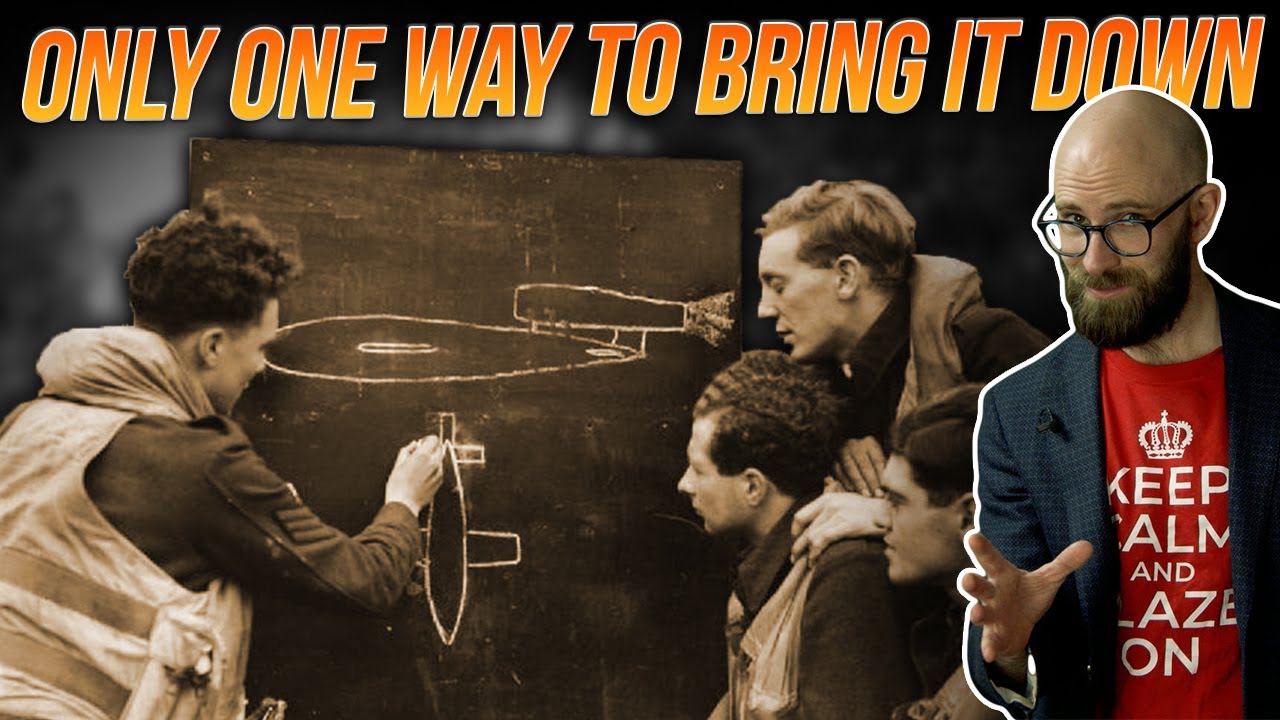
“I had used up my ammunition on one V1 and saw another and decided to do something about it. The idea was to get my wingtip close under the wingtip of the V1 but not touching it, then gradually raising my right wing causing the airflow over it to make the V1 bank. This affected the gyro-stabilization of the missile, causing it to go out of control, toppling over and crashing.”
“Wing tipping” would not be the only clever means of defeating the V-1s as we’ll get into shortly, but it nonetheless soon became the standard method for taking them down, though it was not without its own risks. The Spitfire and Tempest, being optimized for lightness and speed, were built of relatively delicate aluminium alloy, meaning many an aircraft returned to base with severely damaged wings following a wrestling match with the much more robust V-1.
Another valuable weapon which had just come into service was the Gloster Meteor, Britain’s first jet-powered fighter. With a top speed of 600 mph, the Meteor was more than a match for the V-1, though its 20-millimetre cannons had an unfortunate habit of jamming. On August 4, 1944, Flying Officer T.D. ‘Dixie’ Dean of No.616 squadron used wing tipping to bring down a V-1 over Tunbridge Wells, scoring the first-ever combat victory for an Allied jet aircraft. By war’s end, No.616 Squadron would shoot down a total of 13 V-1s. The most prolific V-1 ace, however, was Tempest pilot Squadron Leader Joseph Berry of No.501 Squadron, credited with 59-1/2 victories. He was followed in the rankings by Dutch Spitfire pilots Flying Officer R.F. Burgwal and Flight Lieutenant J.L. Plesman with 21 and 12 victories, respectively.
The efficiency of Operation Diver steadily increased until, by late August 1944, hardly any V-1s were getting through the defensive screen. For example, of the 94 bombs launched on August 28, 65 were brought down by guns, 33 by fighter aircraft, and 2 by the belt of barrage balloons encircling London. The Allied air forces also continued their Crossbow bombing campaign against V-1 launch sites and storage depots, greatly reducing the number that could be fired. But of the 3,531 V-1s that actually reached the English coast, the vast majority were defeated not by guns or aircraft but by clever counter-intelligence. Though some V-1s were fitted with radio transmitters so their flights could be tracked, the Germans relied more on secret agents to report where the bombs fell. What the Germans didn’t know, however, was that nearly all their agents in the British Isles had been captured and turned in a massive counter-intelligence operation called Double Cross. Using Double-Cross agents, British Intelligence was able to convince the Germans that most of their V-1s were overshooting their targets. This, in turn, led the Germans to set their ranges too short, causing many V-1s to dive harmlessly into the English Channel. But what ultimately defeated the V-1 were the advancing Allied ground forces on the continent, who in September 1944 overran the launch sites in France and brought the main bombardment campaign to an end.
Undeterred, the Germans switched to launching V-1s from beneath the wings of Heinkel He-111 and He-117 bombers. Around 1,200 of these bombs were launched against Portsmouth and Southhampton and 50 against Manchester, but due to stability problems few actually reached their targets. But as the strength of the Luftwaffe gradually dwindled and more and more airfields were overrun, the V-1 campaign quickly tapered off, with the last bomb to reach England being shot down over Suffolk on March 29, 1945 – barely a week before Nazi Germany surrendered.
By this time, however, England had come under attack by an even more advanced weapon: the V-2 ballistic missile. Fuelled by alcohol and liquid oxygen, the V-2 climbed up to the edge of space before plunging down on its target at twice the speed of sound, making it impossible to hear or see coming or to shoot down. Development of the V-2 actually began long before the V-1, but due to its greater complexity it was not ready for operational use until September 1944 – around the same time the main V-1 campaign came to an end. That said, between September 7, 1944 and March 27, 1945, 3,172 V2s were launched against targets in southern England, Belgium, the Netherlands, and France. However, the V-2 was even more inaccurate than the V-1 – a flaw made worse by misinformation on missile impacts spread by the Double Cross System – and even less reliable. Also, its silent, supersonic approach ironically made it less effective as a weapon of terror, lacking the dread factor of the V-1’s distinctive droning sound.
But arguably the V-2’s greatest flaw was its unjustifiably astronomical cost. Each V-1 cost around 5,000 Reichsmarks – equivalent to about $500 USD. Of the 10,500 V-1s launched over the course of the war, 3,531 reached their targets, killing 6,000, wounding 40,000, and causing around $150 million in property damage. This comes out to 0.008 casualties and $28 of damage for every dollar spent on the weapon. Each V-2, by contrast, cost a whopping 100,000 Reichsmarks or $17,000 dollars – the same as a top-of-the-line fighter aircraft – not counting development costs. Yet the 3,172 V2s launched during the war only killed around 5,000 people and wounded 6,500 – a casualties-to-cost ratio nearly 40 times smaller. The human cost of its creation was also atrocious. Around 20,000 concentration camp inmates died in horrific underground factories producing Hitler’s second vengeance weapon, making the V-2 the only weapon in history to kill more people in its manufacture than in combat. Indeed, the V-2 program diverted so many vital resources from the German war effort that American theoretical physicist Freeman Dyson once remarked:
“… those of us who were seriously engaged in the war were very grateful to Wernher von Braun [the director of the V-2 program[. We knew that each V-2 cost as much to produce as a high-performance fighter airplane. We knew that German forces on the fighting fronts were in desperate need of airplanes, and that the V-2 rockets were doing us no military damage. From our point of view, the V-2 program was almost as good as if Hitler had adopted a policy of unilateral disarmament.”
Thus, despite its relative crudeness and its inability to secure victory for the Third Reich, the V-1 was among the most cost-effective Nazi secret weapons of the war, inflicting considerable psychological damage and industrial disruption at a relatively low cost. It was also a weapon ahead of its time, laying the foundation for advanced guided cruise missiles like the BGM-109 Tomahawk still in use today.
Expand for ReferencesJohnson, David, CH. X: Buzz Bomb Blasts Britain, WWII Air War: The Men, The Machines, the Missions, Cowles Enthusiast Media/History Group, 1996
Johnson, Brian, The Secret War, Arrow Books, London, 1978
AA27403 Gloster Meteor ‘Dixie’ Dead, RAF No.616 Sqn and Fieseler ‘Doodlebug’ 4th August 1944, https://www.warkswings.com/aa27403-gloster-meteor–dixie-dean-raf-no616-sqn—and-fieseler–doodlebug-4th-august-1944-2514-p.asp
Missile, Cruise, V01 (Fi 103, FZG 76), Smithsonian Institution, https://www.si.edu/object/nasm_A19600341000
Lister-Fell, Francesca, World War II’s First ‘Doodlebug’ V-1 Flying Bomb Was Dropped on Grove Road, Roman Road London, June 10, 2020, https://romanroadlondon.com/first-v1-flying-bomb-doodblebug-hits-london/



| Share the Knowledge! |
          |
 |