
How was the German Army so Successful at the Start of WWII Against Vastly Superior Numbers?
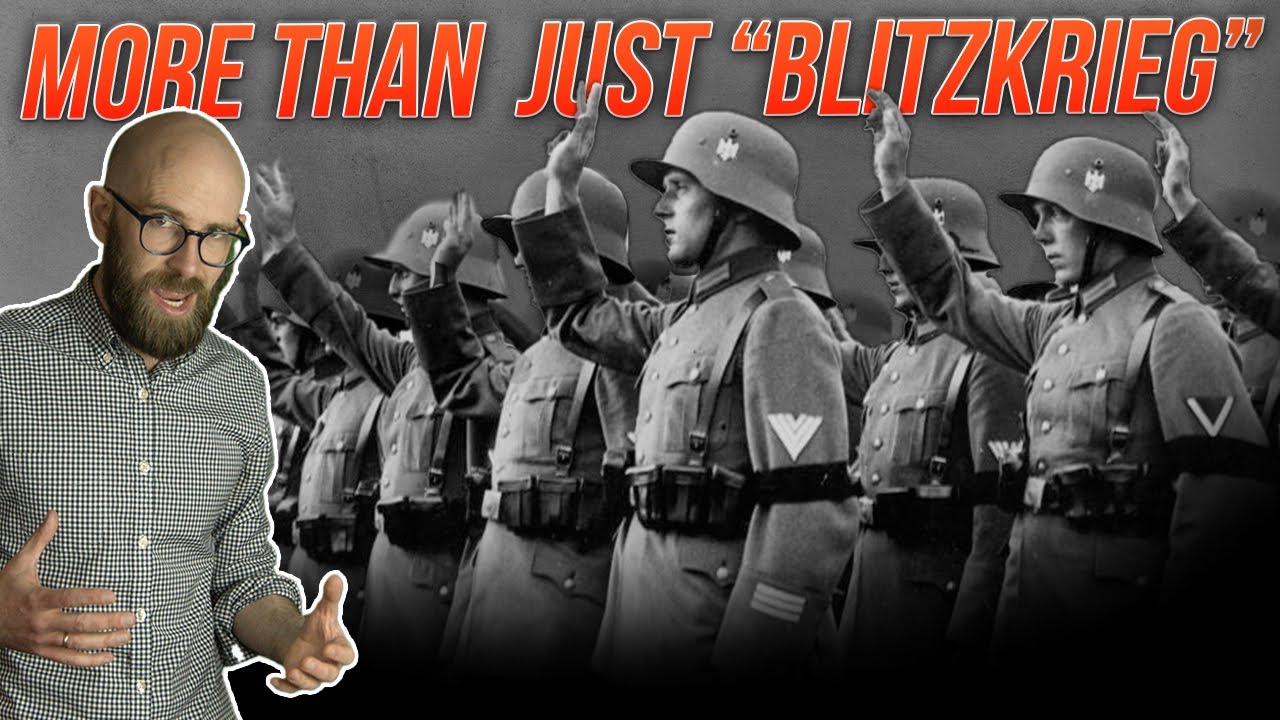 In the first two years of WWII, the German armed forces – or Wehrmacht- and especially the Army – or ‘Heer’- stunned the world with an unprecedented string of victories against several otherwise prominent nations that it boggles the mind one small nation could so easily conquer, let alone so rapidly. From September 1939 to December 1941, German troops occupied Poland, Denmark, Norway, Belgium, Netherlands, Luxembourg, France, Yugoslavia and Greece.
They also ejected the British Expeditionary Force from continental Europe, sank countless Allied convoys in the Atlantic, and, alongside Italy and other Axis powers, collected further victories in Northern Africa and the Soviet Union.
So what made the Wehrmacht so effective against so many other nation’s armies that on the surface should have been able to repel them? It is tempting to reply with a single, all-encompassing answer: It was because German soldiers were indoctrinated fanatics! It was down to superior German technology! The Germans won because they got as high as Stukas on meth! And another favourite go-to-answer for keyboard generals: Because Blitzkrieg Tactics!!!
But as you’ll no doubt guess from the length of this piece, contrary to popular belief, it’s not really so simple as that and there was a lot more that went into it.
To briefly address the first of the often put forth answers, the use of methamphetamine was introduced amongst both Axis and Allied soldiers, as a means to combat fatigue and to heighten morale. However, German officers realised early on that the negative side effects of the drug far outweighed its benefits and discouraged its use. Moving onto ‘Blitzkrieg’, or ‘Lighting War’, this has been described alternatively as strategy, a tactical mindset or a doctrine. But in reality, the German military despised the term, which was used by press and propaganda to describe the effects of a successful combined arms offensive.
Now, to be fair, the German approach to combined arms operations – although never described as ‘Blitzkrieg’ – played an important role in securing military successes – but they were not the single deciding factor.
To the surprise of absolutely no one – I hope – once again, the early victories of the III Reich were a combination of several factors, many of which had been at play since the early 1920s.
So let’s dive into it, shall we?
To begin with, let’s discuss Interwar Rearmament
At the end of WWI, the victorious Entente imposed a substantial disarmament on the Weimar Republic, the successor State to the 2nd German Reich. Article 160 of the Treaty of Versailles limited the Reichswehr to a land army of 100,000 soldiers with no General Staff, no airforce, no tanks and a small navy.
In essence, Germany was allowed to maintain a military devoted exclusively to preserving order within its territory and patrolling the borders. These restrictions were to be enforced by the Inter Allied Military Control Commission, which maintained a presence in Germany until 1927.
With such a heavy disadvantage, how could Germany rebuild its forces and become such a military threat in the 1930s? Well, the truth is that the Weimar Republic circumvented these limitations from the early 1920s.
First of all, they kept their General Staff, although it was rebranded as ‘Truppenamt’, or ‘Troop Office’. As early as May 1923, this office drafted secret plans to mobilise an army larger than the Versailles-imposed restrictions.
A document captured at the end of WWII showed that these early plans envisaged two options: the creation of a force of either 18 or 35 infantry divisions.
While the chance to equip the second option was admittedly slim, the Reichswehr appeared confident they could outfit the first option. Considering a division strength of at least 14,000 men, the Reichswehr packed enough guns and ammo to field an army of 252,000 troops, more than double than the size permitted by the Versailles Treaty.
In fact, the German government had access to large secret stashes of weapons, either maintained in secret from the WWI arsenals, or imported illegally. Moreover, throughout the 1920s large numbers of men underwent unauthorised military training by joining one of dozens of paramilitary units, politically motivated militias or sporting associations. Notable examples include the SA, the ‘Brown Shirts’ employed by the Nazi Party. Or their communist equivalent, the Red Front Fighters’ League.
In 1926, the mobilisation plan was toned down to 16 divisions. But in 1932, War Minister General von Schleicher created a new plan, designed to fully equip 21 divisions by 1938.
In 1933, when Adolf Hitler became first Chancellor, and then Fuehrer, he ordered to accelerate Schleicher’s mobilisation plans. These were carried out in secret, in the span of 18 months. However, these troops were badly equipped and poorly trained.
Two years later, in March of 1935, Hitler further ordered for the standing army to be ramped up to 36 divisions. To compensate for the additional efforts, German military expenditure doubled in the 1933 to 1935 period, from 3 to 6% of gross national product. This rate of expenditure would continue to grow, reaching 23% in 1939 and peaking at an astounding 61% in 1943.
Now, we have mentioned that the Troop Office could rely on a pool of men who had already received basic training – albeit privately – from their political party of choice. And these men could surely hold their own in a fistfight, or when handling small arms such as rifles and machine guns. But how about developing competence with tanks, aeroplanes and submarines? That was a no-no according to the Inter Allied Commission.
But the Troop Office had an answer to that. Going back a bit, in February of 1919, Weimar authorities arrested a Russian national, Karl Radek, due to his involvement in the Spartacist Revolution, a communist uprising. Thanks to his contacts with Germany’s military attaché to Moscow, Radek avoided a harsh prison sentence. He was even able to hold a political salon in August of 1919, in which he first suggested a political and military collaboration between the Weimar Republic and Soviet Russia. The idea was further expanded following the Russian defeat in the Russo-Polish war of 1920, its main driver being German General Hans von Seeckt.
And so it was that in early 1921, the Troop Office established ‘Special Group R’, devoted to collaboration with Russia. Germany was to offer financial and technical aid to build Russia’s armament industry. In exchange, Berlin would receive artillery ammunition – which it was forbidden from manufacturing by the Versailles Treaty.
The two powers concluded an economic treaty on April the 16th 1922, the Treaty of Rapallo, which was rumoured to contain secret military clauses. This was just unsubstantiated rumour but it captured the cloak-and-dagger nature of the military negotiations, conducted mostly behind the back of the German Ministry of Foreign Affairs.
In any event, from February to August of 1923, the Chief of the Toop Office, General Otto Hasse, conducted secret talks with Moscow, in which the two parties discussed a defensive alliance against Poland and its ally, France. The most tangible outcome of the talks was the establishment of a Special Group R detachment in Moscow: the ‘Zentral Moskau’ or ‘Z. Mo.’ for short.
In 1924, the Z. Mo. founded three secret schools to test and train troops on weapons systems forbidden by Versailles. These were located in Lipetsk, Kazan and Saratov. And were dedicated to aircraft, tanks, and gas warfare respectively. These secret plans however did not escape the watchful eye of French and Polish intelligence, and news leaked to Britain.
In December of 1926 The Manchester Guardian blew open the affair, embarrassing the Weimar government. But even officials initially opposed to the dealings with Russia begrudgingly admitted to the importance of this friendship in rebuilding the German military.
What followed was a token reaction from the Weimar government to reassure the world that they were all about peaceful coexistence. First, they discontinued the import of Soviet ordnance by early 1927 … BUT we should probably also mention military industrial cooperation resumed the following year…
As for the three schools, they were handed over to private enterprises – which continued to train off-duty German officers as private individuals. In other words: it was totally fine for a reserve officer to catch a train to Kazan and play around with tanks for a couple of weeks.
The schools founded by the Zentral Moskau continued their operations until 1933, providing a solid base for the future development of German combined armour and aircraft tactics. With the rise to power of the Nazi Party, however, the ideological gap between Germany and the Soviet Union became too large, and the training stations were closed by September 1933.
A similar scheme had been put in place to develop the submarine capabilities of the Kriegsmarine [Kreegs Mari-nay], or Navy. In this one, in 1922, a consortium of three German shipyards founded a new company headquartered in The Hague, Netherlands. This company’s innocent-sounding name was ‘Engineering Office for Ship-building’, or IVS in its German acronym. The not-so-innocent purpose of the IVS was to build and test U-Boats in Dutch shipyards.
Three years later, in 1925, the Naval Ministry poured funds into IVS when Turkey placed an order for two U-Boats. These vessels needed to be tested, so Navy officers Admiral Spindler and Corvette Captain Canaris created a ‘Training Office’ within the ministry.
Worthy of note: Canaris would later rise to the rank of Admiral, and become the head of the Abwehr, Nazy Germany’s military intelligence service. In that capacity, Canaris actually undermined Hitler’s plans for conquest and for the extermination of ‘undesirables’ via sending secret military plans to the Allies and actively protecting certain Jews from arrest – but more on all this in a bit, and how the Allies really messed up with regards to all of this.
Back to the mid-1920s now. Spindler assigned two retired Naval officers to set up a U-boat training school in conjunction with the Turkish Navy. This was the start of another secret training program, albeit less developed than the schemes founded by the Zentral Moskau. Specifically, in 1927, Spindler established a Torpedo and Radio school in Flensburg, northern Germany, where 24 young officers received theoretical lectures delivered mostly via films shot during WWI.
By now you should have noticed a recurring theme emerging: a massive amount of training
A thorough preparation of fighting personnel had always been a staple of first Prussian, then German military life. When the Nazi Party assumed power this became even more important, and something they were extremely successful at. As American military analysts Trevor Dupuy and Martin Van Creveld in a study of both Allied and German troops facing each other after the D-Day landings of June the 6th 1944 noted, “On a man for man basis, German ground soldiers consistently inflicted casualties at about a 50 percent higher rate than they incurred from the opposing British and American troops under all circumstances. This was true when they were attacking and when they were defending, when they had a local numerical superiority and when, as was usually the case, they were outnumbered, when they had air superiority and when they did not, when they won and when they lost.”
Another analyst, W. Victor Madej, writing for the Journal of Political and mIlitary Sociology in 1978, noted how Allied propaganda and popular culture had perpetuated the idea that German early military success and later perseverance could be traced back to fanaticism, fuelled by propaganda and indoctrination. This idea was itself rooted in the belief that totalitarian states could somehow instil their forces with an almost supernaturally high morale and willingness to fight. But Madej quoted a study conducted by Edward Shills and Morris Janowitz of the Allied Psychological Warfare Division, which revealed that German troops’ morale and willingness to fight had little to do with political belief, and mostly derived from group cohesion at small-unit level. Madej partially accepted this view, but preferred another conclusion: the Wehrmacht’s effectiveness derived, very simply, from military professionalism and the ‘proper use of weaponry’.
In other words: German soldiers were extremely effective soldiers not so much from fanaticism, but because they were extremely well trained.
You may remember that Hitler’s government doubled military expenditure from 1933 to 1935. That is when intensive troop training really kicked in. But the arms budget did not yet allow the German coffers to equip all units with the best and latest military technology. Hitler’s General Staff therefore decided to concentrate their efforts on a small number of selected units, which would be used as a spearhead for offensive operations.
So now let’s take a look at these training regimens.
Rank-and-file soldiers, usually conscripts, were initially subjected to 16 weeks of basic drills, consisting of physical fitness and fire and manoeuvre techniques. These were followed by further three months of schooling in armour, artillery or other specialised branches.
Training from sunrise until dark, recruits underwent lengthy forced marches, live fire exercises and conditioning exercises, which caused high rates of injuries and exhaustion. Soldiers also became familiar with the grooming and handling of horses. This was an absolute necessity: despite the propagandist image of a Heer speeding through Europe atop trucks, tanks and motorcycles, the reality was that less than 20% of German infantry was actually motorised at the time!
Further, career soldiers who had previously served in the Weimar Republic’s Reichswehr, or foot soldiers with potential, were selected to join the noncommissioned officer ranks, the backbone of the Heer. In this case, candidates completed four months of basic instruction, followed by six months of specialisation.
As you might expect, training for commissioned officers was even lengthier and more intense. Candidates first had to go through the same courses as a noncommissioned officer, totalling 10 months. Then, they were assigned to an already serving unit for a period of 7 months. During this period, they developed affiliation and cohesion with existing units and honed their leadership skills. Finally, candidates completed three months of advanced specialisation with an infantry, armour, artillery or support branch.
Throughout the training, would-be officers learned how to lead from the front. A concept which heightened morale and stressed the importance of independent tactical decisions, provided they served a pre-assigned operational goal. This approach proved incredibly effective, as officers learned how to exploit enemy weaknesses on the spot and take often brilliant initiatives. The flipside was the high death rate amongst leadership ranks: in the first three years of WWII, more than 16,000 German officers died in action.
Moving on to the service branches, their training was likewise top notch. Candidate pilots joining the German air force, the Luftwaffe, first completed a six months spell of basic drills. They then spent two months studying general aeronautical topics, before moving to flying school. The first step was to learn how to pilot light aircraft, a course which included aerodynamics, engineering, navigation, meteorology and communications.
Upon completion, candidates learned how to fly heavier, high-performance craft, which awarded them a ‘B flying licence’. Next, trainees split into two separate specialty courses: one for single-engined fighters and dive-bombers; and one for twin-engined fighters, bombers and reconnaissance craft. By the time a fighter or dive-bomber pilot had completed his course, he would have received about 13 months of training, totaling 150 to 200 flying hours. While a bomber or reconnaissance pilot had undergone 20 months in school, with 220 to 270 flying hours.
The longest training period, however, was the one reserved for Naval officers. Recruits started their tenure with 10 weeks of basic drilling, followed by three months at sea. Only those selected by instructing officers were given the rank of Cadet, and allowed to move to the next stage: 10 more months of life at sea, serving as an ordinary sailor.
After another examination, cadets were promoted to Midshipman. And only then, they got access to Naval Officer school, which lasted two years. And it didn’t end there! Graduates were given a non commissioned rank, Warrant Officer, and were finally promoted to Officer only upon selection by their ship’s commander.
So, that covers the manpower and the extensive training the soldiers spearheading the initial attack had previously received.
But soldiers, sailors and pilots needed the kit, which required Hitler to ramp up German Rearmament Programs
On this one, besides what’s already been discussed, in 1933, German military aircraft production totalled to a nice, round figure: 0. But by 1934, it had risen to 840 units. The following year, production more than doubled, and continued to expand, at an average of 2,654 per year. By 1939, German industries had produced a total of 15,927 single- and twin-engined planes, of which approximately 2,000 were operational at the start of the war.
The production of tanks and self-propelled guns followed a similar curve, soaring from 0 to a total of 3,502 in 1939, of which 2,200 units were fully operational.
As for the Kriegsmarine, in 1933 they could boast only five capital ships and 22 destroyers. By 1939, this fleet had been expanded to 53 surface vessels and 63 U-boats. This rearmament, by the way, was a violation of the Anglo-German naval agreements of 1935 and 1937, which limited the German fleet total tonnage to 35% of that of the Royal Navy.
Clearly, developing such an arsenal required tons of cash. Yet the German economy had been badly hit, first by the aftermath of the Great War, then hyperinflation in the 1920s and finally by the Great Depression. So, how on Earth could the Nazis afford such an ambitious rearmament programme? Well, they couldn’t. Yet they did. So what’s going on here?
Well, they had to thank their Finance Minister and former President of the Reichsbank, Hjalmar Schlacht [Sh – lackt]. He created a dummy corporation, the Metallurgical Research Institution, which issued bills of exchange, known as ‘MeFo bills’. The government then used these MeFos – which were essentially IOUs – to pay military and heavy industry contractors, thus funding rearmament projects. Contractors could exchange the MeFos against regular currency after a period of 90 days. But most firms were happy to hold on to them, as they carried an interest rate of 4%, higher than other trade bills at the time. And even if they did want to cash them in, Schlacht continuously extended the maturation period, which eventually peaked at five years.
We could describe the MeFo system using a quote from the Nuremeberg trials: “A swindling venture on a national scale that has no precedent.”
Nonetheless, it did the trick. From 1934 to 1938, the Nazis funded their rearmament with 12 billion Reichsmarks worth of MeFo bills or, adjusting for inflation, about 104 billion dollars in 2023.
Schlacht further motivated private contractors to invest in military production by capping taxation on their dividends, as well as freezing the wages of their workers. All in all, these measures stimulated the German economy and reduced unemployment to virtually zero. Military contractors were very happy to maximise their profits. German workers were very happy, too, to have a job – at least initially.
They were all less pleased in the late 1930s, when they realised all salary increases and promotions had been put on hold. And any dissent was preemptively quelled by laws prohibiting industrial action and reallocation to forced labour details. Of course, the long-term effect of this was a reduction in productivity of factory workers, which would lead to drops in efficiency and quality in the latter half of the war.
But in any event, in addition to issuing ‘Monopoly money’ to pay for ‘Risk tanks’, the Nazi government had another source of funding at their disposal: the re-occupation of demilitarised German territories and the Annexation of Bordering Countries.
As per the provisions of the Treaty of Versailles, the German regions of the Saarland and Rhineland, bordering France and Benelux had been demilitarised. In addition to that, Saarland was also subject to French formal administration.
In January 1935, a referendum returned the Saar to Germany. A great win for the economy, as the area was rich in coal, vital for the arms industry.
Next, on March the 7th, 1936, 20,000 troops moved into the Rhineland, in flagrant violation of Versailles. Not only did this area make for the perfect staging ground for an offensive into the BeNeLux countries and France, but it was also rich in coal and iron.
This action also served as a test to gauge the resolve of Britain and France against German resurgence. The Western allies, enacting a policy of appeasement, did nothing.
Emboldened by this lack of resolve, HItler continued to absorb territories in 1938 and 1939. Notably, on March the 13th, 1938 the Anschluss took place: the annexation of Austria. It may have involved some forceful coercion on the part of Austrian Nazis, sure. But Berlin had seized an entire country without the Wehrmacht firing a single shot, which made for a fantastic return on investment for the rearmament effort. Germany had, in fact, now gained control of iron ore mines on the Ennstal Alps, as well as Austria’s cash reserves, equivalent to 782 million Reichsmarks.
The next victim of what was essentially a large-scale home invasion was Czechoslovakia. With the pretext of protecting German-speaking minorities, the Nazis successfully annexed the border Sudetenland region in October 1938. This is of course a very complex affair, known as the Munich crisis. What matters to us today is that Britain and France essentially allowed the occupation of the Sudetenland by Germany, despite Czechoslovakia’s pleas, in order to avoid a war.
Notably here, the annexation of Czech territories allowed Germany to seize control of the Skoda mechanical works, and their supply networks. Skoda is known today as a manufacturer of reasonably priced cars for suburban families. Back then, it was known as a leading manufacturer of tanks! The acquisition of Skoda allowed the Army to accelerate their armour programs, increasing the quantity and quality of tank production.
Let’s stop for a moment to focus on a character we already met, Navy officer Wilhelm Canaris. By 1938, he was already head of the military intelligence service, the Abwehr, with the rank of Admiral. Despite his position, Admiral Canaris secretly despised the Nazis, and was concerned about the increasingly bellicose plans of the Party leadership. Canaris and his deputy, Colonel Hans Oster, however, knew that not everybody in the Oberkommando der Wehrmacht – or OKW – was aligned to Hitler’s plans of conquest. It was no secret that the Fuehrer intended to expand in the East, and that would entail going to war with France and Britain – a daunting prospect for a professional, rationally-minded officer.
Thus, as the Munich crisis unfolded, Hans Oster and his agents desperately attempted to communicate with British Prime Minister Neville Chamberlain, advising to oppose the land grab in the Sudetenland. Oster’s message essentially was: if Hitler fails, his Generals will turn against him. If he succeeds, they will continue to go along with him!
Unfortunately Chamberlain ignored the advice, preferring to stick to his policy of appeasement. It wouldn’t be the last time that the West would ignore Oster’s warnings.
In any event, as it turns out, the border regions of Czechoslovakia were not enough for Hitler. Following a gradual dissolution of the country, and the independence of Slovakia, German troops took control of Bohemia and Moravia in March of 1939. Once again, the move was economically motivated: the aggressive rearmament plan had already exhausted Germany and Austria’s currency reserves, and Prague’s central bank’s gold stashes made for a much needed cash injection.
Now, to recap, we have covered how the Weimar Republic first, and then the III Reich, gradually rebuilt Germany’s military, funded the entire process and expanded their reach both to the West and to the East.
It’s time to consider how Hitler and the OKW intended to use their forces.
In other words, let’s talk strategy, operations, tactics and doctrine.
In Germany’s case, Hitler’s strategic endgame was to expand his Reich’s territory into Eastern Europe, thus conquering Lebensraum – or ‘vital space’ – for the German people.
Now, due to its central position on the European landmass, Germany was always at deadly risk of having to wage a war on two fronts. And, according to Gerhard Gross, writing for the Journal of Military and Strategic Studies in 2011, the key to avoid such occurrence rested in the Heer’s excellent operational capabilities. More precisely: the General Staff prepared for a war of manoeuvre, in which highly-mobile, well-trained units would conduct combined arms offensives against clearly established main points of effort. By using speed, surprise and initiative, officers were encouraged to envelop and neutralise enemy forces on Germany’s borders, thus preventing their build-up.
Such a way of war had already been theorised since the 19th Century by German General Helmut Moltke. This approach, dubbed ‘strategy of annihilation’, comprised three phases: rapid mobilisation, deployment, and ‘total’ or decisive battle in which the enemy armies were forced to surrender.
The realities of WWI, in which defensive weapons and tactics outperformed offensive ones, nullified any attempt to enact a successful ‘strategy of annihilation’. But advances in tank technology brought Moltke’s ideas back onto the table.
During the mid-1930s, Colonel and later General Heinz Guderian theorised the use of concentrated armoured units, up to division level, to conduct his version of ‘annihilation’, which he called Bewegungskrieg, or ‘War of Movement’ – the doctrine which later was dubbed ‘Blitzkrieg’.
But Guderian’s ‘War of Movement’ was not exclusive to Germany. Just as an example, Soviet military theorists Georgii Isserson and Mikhail Tukhachevsky had developed a similar concept – ‘Deep Battle’ – since the mid-1920s, and formalised it in a 1936 Red Army regulation manual.
When the Spanish Civil War erupted in the same year, the Soviet Union deployed substantial tank detachments in support of the republican government against Francisco Franco’s nationalist insurgence. The Soviets, however, failed to successfully conduct ‘Deep Battle’ on this occasion, which convinced Red Army commanders – and military observers worldwide – that tanks were best deployed as infantry support vehicles, divided piecemeal across standard, non-armoured divisions.
As a result, when WWII erupted in September 1939, the German land army was the only one to field substantial armoured units, able to act as a steel-clad spearhead against forces which were numerically superior, but tactically inferior.
So, that covers the land army. How about the Luftwaffe and the Kriegsmarine?
The more innovative contribution of the Luftwaffe during the early months of the war was its use as ‘artillery from the sky’, in a support function to advanced armoured and mechanised infantry units. This meant that fighters and dive-bombers such as the legendary Stukas would be used to target enemy formations from the sky, weakening their defences, their resolve and their morale, allowing for their pals on the ground to punch through the frontline.
The Kriegsmarine is perhaps the least celebrated of the three services of the Wehrmacht, and yet its commander Admiral Erich Raeder possessed a sharp, strategic mind. As of 1937, he foresaw that a land war in Europe would sooner or later set Germany on a collision course with Britain – which meant squaring off with the Royal Navy, the best and largest in the World.
Raeder devised a rearmament programme, Plan Zebra, which would almost quadruple the size of Germany’s Navy and bring it almost on par with the British. But this plan required nine years for completion, and Hitler wasn’t particularly known for his patience.
Raeder, therefore, had to maximise the strategic impact of his relatively small forces. To do this, he relegated some of his largest capital ships, such as the battleship Admiral Tirpitz to the role of ‘fleet in being’. This indicates when one or more naval units are kept in port most of the time. But due to its sheer presence, a ‘fleet in being’ requires the enemy to invest precious time and resources in managing its threat potential.
Smaller vessels, from the category of ‘pocket battleship’ down to torpedo boats and U-boats were then used in a commerce raiding capacity. The main aim of the Kriegsmarine was therefore not to wrest control of the seas from the Royal Navy, but to target merchant convoys to Britain and Allied forces in general, thus placing the economy under chokehold.
As Raeder put it: “The task of naval warfare in extra-territorial waters is war on merchant shipping. Combat action even against inferior naval forces is not an aim in itself, and is therefore not to be sought.”
And now …
Let’s Put All the Pieces Into Practice
On the 1st of September 1939, the Wehrmacht invaded Poland. On the 3rd, Britain and France declared war on Germany – and WWII was on.
Despite a heroic resistance, the Polish Army capitulated on the 6th of October. Much of the victory can be ascribed to use of armoured divisions against defenders who could field only light tankettes. But the Reich also had to thank their unlikely ally, the Soviet Union. As per the clauses of the Molotov-Ribbentrop Pact of August 23rd, 1939, the Red Army invaded Poland from the East on September the 17th.
Poland’s Western Allies, too, did their part in securing this early success. After promising Warsaw that they would attack Germany, the French Army conducted an inconclusive offensive into the Saarland, which achieved little gain before returning to base. We have an entire video dedicated to this almost forgotten invasion, Could the Allies Really Have Crushed Germany Right at the Start of WWII? If you’re interested in learning more on this.
But in any event, the next invasions took place on the 9th of April, 1940, targeting Denmark and Norway. Gaining control of Norway was essential to secure imports of iron ore from Sweden, and gaining control of Denmark was essential to secure Norway. The small and ill-equipped Danish army capitulated in a single day, whilst Norway resisted until June the 10th. In this case, the mountainous terrain of the Scandinavian country did not make for an ideal tank playground, but the Wehrmacht conducted effective amphibious and airborne assaults to neutralise stiff Norwegian resistance.
Once again, the German forces received a great deal of help from the Western Allies. Anglo-French forces had planned to mine the waters of major Norwegian ports on April the 5th, before landing in Norway. But the plan was postponed, allowing for the Wehrmacht to rock up, invited by local collaborationist Vidkun Quisling.
In later stages of the campaign, Allied forces did conduct landings in Norway to oppose Hitler’s progress, but they were generally ill-equipped for mountain warfare and were subject to strafing attacks from the Luftwaffe.
While hostilities in Norway were still raging, on May the 10th the Wehrmacht launched its largest attack to date, against Belgium, Netherlands, Luxembourg and France.
Now, it turns out, this campaign could have been stopped in its tracks from the get go.
This brings us back to Hans Oster, right-hand man to head of military intelligence Admiral Canaris. Oster was dead set on preventing Hitler’s rabid dreams of hegemony. In 1939, Oster had become a close friend of Major Gijsbertus Sas, the Dutch military attaché in Berlin. Oster informed him in advance of the German plans to invade France and the BeNeLux countries, initially slated for November 1939.
Sas relayed the intelligence to his superior General Reijnders, who unfortunately did not take it seriously, adamant that Germany would never violate Dutch neutrality! We know that the November invasion was postponed until May 1940. But had Oster been taken more seriously, the Western powers could have been better prepared to stop the Wehrmacht’s next, and most successful, exploit.
This campaign was a masterful example of the principles of ‘strategy of annihilation’ and Bewegungskrieg. The German Army Group C maintained static positions in front of France’s main defensive barrier, the Maginot Line. But this was just a ruse to deter the French Army from redeploying forces away from the Line. Meanwhile, Army Group B advanced into the Netherlands, facing the Allied armies. But this was just a ruse again to distract the Allies from the real threat- General von Rundstedt’s Army Group A, a large force of 44 divisions, 7 of them entirely armoured.
As per an audacious plan conceived by General Guderian, Army Group A was to push through the hilly Ardennes forest in Belgium. This area was considered impenetrable to tanks and had been left largely unprotected by the Allies. As a result, Army Group A cut through weak defences, pouring into Northern France and surrounding the bulk of the Allied armies in the Low Countries from the rear.
When German armoured units met with their French counterparts, the latter proved to be superior in terms of training and weaponry. But Allied tanks were dispersed in an infantry support function, and could not oppose the spearhead of Guderian’s concentrated armour. Once again, German military innovation had received a great helping hand from yet more mistakes of allied leadership.
The British Expeditionary Force – alongside other allied troops – escaped total destruction at Dunkerque, but the French government capitulated on the 22nd of June.
From here, for several months, the Heer was mostly busy with occupation duties. The Luftwaffe attempted unsuccessfully to establish air superiority against the Royal Air Force during the Battle of Britain, so it was time for the Kriegsmarine to shine.
Admiral Raeder’s U-boats scored notable hits on the Royal Navy, as early as September 17th and October 14th, 1939, by sinking the aircraft carrier Courageous and the battleship Royal Oak. But the sub’s main target was merchant shipping: by the end of 1939, 110 cargoes had gone to the bottom.
And in the period from January to October 1940, the Kreigsmarine enjoyed a success streak remembered as ‘The Happy Time’, in which U-boats and surface vessels sank or seized more than 2.1 million tons worth of Allied merchant shipping in the Atlantic and the North Sea.
Hitler’s land forces resumed offensive operations in April of 1941, this time targeting the Balkan region. Their dual objectives were the occupation of Greece and Yugoslavia.
The former nation had successfully repelled a poorly planned Italian attack, launched on October the 28th, 1940. The strenuous Greek resistance had attracted British forces in the area and inspired Bulgaria and Yugoslavia to resist Hitler’s courtship to join the Axis.
Both countries, alongside Hungary and Slovakia, eventually joined Berlin and Rome. But on March the 27th, 1941, a military coup overthrew the regency of Prince Paul of Yugoslavia and reverted to a policy of neutrality.
On April 6th, the Heer and the Luftwaffe attacked Yugoslavia and Greece from their bases in Hungary, Romania and Bulgaria. Five days later, 15 Italian divisions also attacked Northern Yugoslavia, and by the 17th Belgrad capitulated. The brave Greek defenders, already worn out by a victorious yet costly campaign against Italy, resisted until the 22nd.
Commonwealth and local units still resisted on Crete, until the Germans launched a daring airborne assault on the 20th of May. Despite suffering heavy casualties, the Germans eventually triumphed on the 31st.
That said, while mostly defeated in Europe, British and Commonwealth troops enjoyed success in North Africa. Overruling the objections of General Graziani, Italian commander in Libya, Mussolini ordered an attack against British-held Egypt back in June 1940. Marred by poor supplies and equipment, the Italian offensive was first defeated by the desert, then by General Wavell and O’Connor in December. By early February 1941, they could have seized Libya’s capital, Tripoli. But the relocation of British forces to Greece stalled the counter-offensive, allowing for the arrival of German reinforcements: the Afrika Korps, under legendary General Erwin Rommel. The ‘Desert Fox’ effectively led the Italo-German troops into retaking the lost Libyan territory in March and April.
The allied-held city of Tobruk, however, resisted strenuously, preventing a push into Egypt. Moreover, Rommel’s supply lines were now overstretched and he was forced to halt his advance in June of 1941.
The 22nd day of that month marked the beginning of the Wehrmacht’s largest operation to date: Barbarossa, the invasion of the Soviet Union. Once again, Axis forces steamrolled their enemies. And once again, a large chunk of that success can be attributed to the failings of Hitler’s adversaries and the well trained German forces. In this case, Josef Stalin believed that the Germans would abide by the Molotov-Ribbentrop non-aggression pact, and ignored mounting intelligence of Axis buildup on the Soviet borders.
Moreover, once again showing a large part of Germany’s initial success had a lot to do with mistakes on the other side, the communist dictator had shot himself in the foot some five years prior.
You see, from August 1936 to March 1938, Stalin unleashed the Great Purge, to eliminate his political rivals. This purge decimated the officer corps of the Red Army, as the secret police arrested or executed an astounding 178 Generals.
Amongst them was Marshal Tukhachevsky, the leading expert on the effective use of armoured units according to ‘Deep Battle’ principles. The few surviving Generals avoided any association with the executed Marshal, relegating ‘Deep Battle’ into oblivion.
This doctrine was partially resurrected by Minister of Defence Marshal Timoshenko in late 1940, with the creation of 29 mechanised infantry corps by early 1941. These corps fielded a total of 24,000 tanks, against some 3,000 on the Axis side. Unfortunately, the corps commanders lacked the necessary training and experience to lead them effectively. As a result, most of these units were destroyed in the first weeks of Barbarossa.
And so it was that the Heer and the Luftwaffe reached the gates of Moscow by December 1941. But the tide was about to turn. The period of unmatched victories would soon be over.
But to summarise, the impressive war record of the Wehrmacht from September 1939 to December 1941 stemmed from a variety of factors. The German military had been building up their forces, arsenal and capabilities since the 1920s, even before the Nazis took power. Then, throughout the 1930s, Hitler and his acolytes further prepared for war by incurring massive debts, as well as acquiring new territories and their resources without needing to resort to open war per se. All the while, they were also heavily training the troops that would spearhead the initial attacks.
When hostilities did start, the OKW – Oberkommando Wehrmacht – deployed in the frontline the best trained, best equipped, armoured, mechanised and motorised units. This allowed the Germans to effectively execute the well-established Prussian offensive doctrine, in a period in which every major power still played on the defensive.
Such an advantage gave the Wehrmacht the opportunity to concentrate on one adversary at a time, defeating them in detail. This resulted in short, individual campaigns against weaker or unprepared adversaries, which did not place unsustainable strain on the industrial and logistics complex of the Reich. On the contrary, the rapidly occupied territories provided the German economy with further cash, supplies and forced labour to help snowball efforts on the war front.
Last but not least, German forces benefitted from an enormous advantage: allied strategic incompetence, deafness to sound intelligence, and in some cases inferior trained troops and officers.
But everything changed after December 1941.
The German military doctrine and war economy were well-suited for the conduct of quick campaigns and occupation of enemy countries close to its boundaries. But this characteristic, which gave Germany the initial edge, was one of the causes of its downfall.
As of early 1942, Germany was still facing a yet undefeated Britain. The stubborn Soviets had halted the advance of Barbarossa at the gates of Moscow. And the US had just entered the fray. Which meant that the III Reich was facing three adversaries with insurmountable geographic advantages, sustainable economies, and strategic defensive depth – three characteristics which are the perfect antidote to ‘strategy of annihilation’ and Bewegungskrieg. Had Hitler been wiser at this stage of the game, he may well have been able to switch tactics and fortify and make deals to keep at least part of what Germany had won. But, as we covered in a recent video on our sister channel Highlight History, as the war progressed, the Fuhrer was progressively more and more not in his right mind. And, indeed, is unlikely to have survived many years past the war even if he’d not taken his own life or been captured, owing to some rather interesting things little discussed today. For more on all this, go check out our recent video on Highlight History: How Hitler’s Flatulence Defeated Nazi Germany
Expand for Referenceshttp://www.econ.yale.edu/growth_pdf/cdp905.pdf
https://ciaotest.cc.columbia.edu/journals/jomass/v13i4/f_0024694_20171.pdf
https://apps.dtic.mil/sti/pdfs/ADA397297.pdf
https://thestrategybridge.org/the-bridge/2020/4/7/the-importance-of-the-strategic-level-germany-in-the-second-world-war
https://www.jstor.org/stable/422650
https://www.jstor.org/stable/1848881
https://www.jstor.org/stable/45293685
https://www.washingtonpost.com/archive/opinions/1985/05/05/their-wehrmacht-was-better-than-our-army/0b2cfe73-68f4-4bc3-a62d-7626f6382dbd/
https://uboat.net/men/training/preparations.htm
German Naval Strategy In World War II
By Commander D. L. Kauffman, U. S. Navy
January 1954 Proceedings Vol. 80/1/611
Available at: https://www.usni.org/magazines/proceedings/1954/january/german-naval-strategy-world-war-ii
Crumpton, Calen J. (2020) “Surface Ships: The Kriegsmarine’s Downfall During the Second World War,”
Armstrong Undergraduate Journal of History: Vol. 10 : Iss. 2 , Article 5.
DOI: 10.20429/aujh.2020.100205
Available at: https://digitalcommons.georgiasouthern.edu/aujh/vol10/iss2/5
https://www.gale.com/c/the-economy-and-war-in-the-third-reich-1933-1944-
From Hyperinflation to Full Employment: Nazi Germany’s Economic Miracle Explained
https://www.britannica.com/event/World-War-II/The-war-in-Europe-1939-41
https://cupola.gettysburg.edu/cgi/viewcontent.cgi?article=1188&context=ghj
Three Levels of War
USAF College of Aerospace Doctrine, Research and Education (CADRE)
Air and Space Power Mentoring Guide, Vol. 1
Maxwell AFB, AL: Air University Press, 1997
https://faculty.cc.gatech.edu/~tpilsch/INTA4803TP/Articles/Three%20Levels%20of%20War=CADRE-excerpt.pdf
https://books.google.co.uk/books?id=CvMxDwAAQBAJ&pg=PA188&dq=%22Hans+Oster%22&hl=en&sa=X&ved=0ahUKEwjVi7eYt6znAhXEQUEAHV_GDhgQ6AEIUTAF#v=onepage&q=%22Hans%20Oster%22&f=false



| Share the Knowledge! |
          |
 |