Monthly Archives: January 2011

The Color Orange Was Named After the Fruit

cheating orange

Today I found out the color orange was named after the fruit, not the other way around.   Before then, the English speaking world referred to the orange color as geoluhread, which literally translates to “yellow-red”. The word orange itself was introduced to English through the Spanish word “naranja”, which came from the Sanskrit word nāraṅga, which literally means “orange tree”.  […]

Read more
Bananas Don’t Grow on Trees

##EMBED## Click Here to Read More Interesting Banana Facts Text Version Bananas do not grow on trees.  Rather, they grow from a root structure that produces an above ground stem.  The plant is specifically classified as an arborescent (tree-like) perennial herb; in fact, it is the largest herbaceous flowering plant.  The banana plant being an herb is that the banana […]

Read more

Medieval Bread Names

##EMBED## Click Here to Read More Bread Related Facts Text Version In medieval times in Western Europe, breads were typically named after the class of people who typically consumed a given type of bread.  There were knight’s loafs, squire’s loafs, varlet’s loafs, court’s loafs, pope’s loafs, common loafs, table loafs, etc.

Read more

How Long a Moon Day Is

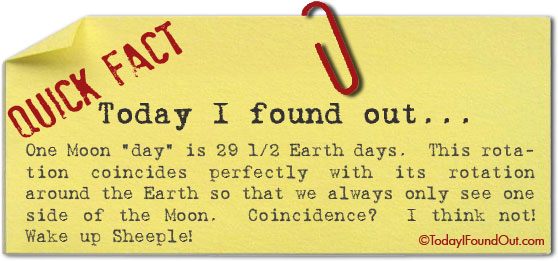
##EMBED## Click Here to Find Out What Moon Dust Smells Like Text Version One Moon “day” is 29 1/2 Earth days.  This rotation coincides perfectly with its rotation around the Earth so that we always only see one side of the Moon.  Coincidence?  I think not!  Wake up Sheeple!

Read more

How Earthworms Breathe

##EMBED## Click Here for Sources and to Learn More Interesting Earthworm Facts Text Version Even though earthworms need to breathe, they have no lungs.  They acquire oxygen through their skin.  This is why earthworms surface after heavy rains, despite the fact that it is extremely hazardous for them to do so.  If they don’t surface, they will suffocate and die […]

Read more

What a Twinkie is Made Of

##EMBED## Click Here for More Interesting Twinkie Facts Text Version Of the 39 ingredients that make up a Twinkie, only one of them is strictly a preservative or rather its only purpose in being included is because it’s a preservative.  Some of the other chemicals have preserving side effects, but their use is primarily as substitutes for the dairy ingredients.  […]

Read more
1 27 28 29