
Was Keel-Hauling Actually a Thing?
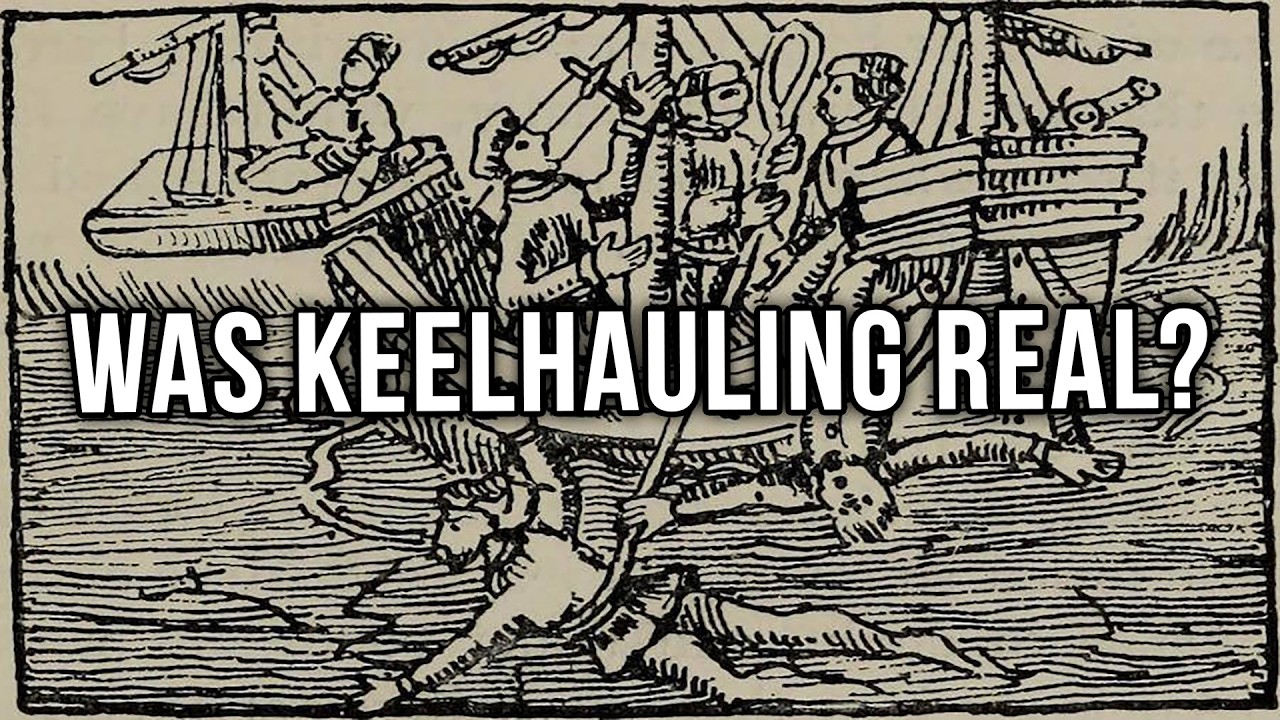 Running the gauntlet. Starting. Flogging with the cat ‘o 9 nine tails. Gagging. Clapping in irons. Hanging from the yardarm. While this all might sound like a super fun Saturday night with the misses when the grandparents are watching your kiddos for you, it turns out these are actually just a few of the dizzying array of corporal and capital punishments inflicted upon sailors of old – both navy men and pirates – to enforce discipline and punish a wide variety of crimes. But while most of these punishments are fairly well-known, you may have noticed two notable practices missing from the list: that old staple of pirate movies, “walking the plank”… and keel-hauling. Perhaps the most infamous of all nautical punishments, keel-hauling struck such fear into the hearts of sailors over the centuries that the term survives to this day as a byword for particularly harsh discipline. But what was keel-hauling? How did it work, who invented it, and was it actually a real thing? Or, like so much popular seamen lore, was it just the product of some adventure writer’s imagination? Well, put on your eyepatch and tricorn hat, strap on your peg-leg, as we dive into the reality of one of the Age of Sail’s most barbaric practices.
Punishments similar to keel-hauling are thought to date back to antiquity, though the actual historical record is rather sparse. Ancient Greek writings from the 5th Century B.C., contain references to katapontismós: to throw someone from a high place into water; and schinismόs: to tie someone up and drop them from a high place. However, the former may simply refer to the practice of tossing someone overboard; indeed, in his Histories, Herodotus uses the term when referring to an incident in which Persian King Xerxes I was caught in a storm at sea and forced some of his soldiers to jump overboard to lighten his ship. Similarly, schinismόs may refer to the perennial torture technique of strappado, in which the victim’s arms are bound behind them and winched up on a rope, dislocating their shoulders. Other executions by drowning are also recorded throughout antiquity, such as with the murderers of Ancient Greek poet Hesiod in 650 B.C.. and of 3,000 Phocian prisoners by Philip II of Macedon during the Third Sacred War of 356-346, well, I’ll go with B.C.E. this time for maximal commenting by using both in the same piece.
However, these accounts give no details of the methods or equipment employed. The most solid evidence of ancient keel-hauling comes from the Lecythos of Attica, a vase dating from around 480 B.C.E. which depicts sailors binding fellow crewmen and lowering them into the water.
While similar practices are mentioned in the Byzantine maritime code or Lex Rhodia of 700 CE as a punishment for piracy, detailed descriptions of the practice as we would recognize it today do not appear until a millennium later, with one of the earliest being from Christopher Frick and Christopher Schewitzer’s 1700 account A Relation of Two Several Voyages Made into the East-Indies:
“He that strikes an Officer, or Master of the Ship, is without hopes of pardon to be thrown into the Sea fasten’d by a Rope, with which he is thrown in on one side of the Ship, and drawn up again on the other, and so three times together he is drawn round the Keel of the Ship, in the doing of which, if they should chance not to allow Rope enough to let him sink below the Keel, the Malefactor might have his brains knockt out. This Punishment is called Keel-halen, which may be call’d in English “Keel-drawing.” But the Provost hath this Priviledge more than the other, that if any one strikes him on Shoar, he forfeits his hand, if on Board, then he is certainly Keel-draw’d.”
While this punishment was in use – both officially and unofficially – in the Royal Navy at this time, in British writings it is nearly always referred to as an exclusively Dutch practice – very often with a great deal of xenophobic disdain. For instance, William Falconer’s 1780 Universal Dictionary of the Marine defines the practice as:
“A punishment inflicted for various offences in the Dutch navy. It is performed by plunging the delinquent repeatedly over the ship’s bottom on one side, and hoisting him up on the other, having passed under the keel. The blocks, or pullies, by which he is suspended, are fastened to the opposite extremities of the main-yard, and a weight of lead or iron is hung upon his legs to sink him to a competent depth. By this apparatus he is drawn close up to the yard-arm, and thence let fall suddenly into the sea, where passing under the ship’s bottom, he is hoisted upon the opposite side of the vessel, As this extraordinary sentence is executed with a serenity of temper peculiar to the Dutch, the culprit is allowed sufficient intervals to recover the sense of pain, of which indeed he is frequently deprived during the operation. In truth, a temporary insensibility to his sufferings ought by no means to be construed into a disrespect of his judges, when we consider that this punishment is supposed to have a peculiar propriety in the depth of winter, whilst the flakes of ice are floating on the stream, and that it it is continued till the culprit is almost suffocated for want of air, benumbed with the cold of the water, or stunned with the blows his head receives by striking the ship’s bottom.”
Indeed, drowning was the least of the keel-hauling victim’s worries, and may well have been welcomed as a sweet release from his torments. The hull of the ship would likely have been encrusted with barnacles and other sea life, cutting the condemned to ribbons as they were hauled across it. For this reason, common practice was to perform keel hauling as quickly as possible – not to minimize the victim’s time spent underwater, but rather to ensure they were scraped along the hull rather than sinking down clear of it. If the ship was new or had recently been cleaned, the hauling was often performed end to end rather than beam-to-beam to extend the victim’s torment. And if, when hauled up, the victim was judged insufficiently drowned or maimed, they would often be thrown overboard and keel-hauled all over again or sometimes flogged on the ship’s deck. Some sources also describe a sponge being forced into the victim’s mouth, allowing them to draw at least one tiny extra breath while underwater.
Keel-hauling is thought to have been introduced to the Dutch Navy and Dutch East India Company or VOC sometime in the mid-17th century. One of the earliest recorded cases involved a sailor by the name of Jan Blank, who in October 1652 was convicted of desertion and, as punishment, was keelhauled, given 150 lashes, and sentenced to slavery for two years.
While records of keel-hauling aboard Dutch ships during this period are sparse, it was apparently a common enough practice to warrant depiction in Lieve Pietersz’s painting The keelhauling of the Ship’s Surgeon of Admiral Jan van Nes, completed sometime between 1660 and 1680. The painting depicts keel-hauling as a public punishment, with ships full of sailors gathered around to witness the spectacle. This suggests that the practice was largely reserved for the most serious offences and used to set an example for the rest of the fleet. In this way it served a similar function to the Royal Navy practice of “Flogging Around the Fleet,” in which the victim was rowed around the fleet in a small boat, receiving a certain number of lashes at each ship.
While the exact origin of keel-hauling is not known, it is likely the practice evolved from the older punishment of ducking or cucking, which also may just seem like a fun Saturday night for you, but in the original meaning included a victim briefly lowered into the sea or a river using a rope or specialized seesaw-like ducking stool. Though best known today for its use in identifying witches, in reality ducking was used to punish people – usually women – for a wide variety of crimes and socially unacceptable behaviours, including scolding, gossip, blasphemy, adultery, or bearing a child out of wedlock. In France, ducking evolved into a naval punishment wherein the victim was bound, tied to a rope, and repeatedly thrown overboard and hauled back up. A common variation on this punishment was “dry ducking”, in which the victim was thrown overboard as before but halted just short of hitting the water. Often cannonballs or other weights were attached to the victim’s feet to increase the shock and pain of the sudden stop. This punishment was infamously applied to François-Marie Perrot, governor of the French colony of Acadia (today parts of the U.S. state of Maine and the Canadian provinces of Quebec, New Brunswick, Nova Scotia, and Prince Edward Island) from 1785 to 1787. An extraordinarily corrupt man, during his brief tenure, Perrot amassed an enormous fortune by secretly trading furs with local indigenous peoples and issuing illegal licenses to New England fishermen. After being ousted as Governor, Perrot took refuge in St. John River, New Brunswick, where he was immediately captured by pirates and tortured using this technique until he revealed the location of his riches. He was soon rescued by French corsairs and returned to France, but died not long afterward, likely of some of the injuries inflicted by the pirates.
Meanwhile, in French service full keel-hauling differed slightly from the Dutch version in that the victim, hauling ropes, and weights were all tied to a small hatchway grating and the whole assembly thrown overboard.
Yet despite its enduring infamy, the heyday of keel-hauling as an official punishment – at least in western navies – was relatively brief, with the British Royal Navy banning its use in 1720 and the Dutch and French Navies in 1750. It did, however, continue to be used very rarely in an unofficial capacity. However, due to its association with barbarism and – well, the Dutch, the Royal Navy was very quick to deny any and all allegations of keel-hauling being performed aboard their ships. For example, the British Parliamentary record for September 4, 1880 contains the following exchange:
- P. A. TAYLOR: asked the Secretary to the Admiralty, Whether he is aware that a statement has appeared in certain Italian newspapers (Palermo and Messina) alleging that a Marine, of H.M.S. “Alexandra,” was lately condemned to be keel-hauled and died under the punishment; and, whether he will institute inquiries upon the subject? The hon. Gentleman added that the newspapers had been ostensibly sent to him by an English officer.
- SHAW LEFEVRE: Sir, it is wholly impossible that there can be any truth in the story reported in the Italian papers, that a Marine has been keelhauled on board the Alexandra, and died under the punishment. We have heard nothing about it, and I do not think it is necessary to insult the officers of the ship by asking whether it is true. The last reference to keel-hauling in the Navy is contained in a well-known story of the Emperor Paul of Russia, which shows that in his day there was a current belief on the Continent that this punishment was practised. When he came on board a man-of-war he asked to see the process, and when he was told that it would cause the death of the seaman, he offered one of his staff for the experiment. The editor of the Italian paper was about as well informed as the retailer of this anecdote. I do not think it necessary to make further inquiry.
However, the practice did persist officially in other navies for much, much longer, with perhaps the most infamous case taking place in Alexandria, Egypt, in September 1882. The event was recorded in gruesome detail by a correspondent from the London Morning Advertiser, revealing many of the more horrific aspects of the practice:
“Yesterday I tried to write a description of the most horrible sight. It was so revoltingly cruel, so barbarous, so infamously brutal, that I gave it up. Still, it is right that the people of England should know what sort of people even the friendly Egyptians are, and therefore this story of how two men were keelhauled from on board the Mehemet Ali,…
Just before noon the men were brought on deck and pinioned with their arms behind their backs, their hands before them, and ankle-irons confining their feet so that they could barely walk. The crew of the ship had been called on deck. The officers stood on the starboard side, the crew on the port, the victims at the mainmast. The officers were in the flaunting dress of their service, the men wore their cutlasses. An officer read the findings – at least that was what we supposed they were – of the court martial. This was a long and protracted ceremony. When he had done some men went aloft and made fast to the mainstay near the mast two blocks. From these they rove two stout lines in different directions. These were carried over the sides of the ship and weighted with a sounding-lead about 40 feet from the end. Then the lines were carried around the stern of the ship and brought forward, the leads sinking them under the keel. After that they were hauled on board, the leads detached, the two men were tied side by side, and both ropes made fast to them, one rope being tied to the waist of one, the other rope around the shoulders of the other. The arrangement of the tackles was to drag the men under the ship from either side by hauling on the fall or running end of the rope that fell from the leading blocks on the mainstay. These ropes, to enable the hauling parties to “walk away”, were led through a snatch-block on the deck The crew were then divided, half of them out to each rope, and the two wretches, being led to the side, were shoved overboard. They both screamed as they fell into the water and as the distance from the gangway to the surface was quite 14 feet, they must have been more or less hurt.
But this was only the beginning of their misery. The men on one side hauled taut the rope underneath the ship, and then the order to ‘walk away’ was given. The band played a solemn tune, something like the ‘Carnival of Venice’ in movement, except the tune was changed, and stamp, stamp, stamp, went the men. We saw the two wretches go under, and then the only movement was the ropes going through their blocks, one side coming out the other coming in, but slowly. We had no measurement of the ship, but as the rope acted directly – that is, there were no moving blocks – the distance around the bottom was exactly that covered by the men as they walked the deck, drawing the rope behind them, Thus we were able to make some estimate of the distance, and we calculated it at 50 feet from surface to surface.
Presently the two victims appeared on the other side They were hauled quite out of the water, and the rope by which they were hoisted was made easy and coiled up ready to pay out again. An officer – probably a doctor – went down and examined them. The one upon whom the strain of the rope had fallen was apparently lifeless. His face was turned toward us: it was bleeding and torn; his clothes were hanging in shreds and his hands were dripping with blood. His eyes were open, but they seemed to be filled with blood. The ship’s bottom, covered with barnacles, rasped upon the poor devils like nails. The other man seemed to be conscious. His back, as he hung in the air, was toward us, but he moved his head, we thought, and apparently to beg for mercy.
Evidently the officer reported them still alive, for when he had come on deck again the two men were lowered into the water, and the crew manning the rope that led up from the other side marched away with it, and once more the victims disappeared. From the time they went under the surface of the water until they reappeared at the other side of the ship was just 24 seconds. It seemed to us to have been an hour. The first frightful journey had terminated by their being scratched and torn; at the end of the second they were mutilated. The nose of one wretch was torn almost away, one ear was gone, and the shreds of the clothing he had worn clung to him only where they were held by his bonds. He was blood literally from head to foot. His companion’s condition was equally horrible. This time they were hoisted up to the rail and swung on board. Then we could see something of the action of the barbarous punishment, for they were not held off the side, but were scraped up along the ship, striking against the ringbolts, the chains, and every cruel obstruction until they swung in free over the deck. Then they were lowered down and released. They were both unconscious, even then dead. It may be hoped they were. Death must have been a welcome release.
An inquiry as to the facts made on board the ship elicited the reply that it was not a matter of public concern Nevertheless we were offered coffee and cigarettes. It is needless to say that we did not accept either. For my part I should have rather seen the entire ship’s company shot than accepted any hospitality at the hands of its officers.”
And that is the brief and horrific history of keel-hauling, a relatively rare punishment in the Age of Sail but one spine-chilling enough to persist for centuries in the popular imagination. At this point, however, you are probably wondering: what about that other favourite punishment for scurvy sea dogs: walking the plank?
Well, sorry to disappoint you, but unlike keel-hauling there is not a shred of evidence that anyone was ever forced to walk the plank during the so-called Golden Age of Piracy – typically defined as the 80-year period between the 1650s and 1730s, though the practice is known to have happened after its apparently fictitious origins. Indeed, the first written description of walking the plank appears near the tail end of this period in Daniel Defoe’s 1724 book A General History of the Pyrates, in which he describes Ancient pirates in the Mediterranean pushing a ship’s ladder out over the water and telling their Roman captives they were free to go – if they could swim the distance back to shore. Like all great literary devices, later writers took Defoe’s “plank” and turned it into a staple of pirate fiction, with the practice appearing in Charles Ellms’s 1856 bestseller The Pirates Own Book, Robert Louis Stevenson’s 1883 adventure novel Treasure Island, and J.M. Barrie’s 1904 play and 1904 novel Peter Pan.
This is not to say, however, that nobody ever walked the plank – just that such incidents were incredibly rare and took place long after the Golden Age of Piracy. For instance, in 1769 mutineer George Wood, locked up in London’s Newgate Prison, confessed to the prison chaplain that he and his fellow mutineers had forced the officers on their ship to:
“…walk on a plank, extended from the ship’s side, over the sea, in which they were turned, when at the extreme end.”
In an even grimmer incident in 1788, the slave transport ship Garland ran short of food during its Atlantic crossing. In order to preserve their remaining stocks, the crew forced many of the slaves onboard to “walk the plank” to their watery doom. But there is some justice – however minor – to this story, for the food did eventually run out before Garland reached her destination, forcing the crew to resort to cannibalism to survive.
A handful of other cases of “walking the plank” are recorded throughout the 19th century. For example, in July 1822, the British sloop Blessing was captured by the Spanish pirate schooner Emmanuel in the Caribbean and her captain, William Smith, forced to walk the plank. In 1828 a similar fate befell the crew of the former Royal Navy Brig HMS Redpole, which, while carrying mail from Brazil to Britain, was captured and sunk by a Brazilian pirate vessel. And that same year, the Dutch brig Vhan Fredericka was captured by pirates near the Virgin Islands and her crew forced to walk the plank with cannonballs tied to their feet.
And that’s it: those are the few actual recorded cases of people being forced to walk the plank. As with so many fixtures of pirate lore such as parrots, eyepatches, peg legs, treasure maps, and – yes – even “talking like a pirate” – while there is a grain of truth to this practice, it was nowhere near as common as popular books, movies, shows, and other media would have us believe. But that hasn’t stopped us here from adopting walking the plank and keel-hauling as our official punishments for our basement dwellers when they try to do anything but work as god intended. Got to keep your employees properly motivated, you know?
Expand for ReferencesIoannidou, Christy, The Black Version of Water and Underwater Activity Drowning, Torture, and Executions Below the Sea in Ancient Greece During the Archaic and Classical Periods (Seventh to Fourth Centuries BC), The Association of Historical Studies, Koryvantes, Athens, Greece. http://doi.fil.bg.ac.rs/pdf/journals/arhe_apn/2020/arhe_apn-2020-16-1.pdf
Navy – Alleged Instance of Keel-Hauling, HC Deb 04 September 1880 vol 256 c1275, UK Parliament, https://api.parliament.uk/historic-hansard/commons/1880/sep/04/navy-alleged-instance-of-keel-hauling
Keelhauling – Royal Navy Torture Technique, The Way of the Pirates, https://www.thewayofthepirates.com/pirate-life/keelhauling/#google_vignette
Goldfarb, Kara, Keelhauling: Inside The Deranged Torture Method Used To Keep Sailors In Line, All That’s Interesting, October 22, 2022, https://allthatsinteresting.com/keelhauling
Falconer, William, An Universal Dictionary of the Marine: or, A Copious Explanation of the Technical Terms and Phrases Employed in the Construction, Equipment, Furniture, Machinery, Movements, and Military Operations of a Ship, 1780, https://archive.org/details/universaldiction00falc/page/n177/mode/2up
Parliamentary Papers, Volume 33, https://books.google.ca/books?id=_nUTAAAAYAAJ&dq=keelhaul+keelhauling&pg=RA1-PA58&redir_esc=y#v=onepage&q=keel&f=false
Keelhauling: the Atrocious Cruelty of it, With Details in the Recent Case in Egypt, The New York Times, September 22, 1882, https://timesmachine.nytimes.com/timesmachine/1882/09/26/102789113.pdf?pdf_redirect=true&ip=0
Regali, Darius, Torture and Democracy, https://books.google.ca/books?id=-L8GtJY_J00C&pg=PA282&lpg=PA282&dq=keelhauling&source=bl&ots=ufr7aJBP10&sig=QitZyZba7xILPkpvM0M3aC6PU64&hl=en&sa=X&redir_esc=y#v=onepage&q=keelhauling&f=false
Keelhauling, in Living Color, Swordplay & Swashbucklers, https://benersonlittle.com/2017/01/23/keelhauling-in-living-color/


| Share the Knowledge! |
          |
 |