
What Causes Spontaneous Human Combustion?
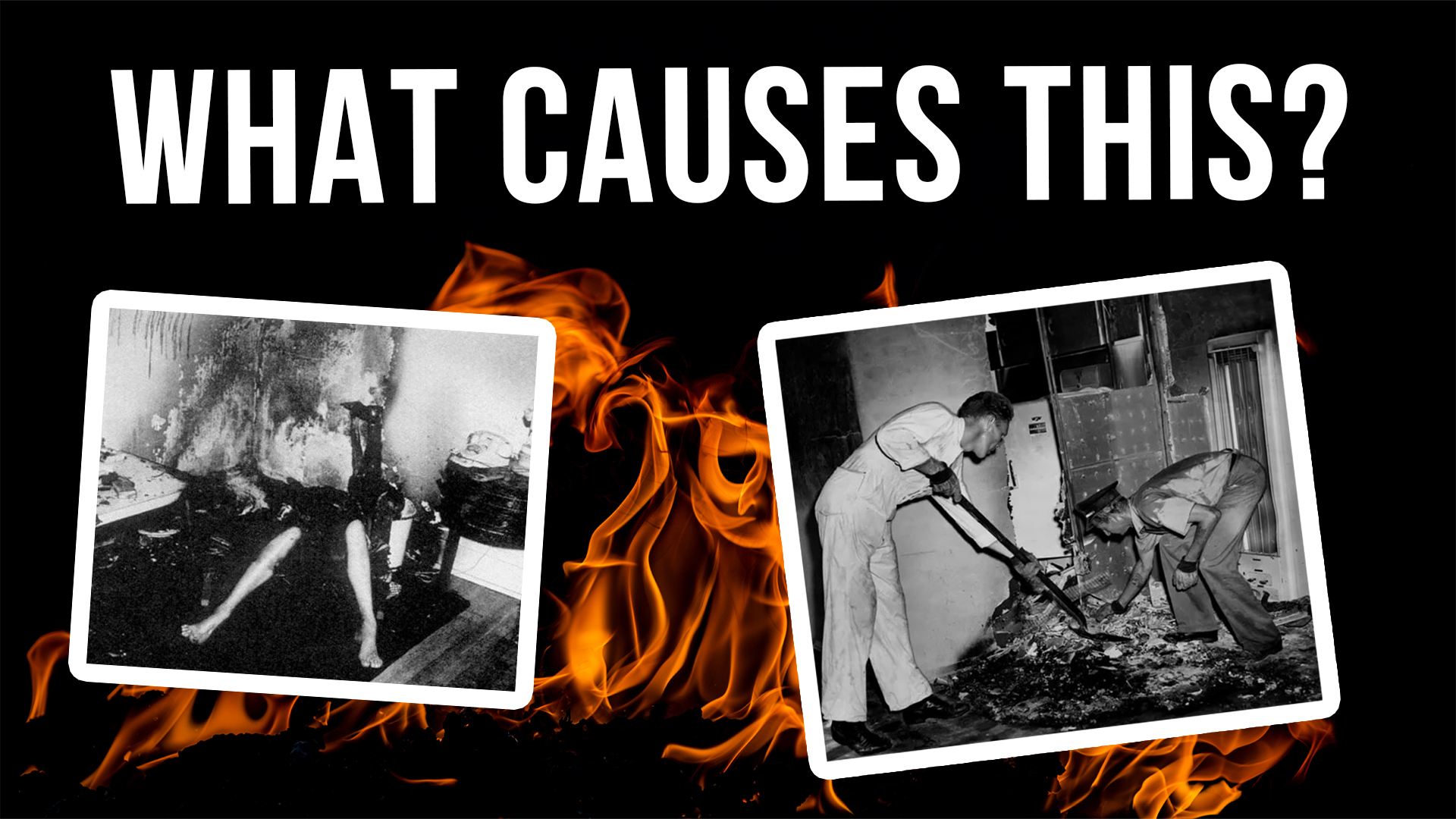 For those of us of the slightly more seasoned vintage growing up in or living in the late 20th century, which was totally only a decade ago and I’ll take no further input on this matter, spontaneous Human Combustion ranks alongside the likes of quicksand, the Bermuda triangle. and rain that melts your skin off as one of those things that everyone from the news to popular social consciousness taught us was going to be something we’d simply have to deal with in our day to day lives for some reason. And then, just as suddenly as a person randomly turning into ash, everyone just moved on and stopped talking about it…
Which leads us to the subject of today’s video- what ever happened to everyone spontaneously combusting? Where did the idea come from, how did it proliferate public consciousness, and what’s up with all the people who did burst into flames and turned to ash, generally leaving only things like arms and legs behind? Can awesome science explain what happened to them?
Well, douse yourself in flame retardants, get out the fire extinguisher, and let’s dive into it all, shall we?
To begin with, people inexplicably spontaneously combusting has been a documented phenomenon as long as humans have been humaning, including the likes of Charles Dickens using it as a literary device in his famed novel, Bleak House. Going back to 1798, Charles Brockden Brown also used the idea in his novel, Wieland, in which one of the characters spontaneously combusts while praying.
But as for the specific moniker of “Spontaneous Human Combustion”, this seems to have been coined by one Paul Rolli in an article he published in a 1745 edition of the Philosophical Transactions of the Royal Society of London, which examined the death of Countess Cornelia Zangari Bandi.
In this one, on the last night of the 66 year old Countesses’ time existing in the universe, her maid stated when she left, the countess was asleep, but when she returned the next day, in place of the countesses’ body, according to Rolli,
“Four Feet Distance from the Bed there was a Heap of Ashes, two Legs untouched, from the Foot to the Knee, with their Stockings on; between them was the Lady’s head; whose Brains, Half of the Backpart of the Scull, and the whole Chin, were burnt to Ashes; amongst which were found three Fingers blacken’d. All the rest was Ashes, which had this particular Quality, that they left in the Hand, when taken up, a greasy and stinking Moisture. The air in the Room also observed cumbered with Soot floating in it: A small Oil-Lamp on the Floor was cover’d with Ashes, but no oil in it. Two Candles in Candlesticks upon a table stood Upright; the-Cotton was left in both, but the Tallow was gone and vanished. Somewhat of Moisture was about the Feet of the Candlesticks. The Bed receiv’d no Damage; the Blankets and Sheets were only raised on one Side, as when a Person rises up from it, or goes in: The whole Furniture, as well as the Bed, was spread over with moist and ash colour Soot, which had penetrated into the Chest-of-drawers, even to foul the Linnens: Nay the Soot was also gone into a neighbouring Kitchen, and hung on the Walls, Movables, aid Utensils of it. From the Pantry a Piece of Bread cover’d with that Soot, and brown black, was given to several Dogs, all which refuse to eat it. In the Room above it was moreover taken notice, that from the lower Part of the Windows trickled down a greasy, loathsome, yellowish Liquor and thereabout they smelled like a Stink, without knowing of what; and saw the Soot fly around. It was remarkable, that the Floor of the Chamber was so thick smear’d with a gluish Moisture, that it could not be taken off; and the Stink spread more and more through the other Chambers.”
Much like the Countesses’ stink, the idea of humans randomly bursting into flames spread from there among the masses to the point of variously being used as a literary device as previously noted, with occasional real world cases popping up here and there.
This all led to a report titled “Spontaneous Combustion” published in a 1938 edition of the British Medical Journal written by one L. A. Parry that, in turn, cites an 1823 A Treatise on Medical Jurisprudence by Dr. John Ayrton Paris and a lawyer named John Samuel Martin Fonblanque, noting a set of very specific commonalities between pretty much all of the cases of spontaneous human combustion that give us a very clear picture of why these individuals were bursting into flames, as well as sheds some flickering light onto why little around them generally gets burned, and why they so often leave parts of their arms and lower legs as their only remains. We’ll get to that in a bit in what’s really going on here because it’s really interesting.
But going back to how the idea continued to proliferate with the masses, peaking in the 1990s, the issue is that after such very sensible reports that are interested in dealing in facts, instead of crafting a narrative to push the supernatural, we have a slew of individuals trying to do the latter for fun and profit.
Enter the likes of Vincent H. Gaddis in 1967 with his book Mysterious Fires and Lights, covering everything from UFO’s to spontaneous human combustion to even houses that, to quote him, “actually destroyed themselves”.
I hate it when houses do that.
The list goes on and on. We could probably make at least a few dozen wildly popular youtube videos debunking all the stuff Gaddis puts in that book. But for now, suffice it to say, Gaddis lived in the wrong era. He could have made a fortune on modern social media trumpeting his ideas and conspiracy theories, and by a bizarre twist of the world we live in today, probably could have also made a very successful politician.
Noteworthy, Gaddis’s real claim to fame came from being the man who created the idea that something odd was going on in The Bermuda Triangle, as well as came up with that name in the process. For full details and the truth of that one, see our video What is Up with the Bermuda Triangle. But to sum his general career arc up, Gaddis was a man who seemed to like to apply the rubric of “Okay, but what if aliens did it?” to almost everything in life.
Similarly, in 1976 author Michael Harrison threw his hat in the ring with his book Fires from Heaven, alleging that spontaneous human combustion is caused by poltergeists, and that, to quote him, “the force which activates the ‘poltergeist’ originates in, and is supplied by, a human being.”
Then, at the height of the fear of spontaneous human combustion, one Larry E. Arnold of ParaScience International wrote a book called Ablaze! published in 1995. He purports that particles he names “pyrotrons” get in the body and then cause a cascading chain reaction at the nuclear level, at which point the body bursts into flames, because, sure, why not.
A year later, John Heymer threw his own ideas into the mix in his book The Entrancing Flame, suggesting that individuals who spontaneously combust suffer from mitochondrial explosions, which, to quote him, free “hydrogen and oxygen within the body”, which then ignites.
The list goes on and on. People, including many a news source back in the day, have been pretty much running with these, and others’ outlandish ideas ever since, including parroting some of the alleged stories of actual cases of spontaneous human combustion presented in these works.
The primary issue being, if you read through some of these works, you find a general trend true of nearly all such paranormally inclined or conspiracy theory ideas or political rhetoric- a foundation of something that happened that exists in reality, but then very selectively reported actual documented facts, mixed in with a whole lot of stuff that was completely made up, but reported as also being very official and documented, that all results in a very compelling narrative and conclusion supporting the author or politician’s argument.
That is, if you don’t bother looking into what they said in any depth and realize a percentage of what was said was completely made up.
Funny enough, a lot like reading responses from generative AI. Which is now also a compounding problem given that so much online content being fed into training such is itself the product of generative AI, leading to less and less accurate responses, and something no amount of processing power can fix. As the old computer science expression goes- garbage in, garbage out.
More on the interesting origin of that expression and our thoughts on all this in the Bonus Facts at the end of this video.
But in any event, going back to spontaneous combustion, let’s look at some of the commonly reported instances of it, and see if we can figure out what’s going on here in reality.
First up, we’ll look at a great example of twisting the facts to fit the narrative before looking into the more mysterious cases where the person actually mostly turned to ash. But to begin with, we have the famous case of Maude Comissiong, reported on by countless spontaneous human combustion proponents over the years, including by the aforementioned author of the 1995 book Ablaze!, Larry Arnold.
Important to point out is that up until Arnold’s book, he claims many got Comissiong’s name wrong, incorrectly referring to her as Mary Carpenter. On this note, showing Arnold, at least, actually bothered to look into contemporary reports, he found her real name, Maude Comissiong, in a 1938 edition of the Liverpool Echo covering her death.
The funny thing is, while correctly tracking down this detail and citing where he got it, Arnold then goes on to parrot a number of incorrect details about her case that make the whole thing seem mysterious, completely ignoring that the very article he cites in the Liverpool Echo refutes many of these, including the alleged commonly touted notion that she had burst into flames in front of many witnesses. In reality, the Liverpool Echo reports she was alone at the time, to quote it, “Albert Comissiong said he left his wife resting on the cruiser while he went into Great Yarmouth with friends.”
And as for the bursting into flames part, well, Arnold leaves out another detail in the Liverpool Echo where it states Comissiong had just opened a can of paraffin and was lighting an oil stove to make tea right before she burst into flames. And by “she burst into flames”, we actually mean, to quote the Echo- “a police officer said apparently Mrs. Comissiong’s clothes caught fire as she made tea.” And further that, “two Sheffield holiday-makers, Ronald Cutting and Bertram Donovan, described how they heard Mrs. Comissiong scream and then saw her in flames on the cruiser” and that “somehow she lit a piece of paper and the paraffin ignited.”
Further, contrary to many a retelling, Comissiong did not ever turn to ash, but later died in the hospital. Other newspaper accounts similarly report that she “was lighting an oil stove in the yacht when a two-gallon tin of paraffin became ignited.”
Meaning that Arnold, by his own explicit source, read all that correct information, and then proceeded to throw it all out as it ruined the common false narrative that made it seem like she randomly burst into flames, including Arnold saying the police were mystified, contrary to what the police actually said.
Now, Comissiong’s case isn’t terribly interesting when looking at the actual facts, but some are much more so, genuinely leaving the corpse little more than a pile of ash with feet and hands attached.
So, moving on from Comissiong, consider another famous case of alleged spontaneous human combustion- the tale of Henry Thomas, a Welshman who, on the morning of January 6th 1980, was found dead in his home. Which in of itself isn’t that unusual. Sad, yes… unless you hated Henry, then maybe it was a good day for you.
But in any event, policeman Terry Russell, among other members of the local fuzz, walked through the door to investigate a report from a neighbour that something was amiss at the Thomas household. Upon entering, they were confronted by the gruesome image of a partially incinerated Henry Thomas who had been reduced to nothing more than a blackened skull and ashes, as well as a pair of mostly unburned legs. Or at the very least, the lower half of a pair of mostly unburned legs, both of which were still wearing socks and encased in what remained of Henry’s trousers… no doubt partially inspiring the plot of the massively underrated film Onward.
As an aside, the police initially thought that the fire had somehow shrunk Thomas’ skull, a detail that sometimes makes it into less well-researched versions of this particular story, and frankly if you read many of these spontaneous human combustion tales, is a commonly reported thing. However, as seems universally the case, it would later emerge that Thomas’ skull was regular-sized, it’s just that most people have never seen a skull without all its squishy bits still attached, and many on first encounter find human skulls to be smaller than they expected.
Which is, just a fantastic detail that was not traumatic or nightmare inducing to research and look at examples of in any way whatsoever…
But we’re not done with bizarre and macabre details yet, because the chair Thomas had been sitting on when he burst into flames was also, somehow, only partially burned.
Further, a later forensic examination confirmed that Thomas was in all likelihood alive when he caught on fire, based on the presence of a build up of carbon monoxide in the muscle tissue of Thomas’ unburned legs, suggesting that he’d inhaled smoke prior to expiring. Smoke caused by his own burning flesh that he somehow didn’t feel being melted off his bones.
The peculiar details didn’t stop there though because the police also noted that the room in which Thomas’ remains were found was still radiating enough heat to make standing in said room extremely uncomfortable.
To quote Constable John Heymer, aforementioned author of, The Entrancing Flame, and one of the men who initially investigated the scene –
“I stepped through the door into another dimension – momentarily thrust down into Dante’s Inferno. The room was as hot and steamy as a sauna…”
Something we should note is that while nothing else in Thomas’ home appeared to have caught on fire, contrary to what is sometimes reported, there was absolutely evidence of fire damage to his other possessions. For example, the TV in Thomas’ living room had bits melted and some of the walls were covered in a layer of black greasy soot so thick the person who moved into the home after Thomas’ demise (identified in contemporary reports as a Mrs. Morris) literally resorted to painting over it when she couldn’t find any other way to remove it completely.
We mention this because in some retellings of the Thomas case, the room he was found in is described as showing no signs of fire damage whatsoever, presumably to make the story sound more spooky and thus lend credence to the idea the fire had an unnatural, or perhaps even supernatural cause. Whatever the case, the idea the fire left no trace save for Thomas’ partially incinerated remains just isn’t true. The police report detailing his demise is quite clear on all this if one wants to actually bother to read it.
Getting back to the police report, we further feel compelled to note this was partially compiled by the aforementioned John Heymer who contends to this day that Thomas’ demise was the bonafide case of true Spontaneous Human Combustion. That is to say, that he believes Henry Thomas caught on fire for no reason science can adequately explain and that there was no external source of ignition that caused the inferno that took his life.
Heymer’s later surmising of the events of that day stand in stark contrast to the opinion of others who investigated the case, notably experts from the nearby Home Office Forensic Laboratory, who concluded that Thomas must have somehow fallen into the fireplace headfirst, stunned himself and then sat down to steady himself not realising that an ember from the fireplace had lodged itself somewhere on his person. An ember that somehow ignited his clothing and set him ablaze. With it being concluded that the head injury Thomas sustained left him so disorientated or completely unconscious that he wasn’t in a state to put the fire out or call for help.
Now, while some question the likelihood of this, and stick with the spontaneous combustion line, we’d like to just explicitly point out that, regardless of your stance on whether spontaneous human combustion is actually possible or not, being burned by an external, nearby known fire source is inherently more likely than some random, unknown, internal one that seems to only happen about once every few years when one of the billions of humans alive at any given point are alone and near a source of flame.
As for why Thomas burned in such a way as to leave behind a seemingly untouched pair of legs while everything above his knees was incinerated to ash, that’s surmised to be the result of a rare, unusual and scientifically contentious phenomenon known as the Wick Effect.
No, not a reference to Mr. Wick going around setting people ablaze during his heyday as the world’s greatest assassin before retiring, though the timetable for when spontaneous human combustion stopped being proliferated in mass media does sort of line up… But in this case, the wick effect is the idea that, under highly specific conditions, the human body is believed to be able to act as a big meaty human-sized candle when the natural fats stored inside our skin suits begin to seep into our clothing while it is ablaze. Much like the wick of a candle, the cottony clothes will continue to burn without being burned to ash themselves so long as the flames have a sustained source of human tallow to feed the flames.
And, yes, human fat does burn quite well, as anyone who’s worked at or around a crematorium can attest. This host even knows of one relatively recent local case a friend was involved in where an extremely abnormally well padded deceased woman’s body ended up having some of her fat, for lack of a better word, melt and, while aflame, escape the confines of the oven her remains were being turned to ash in. These flame drops then caught other things on fire, ultimately burning down the entire crematorium and causing a major backlog in ability for that region to have bodies cremated, as it turns out you can’t just order a new crematorium oven on amazon.
Interestingly in this case, while local news did report the crematorium burning down, not one of them mentioned the cause. But it turns out, if you google crematorium fires, this sort of leaking burning fat thing happens every now and again, though in most cases doesn’t result in significant damage to the rooms or buildings for reasons that will become clear momentarily.
But going back to the wick-effect, proof-wise very few actual formal studies have been conducted into the wick effect, as while, as we’ve covered in our video What Actually Happens if You Donate Your Body to Science, your body can be used for all manner of bizarre things from crash test dummy to being exploded by the military, nobody seems to be doing much formal research into looking into the viability of making literal human candles FOR SCIENCE, despite the excellent renewable heat and light source such research could point the way towards…
I mean, Gam gam’s always provided a light through her wisdom and words, as well as warmth from her unconditional love. This is just another way for her to provide the same in a more literal way after she dies, while simultaneously making her lifetime love of KFC a boon to us all at the same time.
That said, a couple of experiments have been conducted that lend credence to the wick effect being at least a possibility. The most notable being an experiment conducted in 1998 by British scientists that involved wrapping a pig in a blanket, coating said blanket in a small amount of accelerant, in this case gasoline, and setting it on fire. If you’re wondering, a pig was chosen for the experiment as lean pig carcasses have an approximate ratio of muscle, fat and bone in the ballpark of a typical human. Also we can only assume the researchers were hoping they could get some bacon out of it after they put out the flames.
As for the results, the researchers found that, under these very specific conditions, the pig did indeed burn well and at a high enough temperature for the carcass to become nothing but ash, with nothing much else surrounding suffering any ill effect from the fire that burned for hours before they finally put it out and broke for a tasty lunch probably.
Another previous experiment in 1963 produced similar results, where the investigators wrapped some human fat in a cloth, then set it on fire with a bunsen burner. They reported, “One end of the candle was ignited by a Bunsen flame, the fat catching fire after about a minute. Although the Bunsen was removed at this point, combustion of the fat proceeded slowly along the length of the roll, with a smoky yellow flame and much production of soot, the entire roll being consumed after about one hour.”
As a 1951 FBI Report on the death of another famous allegedly spontaneous human combustion case in Mary Reeser sums up, “Once the body starts to burn, there is enough fat and other inflammable substances to permit varying amounts of destruction to take place. Sometimes this destruction by burning will proceed to a degree which results in almost complete combustion of the body.”
As to remaining, unburned limbs, like legs in the case of Mr. Henry Thomas, it’s generally thought that they more or less simply fall off, removing themselves from the literal human candle effect happening. Alternatively, it’s been speculated that legs and feet, or potentially how the clothing clings to such or are otherwise arranged, simply don’t burn due to lacking sufficient fat or properly situated wick necessary to perpetuate the wick effect.
In regards to the experiment and speaking of unsavory details we wish we hadn’t had to learn, right up there with those times we had to research in depth the world’s most prolific serial killers that included a trio of individuals from Columbia that we hope are currently enjoying their own perpetual wick effect in hell, a notable and rather grisly detail with the pig experiment is that the pig carcass burned for hours, yet did no real damage to anything around it. From this, the scientists behind the trial concluded that a person to whom it happened could be slowly consumed by the flames without greatly affecting the surrounding objects, not too dissimilar to a candle burning close to very flammable objects, but otherwise not getting them hot enough to ignite. In the end, the candle is burnt to nothing in time, but unless something is put directly in or above the flame, everything else is usually fine.
As for why someone burning to death in this manner wouldn’t, you know, wake up and realise that they were on fire, the researchers point out that in the majority of the known cases of spontaneous human combustion, the person was likely rendered unconscious for a variety of potential reasons, and the carbon monoxide given off by their own burning flesh, bone, and clothing simply ultimately kept them that way until they died, saving all their relatives on having to spend any money on cremation.
As noted, in the case of Henry Thomas, his unconsciousness is speculated to have been from hitting his head before catching on fire. Factoring in that Thomas was 73 at the time, it’s not hard to imagine a scenario where he fell, hit his head, and was rendered unconscious while sitting down trying to steady himself. From there, it’s not really that big a leap in logic to say that an ember from the fire could have seared his flesh, melted and ignited some fat, and it was all downhill from there, with his specific orientation, clothing, fat content, all coalescing into the perfect candly storm.
Moving on from there, you may not be surprised to learn that a huge percentage of purported cases of spontaneous human combustion involve people who are infirm, drunk, had just taken sleeping pills, and in a lot of known instances, also smoked heavily.
For example consider the case of the aforementioned Floridian Mary Reeser who was found on July 2, 1951, dead in her home. Similar to Henry Thomas, all that was left of Reeser was a skull and her left foot, still wearing her slippers. As in the case of Henry, Reeser’s room was similarly mostly untouched by the flames, in terms of nothing else catching on fire, but had been damaged by soot and the extreme heat of the blaze that took its owner’s life.
Like with Henry, police were initially baffled. That is, until a more thorough examination of the crime scene and Reeser’s circumstances revealed that the 67 year old both smoked and was known to take sleeping pills before bed, all while enjoying a nighttime cigarette.
It really doesn’t take a rocket surgeon to put two and two together here. As for why nothing other than Reeser and the chair she was sitting in burned. To quote her daughter in law from an interview with the St. Peterburg Times some 40 years later in 1991 –
“The cigarette dropped to her lap. Her fat was the fuel that kept her burning. The floor was cement, and the chair was by itself. There was nothing around her to burn.”
In cases where the victim didn’t smoke, like with Henry Thomas, they invariably caught fire in a place where there was a fire source nearby- like several feet from a fireplace or a kitchen with a gas stove, such was the case with another poster child among spontaneous human combustion truthers- Jeannie Saffin.
In Saffin’s case, she actually really did spontaneously combust in the presence of another person… Specifically, it’s reported by Jeannie’s father, Jack, that she and he were in the kitchen when, seemingly out of nowhere, the 61 year old Saffin had burst into flames.
However, contrary to some later reports and retellings of the story, Jack wasn’t looking directly at his daughter when she caught fire. In fact, he was facing the opposite direction when he noticed a random light source. It was only when Jack turned to investigate the source of the light that, in stunned horror, he found the cause was his daughter’s clothing on fire.
Despite Jack’s best efforts to save his daughter she later succumbed to the injuries caused by the fire just over a week later.
Now, on the surface, this does sound like there’s no reasonable explanation for Saffin catching fire the way that she did and in the years since spontaneous human combustion proponents, like the aforementioned John Heymer, have pointed to Saffin’s death being another case of true Spontaneous Human Combustion. In fact, Heymer went as far as to claim in a book he wrote on the subject, aptly titled, The Entrancing Flame, that Saffin didn’t so much as cry out in pain as the flames consumed her body. Further, quoting an eye witness to the event, one Don Carroll who was in the house at the time, he alleges her clothes were unburned and that flames shot out of her mouth.
Which we’ll admit, is very odd and makes it sound like the fire that claimed her life had inexplicable and perhaps even supernatural or dare we say, paranormal origins.
We mean, it’s not true, but it sure makes for a good story, right?
So what actually happened? To begin with, to interrogate the former claim Heymer made about Saffin’s demise – that she didn’t cry out in pain suggesting the fire happen so rapidly she literally did not have time to react – Jeannie did in fact cry out in pain, with Don Carroll, who only witnessed the aftermath, reporting that she screamed quite loudly, to quote him “like a dragon”. Which is admittedly a weird way of wording it and ultimately led to the claim the flames emanate from Saffin’s mouth, a claim that was similarly debunked when researchers tracked down the coroner, Jack Burton’s, report which did not show any burns in her mouth at all..
Also, it wasn’t just the light that caught Jeannie’s father’s attention, he recalled first hearing her whimper, but thought nothing of it, until the light later made him turn.
Now, a whimper doesn’t sound like an appropriate reaction for someone who just caught fire, but it should be noted that this elderly woman had the mental fortitude of a small child. Thus, it’s thought she may have observed the beginnings of the fire that took her life and even felt the first minor pain from it, but didn’t comprehend the danger she was in, nor react with screaming until the flames had spread considerably.
Now let’s interrogate the latter claim Heymer and others have made in the years since – that Saffin’s clothes were not burned at all, suggesting the fire began under her clothes or perhaps even originated from within her own body and thus had no reasonable, natural explanation.
Even a modicum of effort looking into the event reveals that quite clearly isn’t true. But what paranormal conspiracy theorist has the time to look into actual details of what they are talking about? They are simply, much like a subset of modern news sources, too busy discussing things that fit their world view to be bothered actually looking into the things they are talking about.
In this case, in the original documentation of the event, Jeannie’s father, the other eye witness in Don Carroll, the police officers who responded to the initial call for help, as well as the medics, all reported that her clothes were indeed very crispy. And for the final smoking gun, the medical records in the aftermath also note that her burns appeared to be the result of having been burned by melted nylon, exactly what her clothing was partially made up of.
Finally, sources like The Entrancing Flame and those who quote it while discussing this story make it sound as if Saffin suddenly caught fire out of nowhere.
And, indeed in this one, the only known source of open flame near her is often said to be a pilot light on the stove, which could not have possibly set her clothing ablaze given positioning. Likewise, while Jack Saffin smoked a pipe, it wasn’t lit when the fire occurred, with the police confirming that very fact when they did their preliminary search of the home for a potential cause of her clothing having caught on fire.
There is a caveat here, however. It was found that Jack’s pipe had just had fresh tobacco put inside of it. And directly before his daughter caught fire, Jack had dumped fresh ashes somewhere in the kitchen.
As such, it was the opinion of the coroner that the ashes had been blown into the folds of Jeannie’s clothes and were further ignited by a draught. Noteworthy, there was an open window right next to them both.
While you might think simple embers from a pipe would be insufficient to catch clothing on fire here and then have the fire spread so rapidly on the clothing to cause sufficient damage to death, it turns out it doesn’t take much researching to find countless known instances of similar such things happening, a rather famous case being the wife of poet Henry Wadsworth Longfellow, Frances.
While it’s not fully clear the exact source of the fire in her case today, on July 9, 1861, it appears she was placing some of her children’s hair in an envelope and when she attempted to seal the envelope with some melted wax, her dress burst into flames, with her screams waking her famed husband up.
Apparently not having had the “stop, drop, and roll” mantra incessantly drilled into her head while having Mr. Yuck stickers pushed on her while also watching videos of frying eggs that were apparently our brains on drugs- the late 20th century was weird you guys- she did nothing of the sort, though Henry did try to use a rug he threw over her to put the flames out.
When that was insufficient to fully cover her body, he used the only other thing around potentially big enough to smother the flames- wrapping his own body around his wife. This resulted in him both successfully putting the flames out, but also suffering severe burns himself. This is in part why after this he always went bearded to cover up the burn scars on his face.
His wife ultimately survived the night, but died the next morning. Longfellow himself appears to have never gotten over it, writing he was “inwardly bleeding to death,” and turning to substances to dull the pain. His, The Cross of Snow, poem written almost two decades later commemorated her death with “Such is the cross I wear upon my breast, these eighteen years, through all the changing scenes, and seasons, changeless since the day she died.”
Going back to Saffin, because of no definitive proof of what had caused the fire, the coroner was forced to issue an open verdict (meaning the cause of death could not be definitely proven), which is usually the evidence proponents of spontaneous human combustion point to as alleged definitive proof the cause of death had to be spontaneous human combustion.
But as Dr. Burton, who didn’t specify a cause of death, so aptly stated of spontaneous human combustion,
“There’s no such thing.”
This all finally brings us to the 1938 report published in the British Medical Journal where they very succinctly outline commonalities between the vast majority of cases of so-called spontaneous human combustion.
First, they note most of the victims were reported to be alcoholics. From this, the idea emerged that that the alcohol itself would concentrate to such a level in their system that it could cause them to ignite, though for obvious reasons this is generally discredited today, with it being far more likely that they were simply drunk and passed out when their bodies caught on fire from an external source, and they simply didn’t wake up.
Next, they note the individuals involved were usually elderly females, though a more comprehensive look today indicates it’s mostly elderly people in general- once again pointing to those slightly more infirm individuals as usually the victims. The classic- I’ve fallen and I can’t get up scenario, but adding insult to injury with fire.
Next they note invariably the body had not burned spontaneously at all, but rather a known lit substance was nearby that seemed to have come in contact with the clothes on the body.
They also note the seemingly weird phenomenon that hands and feet are often preserved and left unburnt.
Next they report that the fire generally caused little damage to surrounding objects.
And that what was left almost always included a greasy residue and, to quote “fetid ashes”, that also had an offensive odor.
These general factors were similarly cited in a few year research projects covering various well documented instances of alleged spontaneous human combustion from 1725 through 1982 done by forensic analyst John F. Fischer and science investigator Joe Nickell.
Of note, as we ourselves found, this pair stated they found that almost universally those reporting on these cases and purporting it to be spontaneous human combustion would generally leave out specific details like that they all had plausible sources of flames next to their burned remains, as well as plausible reasons for their incapacitation, such as intoxication or medical ailment that would have left them unable to appropriately react to suddenly finding themselves on fire.
They also generally found in many cases the burned individuals had previously been covered by clothing or blanket or had been sitting or laying on very flammable substances like chair stuffing or the like, ripe for soaking up liquified fat, unlike their unburned bits, such as hands or feet, which often had no such wicking material under or surrounding them.
And finally, as noted again and again, they point out that fires tend not to spread well laterally, making it no surprise that, assuming the ceiling doesn’t catch on fire in a given case, surrounding objects tended to remain mostly or fully undamaged, especially given that the fires themselves are actually quite small. This is similar to how you can stand extremely close to a small camp fire and not have your clothes catch on fire or otherwise be burned.
Bring it all back around to more definitive science, backing their assertion up on this point, we have a study done in 2002 by Angi M. Christensen, “Experiments in the Combustibility of the Human Body” published in the Journal of Forensic Sciences. Christensen found that burning human tissue and fats produce a small flame with relatively low heat, unlikely to spread unless some flammable material was extremely close to or being touched by the flames themselves.
Summing it all up, the general working theory today is, once again, that alleged spontaneous human combustion cases where the person turns to ash are seemingly just cases where the individual was passed out, whether from alcohol, sleeping pills, or various potential health ailments, and otherwise unable to deal with the situation of catching on fire from some external source when in that state.
The flames in these cases invariably smolder until the skin is broken and some of the fat underneath liquifies and begins to wick into the person’s clothing, making a rather morbid human candle.
This fire seems to typically be of the relatively low heat, smoldering variety that ultimately allows enough time for the water content of the body to be evaporated off, while the fat slowly burns. Some of this fat ends up being unburned and invariably leaves a greasy layer surrounding the remains, while the main portions of the body that contain the most fat eventually turn to ash.
And finally whether because of lower body fat in the regions, lack of a suitable wick material covering, or the simple fact of the way such fire spreads and the particular orientation of the individual at the time, in many cases sitting, or reclining, the feet or lower legs, and sometimes hands, are often left largely undamaged by the fire.
The slow burning nature of the fire also helps account for the often reported extreme heat and soot in the homes when discovered not long after the barbeque.
As for why we don’t really hear about Spontaneous Human Combustion all that much anymore, despite that such cases do still happen occasionally, we’d also like to say it’s because, simply put- there’s a really good explanation to what’s going on that just makes sense, so no news agency today would report on it as a real thing anymore.
But, you know… there’s a perfectly good, easily found with even a modicum of research explanation for a lot of misinformation constantly reported on out there, and it hasn’t stopped even official outlets staffed by alleged journalists reporting on the things as fact.
So mostly we speculate it’s because the news cycle has moved on to other things to scare or enrage us into watching. People just get bored of the current sensationalized thing after a little while, and need new reasons to have crippling anxiety, so that they’ll continue clicking to come back for more and more of that sweet, sweet outrage fueled dopamine hit.
In the end, even 19th century researchers, as noted, had mostly figured out the mundane ingredients of spontaneous human combustion. But, you know, that’s boring. I’m sure it’s aliens or yet to be understood physiological processes in the human body that only people in those specific situations have happen, and somehow never any of the billions of humans walking around every day in sight of other humans.
I think what we can all learn from this is that, and I can attest from over the years reading countless news articles written throughout history- the news has always been a poor place to find the God of Accuracy, more the home of the god of narrative and outrage, because it sold papers in the 18th century just as well as it gets clicks today.
And finally, that when it comes to things like spontaneous combustion, extraordinary claims require extraordinary proof. And, well, this doesn’t have it, and when looking at the actual facts, the explanation seems pretty clear… Or so the lizard people would have us believe.
Bonus Fact:
Going back to the expression “garbage in / garbage out”, the first known instance of that was reported in a 1957 Times Daily of Hammond, Indiana article, where it states, “BIZMAC UNIVAC, GARBAGE IN-GARBAGE OUT — all new terms in the Army… These colorful expressions are part of the working vocabulary of the military mathematicians who man the Army’s electronic computors [sic],” with them, somewhat ironically, misspelling the word computer in that sentence.
It goes on, “Did the results meet the original requirements or should the problem be rerun with corrections?”, to which he [Army specialist William D. Mellin] responds, “That’s where ‘Garbage in, Garbage out’ (GIGO) enters the vocabulary.” Noteworthy, Mellin did not claim to have invented the term, let alone the idea.
Going back to the very first artificial computer, none other than Charles Babbage himself noted the same in his Passages from the Life of a Philosopher, writing, “ On two occasions I have been asked, “Pray, Mr. Babbage, if you put into the machine wrong figures, will the right answers come out?” … I am not able rightly to apprehend the kind of confusion of ideas that could provoke such a question.”
In essence, those asking the question seemed to think the machine worked in an almost magical way, or more aptly otherwise didn’t understand it. Babbage, on the other hand, had no such confusion, making the question rather nonsensical to him.
In the end, an immutable law very much demonstrated in the human brain with so much surrounding the discussion of the alleged spontaneous human combustion, but even more so with computers all the way back to the earliest days to now, over and over again- if you put garbage data in, you will get garbage data out.
Something people and companies using generative AI for hard research should be taking more seriously. But don’t worry, the heads of many of these AI companies concerned about stock valuations will invariably assure you they’ll solve this garbage in / garbage out problem by continuing to throw more processing power at the problem. That will definitely fix this particular issue, and the amount of garbage data generated by generative AI that is, in turn, being now used to train generative AI will somehow result in better and better data coming out….
On that note, for those interested we are working on a documentary on all of this, probably released sometime this summer. My, admittedly, overly simplistic and very pithy remarks just now aside, there are very good uses for generative AI, just I’d argue not for a lot of the ways it’s currently being used by the masses.
That’s not to mention even in many of the actually useful ways it can be used, we still have the very large elephant in the room of the companies invariably using copyrighted content to train on and whether that’s actually legal or ethical or not.
Nuance in everything. There is nothing black and white, and certainly no exception here, and we’ll be covering all the details and all sides of the arguments. It’s going to be super fascinating and in depth and right in our wheel house on a number of levels from our team’s combined decades of doing research for a living to my own educational background. Finally get to use my masters in computer science with specialty in artificial intelligence for something other than draining my bank account from all the student loans those 10 years at university. Everyone should watch that documentary when it comes out, so I can pay those off. Please.
Expand for ReferencesSpontaneous human combustion: Here are cases and questions
The Curious Case of Mary Hardy Reeser
‘First Irish case’ of death by spontaneous combustion
Is Spontaneous Human Combustion Real?
Spontaneous human combustion in the light of the 21st century
Spontaneous Human Combustion – Is it Real or Not?
Weird Wales – Spontaneous Human Combustion
New light on human torch mystery
Spontaneous combustion in St. Petersburg? The curious case of Mary Reeser.
Does spontaneous human combustion exist? -BBC Report
Strange – True Stories of the Mysterious and Bizarre
What Do We Know About Spontaneous Human Combustion?
https://pmc.ncbi.nlm.nih.gov/articles/PMC8286020/
https://web.archive.org/web/20211122153128/https://artcmr.com/Fire-ex/assets/combustion-of-animal-fat-and-its-implications-for-the-consum2.pdf
https://www.bowdoin.edu/news/2019/01/spontaneous-human-combustion-and-the-enlightenment.html
https://www.mdpi.com/2409-9252/5/3/39
https://en.wikipedia.org/wiki/Cornelia_Zangari_Bandi
Spontaneous Human Combustion: The truth behind the myth of Mary Carpenter
Spontaneous Human Combustion: The truth behind the myth of Mary Carpenter



| Share the Knowledge! |
          |
 |