
Is It Really Possible to Bite Through Your Own Finger?
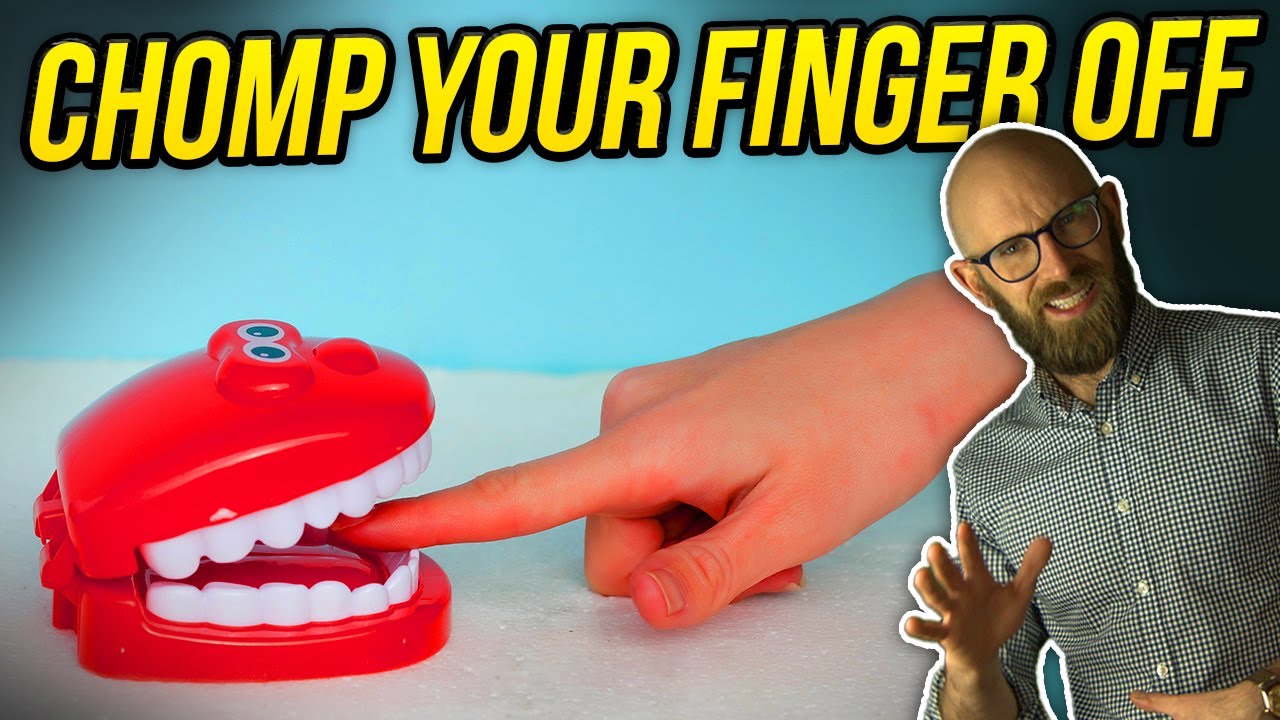 The human body is capable of surviving a frankly astonishing amount of trauma to the point that even the loss of entire limbs isn’t necessarily something that will inherently kill us so long as we keep a sufficient amount of blood circulating and avoid a deadly infection. Curiously, despite stories of people surviving things like falls from high in the sky without a parachute or being hit by cars, a persistent myth about the body is that our fingers are relatively easily bitten off, with some even putting forth this can be done with little more effort than it would take to bite through a good sized carrot. But can a human being actually bite off their own finger as depicted in such films as the 2012 Jack Reacher? Or is this simply not possible?
As for the whole carrot thing, the first and most obvious reason this idea is ridiculous is that human bones are stronger than even the most hardy of carrots by several orders of magnitude. Though admittedly exact figures for the force required to chomp a carrot in two are somewhat sparse, a commonly quoted figure for the amount of force required for the average full sized carrot is around 200 Newtons. In contrast, according to a 2012 study published in the Journal of Biomedical Engineering, it takes on average about 1485 Newtons or roughly 330 pounds of force to fracture a human finger bone, which keep that one in mind as it’s going to be important to our discussion later.
For anyone curious about how these results were obtained, researchers jammed the fingers of cadavers donated for medical research into an apparatus and tested the force required to go snap. Beyond the bodies, the researchers also used a handful of brave volunteers, with, again, both alive and dead individuals having their hands placed into a specially made contraption designed to bend them at awkward angles and subject them to various amounts of force. The purpose of the research was to test whether electric windows in motor vehicles are capable of shearing off a human finger, with the results finding that they are not, even in the most unlikely of “jamming scenarios”. Most pertinent to the topic at hand, according to this study, most still living test subjects reported nothing more than slight discomfort at forces well above what it would take to snap a carrot.
These results aren’t surprising given that bone is stronger by weight than steel and about four times more resistant to force than concrete. Carrots, on the other hand, can be snapped in half by a small child. There’s really no comparison to be made here between the two despite the fact that many do, and some even going so far as to put forth that it’s not just an analogy, but that the strength of the two is similar.
Okay, so we’ve established that fingers are stronger than carrots. Something that we’d have thought wouldn’t shock anyone with a functioning brain, but here we are. But what about the other half of this idea- that an average human could bite through a human finger?
The first aspect of this we need to cover is whether your tooth or your finger bone would break first? While nobody seems to be taking any cadavers and having them mash down on finger bones to see, it seems likely from the data we do have available that the tooth would win out here given tooth enamel, while very thin, is significantly stronger than bone, and what’s under it directly is similar to bone. On top of that, when talking compressive forces, studies do show that your mashers have what it takes here. Thus, at least with a healthy toothed individual, it’s generally thought the bone would fracture first in the majority of cases.
So, the hardware is capable in healthy toothed individuals. What about biting power? Well, mostly no, but also in extremely rare cases, borderline yes. But also no. Sorry, not even close.
Confused? Let’s dive in, shall we.
First, let’s discuss some studies on human biting power, and keeping in mind the aforementioned figure of an average of 1485 Newtons or roughly 330 pounds of force required to fracture a human finger bone.
Enter Dr. G. E. Black who tested the average biting force of numerous humans from near enough every walk of life imaginable. During his testing, Dr. Black found that the average amount of max force a human being is capable of delivering with a single bite is about 760 Newtons or roughly half what would be required to fracture a human finger bone.
Of note about Dr. Black’s research is that these figures were the highest amount of force subjects could provide when biting with their molars, AKA the teeth used to grind and crush food. Or to put it another way, teeth that are in no way optimally suited for cutting through bone. As for teeth that are suited for cutting, the incisors, Dr. Black found that the average maximum force men could exert when biting with these teeth was a lowly 370 Newtons while the average for women was 253 Newtons.
Other studies include the work of Patricia Takaki et al in their 2014 study Maximum Bite Force Analysis in Different Age Groups. In it, they found some rather interesting results, such as that the strongest biters of all were, surprisingly, prepubescent males with a maximum bite force of around 354 Newtons, with the only other close being young adult women at 345 Newtons. As for more seasoned adult men and women, they rang in around 284 and 304 Newtons respectively. As for the overall averages, males rang in at 285 Newtons and females at 253.
Yet another study, this one, Maximum Voluntary Molar Bite Force in Subjects with Normal Occlusion, published in the European Journal of Orthodontics in 2010 looking at individuals from 15-18 years old, they saw a maximum of 777 Newtons in male subjects and 481 Newtons in females, in this case about half to 1/3 what would be required to fracture a finger bone.
From these and many other studies you’ll find a somewhat large range of maximum bite force, but all of which is insufficient to fracture a human finger bone, in most cases substantially so. But there is an important caveat here and something that explains some of the wide variance- pain. In this case, not even factoring in the pain you’d feel when biting your own finger, but in the teeth. Going back to Dr. Black’s study, he noticed that people generally stopped biting when their teeth hurt. Takaki et al’s study also noted the same was happening, which was speculated to be how prepubescent boys in their study could show greater bite strength than adult males with much more powerful jaw muscles.
Thus, the limiting factor here, at least so far, is not potential biting power, but your pain tolerance. (We’ll get into theoretical mashing power shortly and whether this is sufficient to chomp through finger bones.) But before that, this pain factor is similar to an idea you may have heard that the brain usually actively limits the amount of force we exert with our muscles in order to prevent injury. Of course, there are exceptions to this and in life or death situations things like adrenaline and the like can help us ignore this pain and power through, or similarly in some cases being drugged up on certain substances can result in the same, which is why you occasionally hear stories of drugged up individuals going beast mode on a group of police officers trying to subdue them, tossing them around like rag dolls.
So what about the theoretical limit of human biting power if pain wasn’t a factor? Could a human bite off a finger then? Well, almost, at least according to a research done by one Dr. Stephen Wroe. Analyzing skulls, jaws, etc. of various animals, Wroe created a computer model to try to figure out an estimate of what we humans might be capable of in biting power if pain wasn’t a factor. And, at least according to his model, the max a human could probably do with their strongest positioned teeth for this is in the ballpark of 1100-1300 Newtons, which is only slightly less than the average of 1485 Newtons to fracture a human finger bone. Close enough that presumably there are some outlier individuals who could do it if pain wasn’t a factor.
Of course, this is only theory. Are there any real world examples of humans biting fingers off? It turns out, while insanely rare, yes. Although in the few cases we could find, other forces contributed outside of sheer biting power. Further, it should be noted that in these rare cases we could find it was not so much biting through bone, but severing and tearing around the joint tissues and structures which is still, to be fair, insanely difficult to do.
As for these specific examples, we have such a 1999 forensic case report published in the British Dental Journal, Biting Off More Than You Can Chew, which by the way, the researchers note in this “The case report represents a very unusual bite injury and is the most damaging bite injury, in terms of tissue loss, we have seen in more than 40 years of combined forensic experience.” So what was the damage? In a nutshell, during a bar fight, one man managed to bite off the tip of the finger of another man just past the base of the nail bed around the joint, with significant enough damage done in the process that it could not be reattached. Given how the tissues were severed and injured, it appears there was also significant pulling force involved to accentuate the biting force.
In another case, two women fighting over shoes saw the woman apparently unwilling to give the shoes back grab the other woman by the hair, then start by biting her forehead because, sure, why not? When the other woman tried to push the gnashing teethed woman away, said biter bit one of the other woman’s fingers, with the combination of bite force and, similar to the aforementioned bar fight, the pulling away force, see the tip of the woman’s finger become detached.
Thus, in the end, when talking bite force alone, while it does appear that at least our best mashing teeth and jaws and muscles of an adult are in theory close to capable of fracturing a human finger bone, and given some people are outliers, presumably there are people out there who can theoretically do this, most people cannot, especially in real world scenarios. This is not just from the pain if biting your own finger, but also because of the pain in your teeth and jaw muscles as well causing your brain to nope out of such mashing in most cases. That said, perhaps in a drunken bar fight, where other forces like yanking your arm back and tearing and the like are involved, and particularly all centered around a joint, rather than actually needing to bite through the bone itself, it does appear possible to bite off a finger in this way. But even then, real world examples are almost non-existent, pointing to the difficulty of accomplishing even this, and also that most bar fights don’t involve the Wachootoo or Mike Tyson…
But, in the end, it would seem if you ever find yourself in a Jack Reacher-esk situation where someone is going to put a bullet through your brain if you don’t chomp your thumb off, about the only workable strategy here, beyond trying to incapacitate the person with the gun first, would be to first break your thumb somehow, perhaps via curb-stomping it at an odd angle, and then attempting to gnash your way through the skin and supportive tissues at the break point… This would dually be beneficial because if you did it swift enough, the breaking force could be applied before your brain could make you stop. And, once the extreme pain from said breaking is already present, you may not be as consciously aware of the pain from gnashing through the connective tissues…
On that note, in a similar vein, British explorer Ranulph Fiennes once cut half of the fingers on his left hand off after sustaining severe frostbite while trying to walk to the North Pole on his own. Rather than waiting for the necrotic flesh to perhaps heal as doctors advised to save as much of his hand as possible, Fiennes cut the most damaged parts of his fingers off with a saw in his garden shed…
Moving on from there to other British badassery, British military legend, the so-called “Unkillable Soldier”, Sir Adrian Carton de Wiart tore off his own fingers during WW1 when a doctor refused to amputate them after he was wounded in his left hand. During the war Adrian was also shot 7 times, including twice in the head, survived a couple plane crashes, and eventually also lost an eye and his whole hand. When later asked about all this, Adrian was quoted as quipping “Frankly, I enjoyed the war.” … So much so that he once again signed up for the second world war as well. Of all of this, he stated, “Governments may think and say as they like, but force cannot be eliminated, and it is the only real and unanswerable power. We are told that the pen is mightier than the sword, but I know which of these weapons I would choose.”
Expand for References
Could you bite your finger in half like a carrot?
Brute Force: Humans Can Sure Take a Punch
Just how much punishment can your body take?
How It’s Possible for a Normal Person to Lift Car
https://www.nationalgeographic.com/science/article/who-are-you-calling-weak-human-jaws-are-surprisingly-strong-and-efficient
https://www.nature.com/articles/4800307
https://www.ncbi.nlm.nih.gov/pmc/articles/PMC4297017/
https://academic.oup.com/ejo/article/33/4/427/397357
https://www.sciencedirect.com/science/article/abs/pii/0022391386904804
https://www.rosecitydentalcare.com/post/who-has-the-strongest-jaws-in-the-animal-kingdom-with-your-portland-or-family-general-dentist
https://www.mdpi.com/2076-3417/12/3/1544/htm
https://www.auroradentist.com/how-strong-are-your-teeth/
https://www.corbetlockedds.com/waco-dentist-enamel-bone/
https://bondmeout.com/womans-fingertip-bitten-off-fight-shoes/



| Share the Knowledge! |
          |
 |